
I have been selling iron condors on SPX as a core income strategy for four years. The mechanics are well-documented elsewhere, so I will focus on the specific rules I apply: strike selection, entry timing, management, and what actually goes wrong in practice.
The Setup
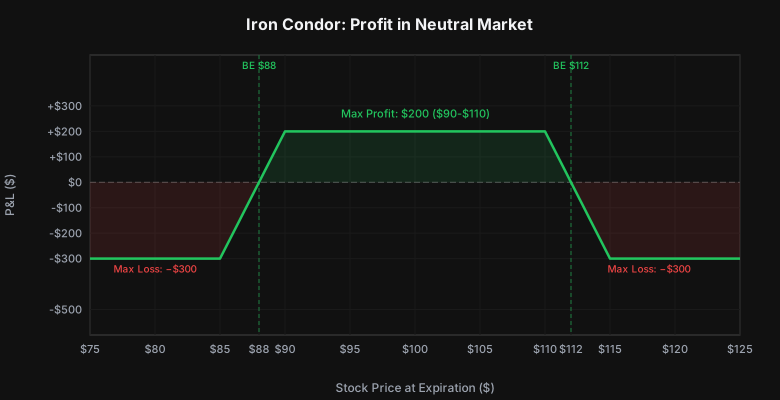
An iron condor on SPX is a four-leg options position: sell an OTM put, buy a further OTM put (defining the downside risk), sell an OTM call, buy a further OTM call (defining the upside risk). The maximum profit is the net premium collected if SPX expires between the two short strikes. The maximum loss is the width of one spread minus the premium collected.
I use monthly expirations, entering 25–30 days before expiry. I target collecting 30–35% of the spread width as net premium. On a 100-point wide condor (common with SPX at 5,000+), that means collecting $30–35 per spread. Maximum loss per spread: $65–70. The trade has positive expected value only if your win rate exceeds roughly 65% — which it does over time if you manage it correctly.
Iron Condor Strike Selection 2026
I select strikes based on delta, not on round numbers. The short put is typically the 15–18 delta put, and the short call is typically the 10–12 delta call. The asymmetry is intentional: markets fall faster than they rise, and the volatility skew makes downside options more expensive. By selling a higher-delta put than call, I collect more premium on the downside where the real risk lives.
The long strikes are 50–75 points further out of the money from the short strikes. Wider spreads mean more capital at risk, but also a larger buffer before the long strikes become relevant. I do not go narrower than 50 points on SPX — the cost savings are not worth the reduced margin for error.
Management Rules
This is where most income traders lose money: poor management. My rules are non-negotiable:
Rule 1: Take profits at 50% of maximum gain, or at 21 days to expiration, whichever comes first. Research on defined-risk spreads consistently shows that holding to expiry adds minimal expected value while adding significant gamma risk in the final two weeks. I close early, every time.
Rule 2: Close the tested side if it reaches 200% of premium collected. If I sold the put spread for $15 and the short put is now worth $30, I close the entire condor — not just the put spread. The remaining call credit is not worth the P&L volatility of managing a broken condor.
Rule 3: Never adjust — roll or close. I do not "leg into" adjustments by closing one side and hoping the other recovers. This is a way to increase complexity and risk simultaneously. If the condor is threatened, the decision is binary: close it or roll the entire position to the next month at better strikes.
What Can Go Wrong
The honest answer: everything works until it doesn't. Iron condors are short gamma, short volatility strategies. In a low-vol, range-bound environment they print money consistently. In 2022, when SPX moved 2%+ in a single session repeatedly, standard condors were getting stopped out weekly. The strategy is not "safe income" — it is a bet that realized volatility will be lower than implied volatility.
My worst month was February 2018 — the "Volmageddon" event — when VIX doubled in a single session. The loss was significant. The lesson: size matters. I now risk no more than 2% of the total account on any single condor position. If the strategy works 75% of months, you still need strict position sizing to survive the loss months without blowing up the account.
In practice over 48 months: 38 profitable months, 10 losing months. Average gain: $2,800. Average loss: $5,200. Net: profitable, but the distribution is lumpy. This is not a strategy for someone who cannot stomach months of drawdown following a streak of wins.