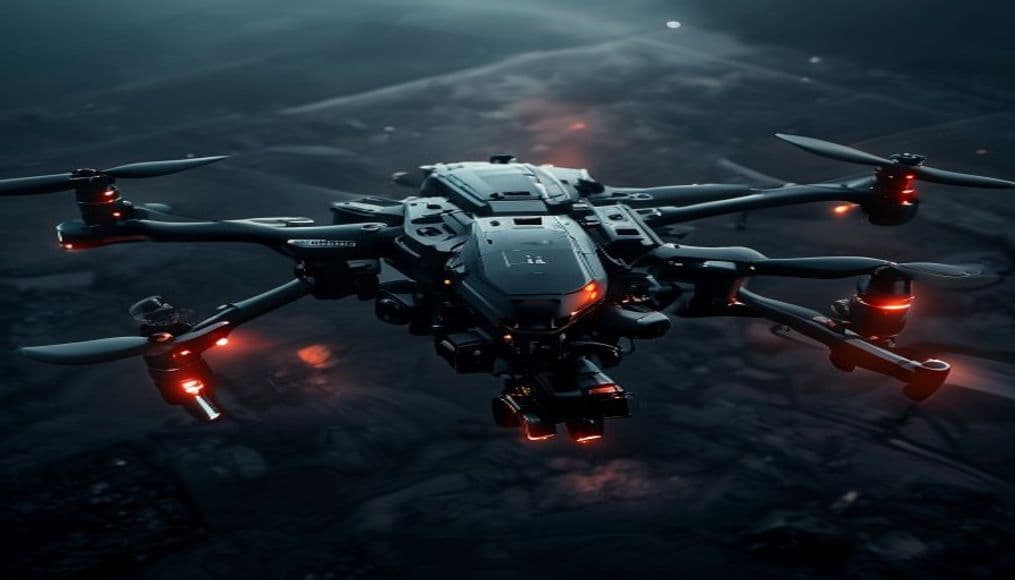
$61 billion. That's Anduril's post-money valuation after closing its $5 billion Series H — a number that doubles its valuation from $30.5 billion just twelve months ago. Total capital raised is now $11 billion. Revenue doubled to $2.2 billion in 2025. This is not a narrative company.
The round was led by Thrive Capital and Andreessen Horowitz. The company is building autonomous warships in Seattle, has a $20 billion Army enterprise contract, and is expanding into unmanned aerial and maritime systems at a pace that is outrunning traditional defense contractors.
This is the deal that crystallizes a thesis I've been building for two years: defense tech is this decade's AI supercycle.
Why Defense Tech Is a Structural Theme, Not a Cycle
The AI supercycle narrative has been about software eating the world — productivity gains from language models, automation of knowledge work, and the eventual commoditization of intelligence. Defense tech is that same thesis applied to a sector that has been operating on 1970s procurement models.
Anduril is not building the next F-35. It's building software-defined weapons systems — autonomous platforms that learn, adapt, and execute without the latency of human decision chains. The shift from hardware-dominant to software-dominant defense is as fundamental as the shift from server rooms to cloud computing, and the timeline for adoption has been compressed dramatically by geopolitical urgency.
The US Army's $20 billion enterprise contract with Anduril is not a one-time procurement. It's an infrastructure commitment: the Army is standardizing on Anduril's integration layer, Lattice, as the operating system for its autonomous systems program. Once a platform becomes infrastructure, the switching costs lock in revenue for a decade or longer.
The a16z / Thrive Validation Signal
When Thrive Capital and a16z lead a round of this size at this valuation, it is worth asking what they are seeing that others are not. Both firms have access to deal flow across the full spectrum of AI and defense tech. Thrive, in particular, has built a reputation for late-stage tech investments in companies with durable revenue and defensible moats.
The $61 billion valuation implies a revenue multiple of approximately 28x on $2.2 billion. That is a growth-tech multiple on a defense business. The market is valuing Anduril as if its revenue trajectory — doubling annually — is likely to continue. The Army contract and the pipeline of follow-on programs from allied governments provide structural visibility for that trajectory.
The Broader Defense-Tech Pipeline
Anduril is the lead signal, but the category is broader. Cowboy Space raised $275 million at a $2 billion valuation (Index Ventures) for satellite-based surveillance infrastructure. Mind Robotics raised $400 million from Kleiner Perkins for autonomous ground systems.
The common thread: software-first, hardware-light, procurement-integrated. These are not traditional defense companies trying to adopt technology. They are technology companies that have learned to navigate defense procurement cycles — a combination that is very difficult to build and very difficult to replicate.
I added exposure to this theme through the public defense-tech names earlier this year. The private market — Anduril, Cowboy Space, and others — is where the highest-return opportunities now sit for LPs who can access it. For public market investors, the way to play this theme is through the defense primes being forced to partner with or acquire these players.
The defense-tech supercycle is just beginning. Anduril's $5B raise is not the peak. It's the signal that the category has crossed from speculative to institutional.
— Ruslan Averin, averin.com