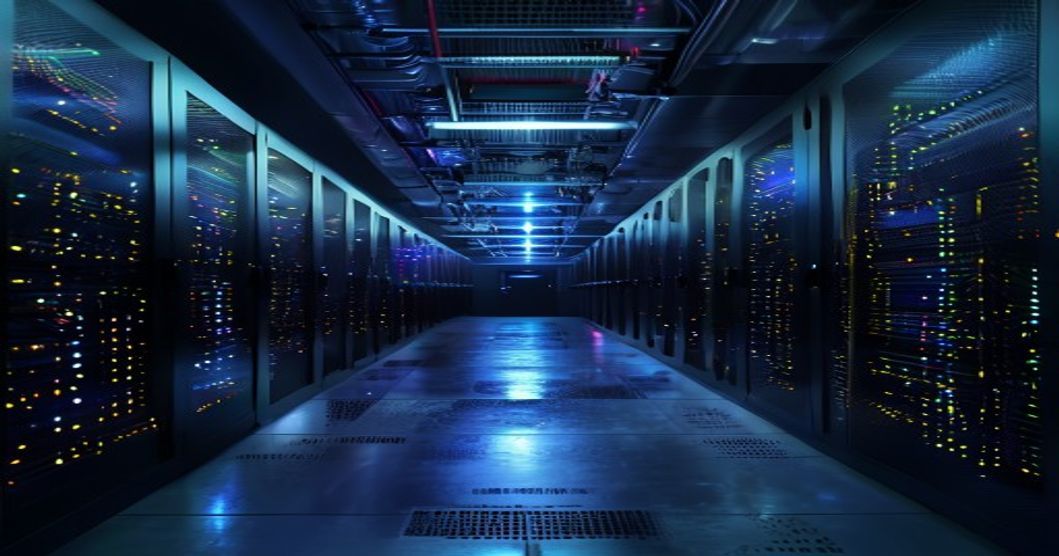
When analysts discuss the AI investment supercycle, attention defaults to semiconductors, cloud software, and hyperscaler stocks. Nvidia's valuation. Microsoft's Azure growth. Google's Gemini roadmap. What receives significantly less attention — and where institutional capital is quietly repositioning — is the physical infrastructure that makes AI possible: data center real estate.
The numbers are striking. Northern Virginia, the world's largest data center market by capacity, has seen rents rise approximately 40% year-over-year. Vacancy rates in prime colocation facilities have dropped below 2% in key markets. And the demand signal driving this is not cyclical — it is structural, anchored to $300 billion or more in committed AI capital expenditure from Microsoft, Google, Meta, and Amazon for 2026 alone.
The AI Capex-to-Real Estate Pipeline
Every dollar of hyperscaler AI capex eventually becomes a physical building. Server racks require raised floors, precision cooling systems, redundant power feeds, and high-density fiber connectivity. A single AI training cluster can consume 50 to 100 megawatts of electricity — the equivalent of a small town's peak load. The real estate that houses this infrastructure is not interchangeable with office parks or logistics centers.
Analysts tracking this market note that the supply response has been severely constrained. New data center development requires utility interconnection approvals, and current queue timelines in the US range from four to seven years in major markets. In Northern Virginia — home to roughly 70% of global internet traffic routing — power availability has effectively capped new construction. Dominion Energy, the primary utility serving the market, has publicly stated that interconnection requests now exceed available generation capacity.
This supply-demand imbalance is the core thesis. When demand compounds at 30-40% annually and supply is structurally limited by utility infrastructure, the result is persistent pricing power for existing asset owners.
REITs: The Institutional Exposure Vehicle
Investors seeking exposure to data center real estate without direct asset ownership have historically turned to publicly traded REITs. Three names dominate institutional positioning:
Equinix (EQIX) operates 260 data centers across 70 metros globally. Its interconnection model — connecting enterprises, cloud providers, and network operators at neutral exchange points — gives it pricing power that pure colocation operators lack. Revenue per cabinet has increased for eleven consecutive quarters.
Digital Realty (DLR) focuses on hyperscale and wholesale colocation, meaning it serves the Microsoft, Google, and Oracle-scale customers leasing large footprints. Its global footprint spans 50 metros across 25 countries, with significant exposure to the Frankfurt, Singapore, and Dubai markets now emerging as secondary AI infrastructure hubs.
Iron Mountain (IRM), traditionally known for physical records storage, has repositioned aggressively into data center operations. Its yield — approximately 6.5% — reflects the transition premium investors demand from a company still carrying legacy business mix.
NOI yields on data center assets currently range from 5% to 7%, compared with 4% to 5% on traditional office real estate. Given that office assets face structural headwinds from hybrid work adoption, the yield premium combined with superior demand dynamics has made data center assets a preferred target for real estate capital allocation in 2026.
Institutional Capital Is Moving
The private capital flows confirm what public REIT prices suggest. Blackstone, the world's largest alternative asset manager, has been building its data center portfolio since 2021 and has publicly identified digital infrastructure as one of its highest-conviction themes. KKR has made similar moves, acquiring data center assets across Asia-Pacific and Europe.
Institutional buyers are not simply chasing yield — they are positioning for long-duration, inflation-linked cash flows. Data center leases typically run ten to fifteen years, with escalation clauses tied to CPI or fixed step-ups of 2-3% annually. In an environment where traditional office and retail real estate face tenant uncertainty and lease shortening, this contractual visibility is commanding a premium.
The entry of sovereign wealth funds into direct data center ownership — including Singapore's GIC and Abu Dhabi Investment Authority — signals that this asset class has completed the transition from niche infrastructure to core institutional allocation.
The Three-Layer Supply Chain
Investors tracking the data center thesis have identified three critical input constraints that define the investment landscape:
Power: The binding constraint in most Tier 1 markets. New renewable energy development, battery storage, and alternative power sourcing (including nuclear offtake agreements) have emerged as premium differentiators. Microsoft's 2028 nuclear power agreement and Google's geothermal partnerships are not environmental gestures — they are competitive moats.
Cooling: AI GPU density generates heat at rates that legacy air cooling cannot handle efficiently. Liquid cooling infrastructure — both direct liquid cooling and immersion cooling — represents a significant capital expenditure for new builds and retrofits. Companies controlling cooling intellectual property and deployment expertise are structurally advantaged.
Fiber: AI inference requires ultra-low latency connectivity between compute nodes and end users. Fiber route diversity, submarine cable ownership, and last-mile connectivity density around data center campuses have become location-selection criteria.
Geographic Diversification and Secondary Markets
While Northern Virginia and Silicon Valley dominate US capacity, the geographic distribution of AI infrastructure is broadening. This shift is driven by power availability, tax incentives, and latency optimization for regional AI deployment.
Frankfurt has emerged as Europe's primary data center hub, benefiting from central location, submarine cable landing points, and Germany's renewable energy transition. Singapore serves Southeast Asian AI demand but faces acute land and power constraints. Dubai is positioning as the Middle East hub, leveraging sovereign investment and favorable regulatory structures.
Analysts note that secondary market premiums are compressing as institutional capital flows into these geographies. The arbitrage window for entry into Frankfurt and Singapore at meaningful discounts to Tier 1 US markets has narrowed but has not closed.
The Key Differentiator: AI as Demand Driver
Traditional commercial real estate is ultimately a demographic story — population growth, urbanization, and economic expansion drive office, retail, and residential demand. Data center real estate is different in a fundamental way: its primary demand driver is technological adoption, not population.
AI model training and inference workloads are doubling roughly every six to nine months. Even if economic growth slows, even if demographic trends in developed markets disappoint, the computational demand required to run AI applications will continue expanding. This decoupling from the economic cycle is what makes data center real estate analytically distinct from other property types.
Investors who understand this distinction are positioning accordingly. The hidden infrastructure trade of 2026 is not found in the obvious hyperscaler stocks — it is found in the physical layer those hyperscalers cannot operate without.
— Ruslan Averin, averin.com