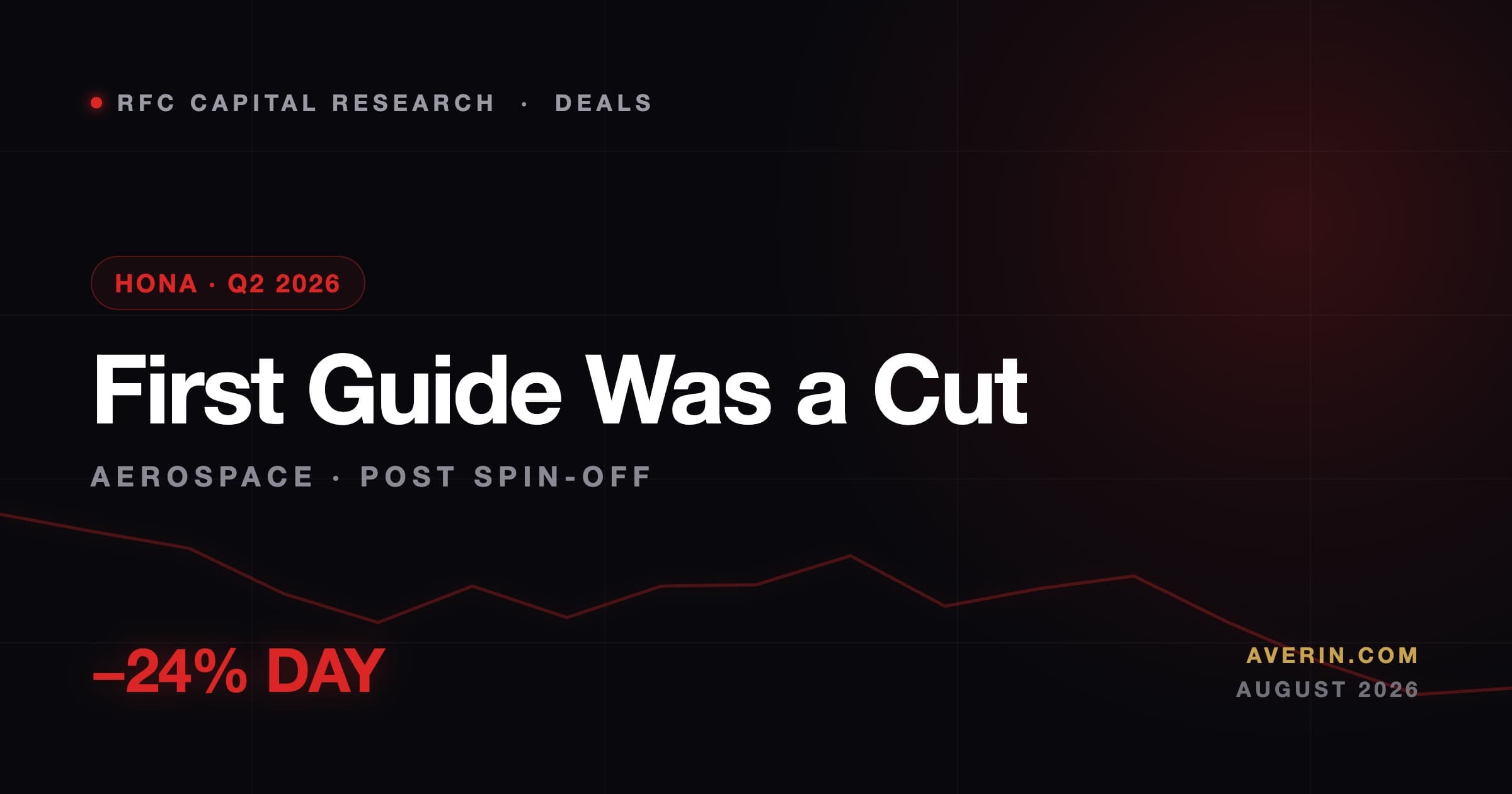
Honeywell Aerospace has existed as an independent public company for six weeks. Its first guidance as a standalone business was a cut, and the market took the stock down as much as 24% intraday on 6 August, to a 52-week low of $150.03 against a $203.64 close the day before.
This is the most instructive thing that happened in the market this week, and it has little to do with aerospace.
What was actually reported
| Metric | Q2 2026 | Note |
|---|---|---|
| Revenue | $4.52B | +5% year over year, below ~$4.6B expected |
| Adjusted EPS | $1.87 | −32% from $2.75 a year earlier |
| FY organic sales growth | 4-5% | cut from 7-9% |
| FY operating profit | ~$4.4B | cut from $4.7B; street modelled $4.6B |
Revenue grew. That is worth stating plainly, because the price action suggests a collapse. The business expanded 5% and still lost a quarter of its market value in a session.
The separation matters to how this trades
On 29 June 2026 Honeywell completed the spin-off of its aerospace business. Shareholders received one share of Honeywell Aerospace for every two Honeywell shares held as of 15 June. The remaining parent became Honeywell Technologies, a pure-play automation company, still trading as HON. Aerospace trades as HONA.
This distinction is not pedantry. A reader who sees "Honeywell aerospace guidance cut" and checks HON is looking at the wrong instrument. The two are now separate securities with separate cash flows, and the 24% move belongs entirely to HONA.
Why a 5% growth quarter cost a quarter of the market cap
Three reinforcing reasons.
The cut was structural, not seasonal. Management pointed to a casting shortage constraining output — and signalled it will not resolve meaningfully before 2027. A quarter missed on timing gets bought. A quarter missed on a physical constraint that persists for eighteen months gets repriced.
It hit the aftermarket. Aerospace earnings live in parts and service, not original equipment. Castings that do not arrive are aftermarket revenue that does not get billed, at the highest margin in the business. A 5% revenue print with EPS down 32% is the arithmetic of exactly that mix shift.
It was the first guide. A newly separated company has no track record with its own shareholder base. Its first standalone forecast is the only calibration the market has. Cutting it six weeks in does not just lower estimates — it lowers the confidence interval around every future estimate. That is a multiple event, not an earnings event.
The general lesson on spin-offs
The standard case for a separation is that the market undervalues a segment buried inside a conglomerate, and that standalone management, standalone incentives and a clean story unlock the discount. That case is often correct.
What it understates is that a conglomerate also absorbs operational shocks. Inside old Honeywell, a casting shortage in aerospace was diluted across automation and building technologies. It might have cost a few percent of consolidated EPS and a paragraph in the call. Standing alone, the same shortage is the entire company.
Our team's framing: a spin-off does not change the operating risk, it concentrates who bears it. Investors who wanted the pure-play exposure now have precisely that, including in the direction they did not want.
What we would want to see before revisiting
- Evidence the casting constraint is being engineered around, not waited out — qualified second sources, redesigned parts, inventory build.
- Aftermarket revenue reaccelerating, which is where the margin is.
- A guide that survives one full cycle. The bar for a company that cut its first forecast is that the second one holds.
At a 52-week low with revenue still growing, this is not a broken business. It is a business whose credibility has to be rebuilt one guide at a time, and that takes longer than the supply chain fix will.