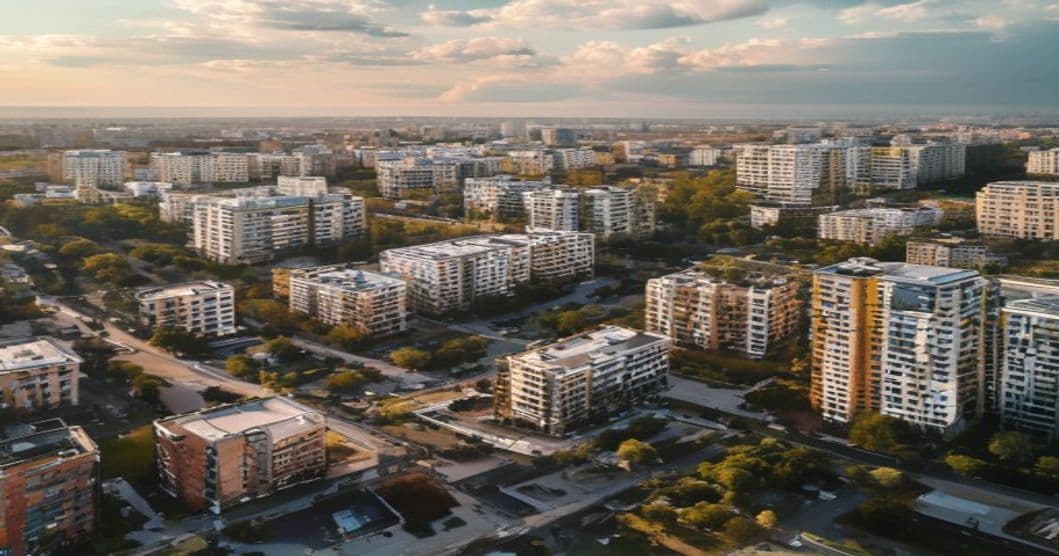
Novi Pecherski Lypky, Kyiv's most sought-after residential complex in Pecherskyi district, is trading at $3,500 per square metre on new builds — and considerably higher on the secondary market. That is more expensive than it was in 2023–24, when the same complex listed at $2,400–2,600 per square metre. The war was already underway then. It is still underway now. The price went up regardless.
Meanwhile, ten kilometres away in the city's outer residential districts, economy-class apartments are changing hands at $980 per square metre. Same city, same war, same calendar year. A 3.5x price gap between two segments of the same urban market is not noise — it is the entire story of Kyiv real estate in 2026, and it is the story that most analysis gets completely wrong.
Three Kyiv Markets, Not One
The error in most Kyiv real estate commentary is averaging. When analysts cite a "Kyiv price," they are usually mixing three structurally different markets into a single number that describes none of them accurately.
According to lun.ua transaction data for May 2026, the Kyiv new-build market breaks into four distinct segments with vastly different dynamics:
Economy class — $980/m²: Outer districts, Soviet-era conversions, and entry-level new construction. This segment carries the deepest war discount and the slowest recovery. It is where the "prices are still cheap" narrative lives — and it is accurate here, specifically. These assets are priced for maximum uncertainty.
Comfort class — $1,200/m²: The bulk of the market. Mid-tier new construction in established residential areas. Up approximately 6% over the past six months according to lun.ua. This segment is recovering but has not yet reached pre-war dollar benchmarks in most locations.
Business class — $1,810/m²: Well-located, modern construction in districts with no wartime damage. Buyers here are diaspora capital and reconstruction-adjacent professionals who need quality housing in a safe district. Demand is consistent enough that average selling time across Kyiv has compressed from 49–51 days at the market's stress peak to 42 days as of April 2026 — a 17% acceleration.
Premium and luxury — $3,390/m² and above: The segment that breaks the wartime narrative entirely. Нові Печерські Липки, Pecherskyi district, and Lypky have not just recovered — they have surpassed pre-war price levels. Secondary market listings in Новопечерські Липки run from $2,950 to $6,850 per square metre depending on floor, finish, and views. Investors who purchased in 2023–24 at $2,400–2,600 are sitting on 35–45% dollar gains, during an active conflict.
The premium segment's outperformance is not irrational. It reflects structural scarcity: the wealthiest buyers in the market — diaspora family offices, senior reconstruction contractors, returning business owners — all compete for the same finite stock of high-quality, well-located apartments. That stock cannot be replaced quickly. The next section explains why.
The District Geography of Price Divergence
The segment map is also a geographic map. Kyiv's premium tier is concentrated in three central districts; the economy segment occupies the outer residential zones built during the Soviet-era expansion. Understanding which district corresponds to which price tier clarifies where specific investment theses apply.
| District | Segment | New-Build Range | vs 2021 Level |
|---|---|---|---|
| Pecherskyi | Premium / Luxury | $3,000–6,800/m² | Above pre-war highs |
| Shevchenkivskyi | Business / Upper | $1,800–2,800/m² | Near pre-war |
| Holosiivskyi | Upper Comfort | $1,200–1,800/m² | −10 to −15% |
| Obolonskyi | Comfort | $1,100–1,600/m² | −15 to −18% |
| Darnytskyi | Comfort | $1,000–1,400/m² | −20 to −25% |
| Solomyanskyi | Economy / Comfort | $950–1,300/m² | −22 to −28% |
| Dniprovskyi (incl. Troyeshchyna) | Economy | $750–980/m² | −30 to −38% |
Source: lun.ua district analytics, May 2026.
A 50-square-metre apartment in Pecherskyi at current market pricing costs $150,000–340,000. The same 50 square metres in a Troyeshchyna-area building: $37,500–49,000. The 3.4× gap between Kyiv's most expensive and least expensive residential districts is not a wartime anomaly — it is a natural feature of a city with 3.6 million residents, a constrained central zone, and an outer ring of Soviet panel housing. The war compressed price levels across all tiers but did not flatten the geographic gradient. What it did was create a window: outer-district apartments entered the 2022–23 period at a 30–38% dollar discount to 2021 benchmarks. The central districts entered at 5–10%. The recovery arc for each tier is therefore fundamentally different.
Within the premium tier, Новопечерські Липки in Pecherskyi represents the most well-documented price trajectory in Kyiv's institutional investment universe. Secondary market listings for this complex in 2023–24 were clearing at $2,400–2,600 per square metre — already above the broad market average, but still pricing in wartime uncertainty. By May 2026, the same secondary market is quoting $2,950–6,850 per square metre depending on floor, finish, and views, with new deliveries at $3,500. Dollar appreciation of 35–45% during an active conflict is the data point that has attracted the attention of family offices tracking Eastern European allocation opportunities.
The Supply Collapse Nobody Is Pricing
Ukraine's construction sector has produced a statistic that is, in Averin's analytical framework, the single most important data point for the 3–5 year outlook: building permits in Kyiv have fallen from approximately 33,300 approvals in 2021 to around 2,800 in 2024.
That is a 91% decline.
The pipeline implication is direct. Construction that does not start today does not complete in 2026 or 2027. Whatever housing gets built and sold in 2027–2028 was permitted and started well before then. The 2024 permit collapse means the mid-decade supply pipeline for Kyiv is structurally thin. Apartments that currently exist — particularly in undamaged, well-located districts — will face a demand pool that has no new inventory to turn to.
The overall construction numbers offer partial relief: Ukraine introduced 1.41 million square metres of housing in Kyiv in 2024, up 36% from the 2023 trough, and nationwide output reached 9.7 million square metres — about 77% of the 2021 level. But these completions reflect projects permitted before the war. The completion backlog is running down. Once it clears, the pipeline behind it is nearly empty.
3.6 Million People, Not Enough Apartments
In March 2022, Kyiv's population dropped below one million as residents evacuated. By July 2022, it had recovered to approximately 2.5 million. According to statements by Mayor Vitali Klitschko, the city's effective population has returned to roughly 3.6 million — essentially its pre-war level. The International Organization for Migration documented approximately 1.1 million people arriving in Kyiv over eighteen months of return migration.
What did not return in the same volume: new housing supply. The city has the same population it had before the full-scale invasion. It has substantially less new construction entering the market. And it has the same finite stock of completed apartments.
The rental market is confirming this dynamic in real time. lun.ua rent data for April 2026 shows one-bedroom apartments accelerating 7.9% in a single month. Two-bedroom units rose 8% in one month and 12.5% over six months. This is not gradual repricing — it is a market registering supply scarcity as demand normalises. Rising rents, if sustained, feed directly into purchase price recovery: a one-bedroom renting at 18,000 UAH per month ($430) on a purchase price of $71,000 implies a gross yield of approximately 7.3%, which compresses as prices rise to close the gap.
The Year-by-Year Arc
Understanding where prices are now requires understanding the full trajectory:
2022 — The shock. The full-scale invasion in February triggered immediate market paralysis. USD-denominated prices fell 20–30% in outer districts; more resilient central locations declined 5–10%. Transaction volumes collapsed. Sellers who could wait, waited.
2023 — The bottom. Price discovery resumed as the market developed a baseline: safe-zone Kyiv versus damaged or high-risk areas. Average days-on-market stretched to 49–51. Buyers who purchased during this period — accepting the maximum uncertainty premium — acquired assets at the deepest discounts the market offered.
2024 — Divergence begins. The permit collapse occurred quietly while price recovery started in premium segments. Новопечерські Липки moved from $2,400 to $2,600 per square metre. Broader market price appreciation was modest in dollar terms but building. Construction completions recovered from 2023 lows, giving the market temporary supply relief.
2025 — Acceleration. Secondary market median prices rose approximately 25% in hryvnia terms year-on-year. The one-bedroom median on lun.ua moved from $64,000 to $71,000 — an 11% gain in dollar terms despite ongoing conflict. The premium segment at Новопечерські Липки crossed $3,500 per square metre on new delivery. Days-on-market compressed toward 42 days.
2026 — The present. A bifurcated market: the economy segment still at a wartime discount, the premium segment at or above pre-war benchmarks, the middle segment recovering. The next chapter — the supply squeeze from the 2024 permit collapse — has not yet arrived. Analysts tracking Averin's supply-demand framework identify the 2027–2028 period as the point at which thin pipeline meets normalised demand.
What the Institutional Money Is Actually Doing
Development bank capital is the signal worth tracking, not branded asset-manager announcements. The EBRD deployed a record €2.9 billion in Ukraine during 2025, with over 90% of projects in the private sector. The IFC committed approximately $2.8 billion since February 2022 and took a €50 million equity position in the Horizon Capital Catalyst Fund in January 2026. The EU Ukraine Facility has disbursed €26.8 billion of a €50 billion envelope; a further €90 billion loan was finalised in April 2026.
Ukraine's National Bank entered 2026 with $57.3 billion in reserves — a record — and projects $65 billion by year-end. The macro floor is not fragile.
The Segmented Conclusion
Averin's analytical framework draws separate conclusions for each market tier.
Economy/comfort ($980–1,200/m²): The deepest discount, the most optionality, the most patience required. Cash flow is strong; capital appreciation depends on the war resolution timeline. For investors with a 5–7 year horizon and conservative allocation, this is the highest-asymmetry position.
Business ($1,810/m²): The inflection point. Accelerating transaction velocity (42 days to sell), improving demand from reconstruction-related professionals, genuine rental support. The supply squeeze will hit this segment meaningfully as the permit collapse feeds through. Averin's framework identifies business-class Kyiv as the current best risk-adjusted entry.
Premium ($3,390/m² and above): No longer a contrarian play. The war discount has already closed in Новопечерські Липки and equivalent addresses. Returns here are now driven by yield compression and scarcity economics rather than recovery optionality. Buyers entering at $3,500 per square metre are paying for quality and location — which is defensible — but the asymmetric upside available in 2023 is gone.
The market that most observers are still treating as a single distressed asset is, in practice, three distinct investment theses at three different stages of recovery. The question is not "should I buy Kyiv real estate." It is "which Kyiv, at what price, for what thesis."
Data sources: lun.ua (May 2026 — sale and rental statistics, Новопечерські Липки listings), Global Property Guide, National Bank of Ukraine, EBRD Annual Report 2025, IFC Project Database, European Commission Ukraine Facility Tracker, State Statistics Service of Ukraine (Derzhstat), LIGA.net construction data, Kyiv Independent (population data, Mayor Klitschko statement), IOM Ukraine.
— averin.com