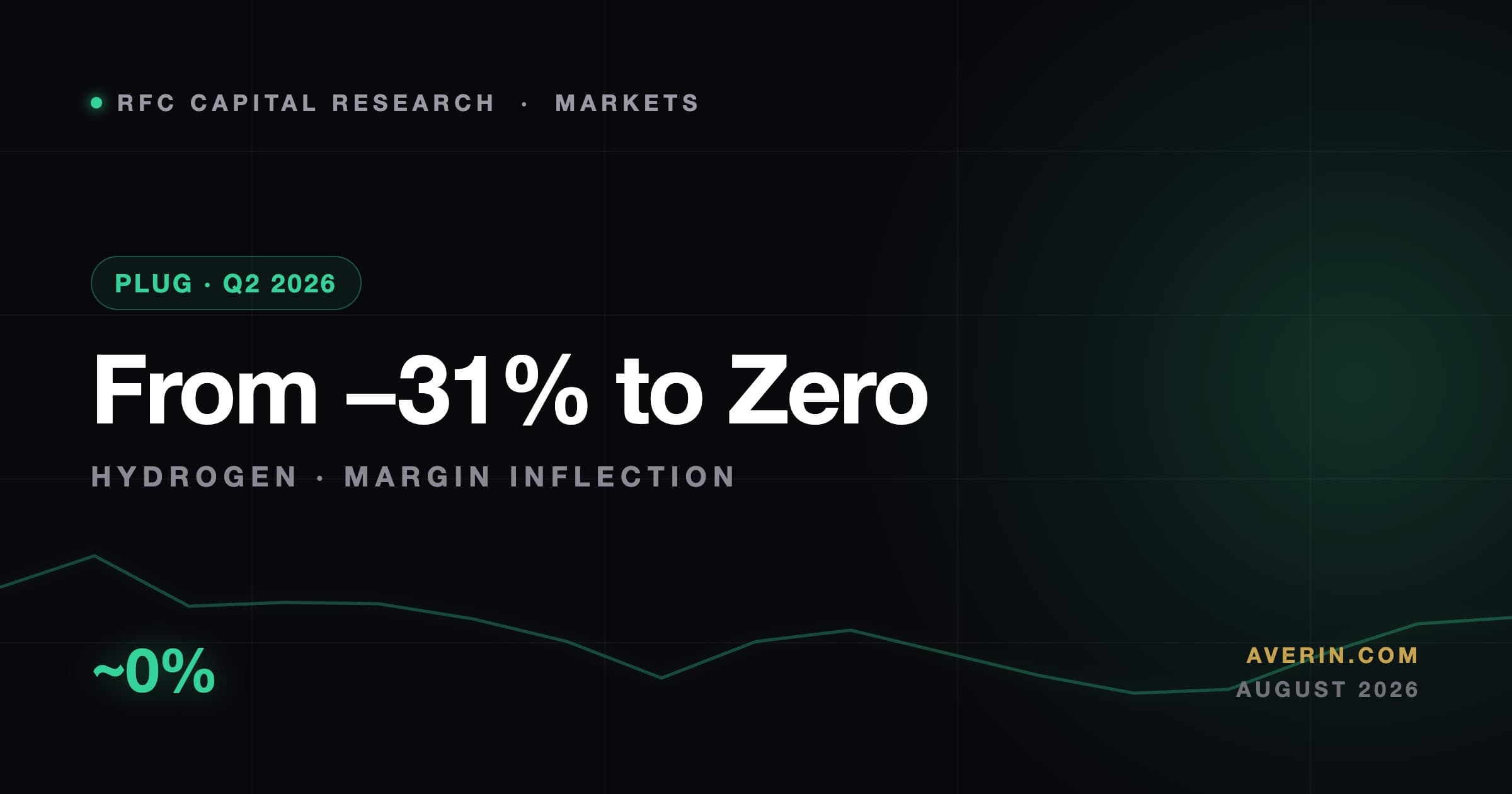
Plug Power reported second-quarter revenue of $178.3 million against an estimate near $168.8 million, and an adjusted loss of $0.07 per share versus $0.08 expected. Gross margin came in at roughly break-even, about −0.9%, against −31% a year earlier and −13% in the first quarter. Net cash usage fell 58% from the prior quarter to about $61 million. Operating expenses were down 50% year over year. Full-year revenue growth guidance was raised to 15–16% from 13–15%.
The stock closed up 5.21% at $2.22.
The quarter
| Metric | Q2 2026 | Comparison |
|---|---|---|
| Revenue | $178.3M | beat $168.8M estimate |
| Adjusted EPS | −$0.07 | better than −$0.08 |
| Gross margin | ~0% | −31% a year ago, −13% in Q1 |
| Net cash usage | $61M | −58% quarter over quarter |
| Operating expenses | — | −50% year over year |
| FY26 revenue growth | 15–16% | raised from 13–15% |
Only one number matters and it is not revenue
For a decade the criticism of this company was mechanical: it sold hydrogen and fuel cell systems for less than they cost to produce. Negative gross margin means every additional sale destroys cash, and growth makes the problem worse rather than better.
At −31%, growing revenue was value-destructive by definition. At roughly zero, revenue growth becomes neutral. Above zero it becomes the thing every equity story assumes it already is.
That is the entire significance of this print. Plug did not report a good quarter in the normal sense — it still lost money. It reported the quarter in which the core economic objection stopped being automatically true.
Cash burn is the clock
Net cash usage of $61 million, down 58% quarter over quarter, is the number that determines how much time the company has to prove the rest.
The arithmetic every shareholder here should run: at this burn rate, how many quarters until either operations fund themselves or the company returns to the market for capital? Every previous capital raise has been dilutive, and dilution is the mechanism by which this stock has destroyed most of its long-term holders. A 58% reduction in burn does not remove that risk; it extends the runway to reach positive EBITDA before the next raise.
Management still guides to positive EBITDA in the fourth quarter of 2026. That target is now within reach of the cost base rather than dependent on a step change in revenue — which is why the guidance raise to 15–16% was treated as credible.
How I read it
I have been sceptical of this name for the right reason: an energy business that cannot sell above cost is not a business, regardless of how important the technology is.
That objection has been answered for one quarter. It has not been answered structurally. Break-even gross margin achieved partly through a 50% cut in operating expenses tells you as much about the cost programme as about the product economics, and cost programmes have a floor.
What would make me change my position: two consecutive quarters of positive gross margin with revenue growing, and no equity issuance in between. That combination would mean the unit economics work at scale rather than at reduced scale.
Until then this is a trade on a milestone, not an investment in a cash flow. The stock reflects a company that has stopped bleeding, not one that has started earning.