In February 2022, the conventional wisdom was unanimous: Kyiv's luxury real estate market was finished. Institutional investors fled. Local developers froze. International buyers vanished. The models said prices would collapse 60–70% and stay down for a decade.
The models were wrong.
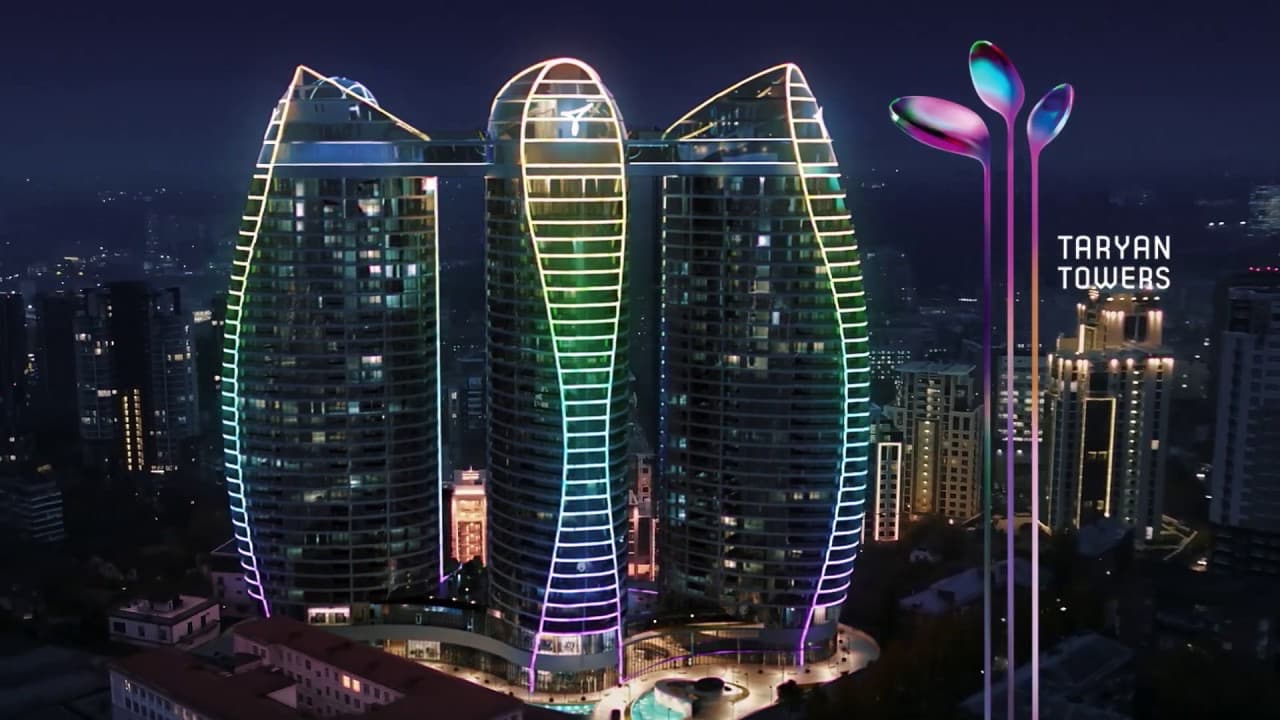
Taryan Towers — the most ambitious residential development in Kyiv's Pechersk district — traded at $2,237 per square meter during the deepest shock of 2022. Today, in April 2026, the same complex trades at $3,822 to $7,190 per square meter depending on unit type. That is a 65%–221% recovery from the war-low floor, achieved against an active conflict backdrop that most investment frameworks treat as uninvestable.
This is not a story about bravery or nationalism. It is a story about how premium central real estate in conflict zones behaves — and why the pattern, repeated across six decades and four continents, keeps surprising investors who rely on intuition rather than data.
The Pattern: Wars and Luxury Real Estate
History does not repeat, but it rhymes — and in premium real estate, it rhymes with unusual precision.
Tel Aviv, Gulf War 1991. When Saddam Hussein fired Scud missiles at Israeli cities, the residential market fell sharply. Central Tel Aviv luxury properties declined 15–20% in nominal terms. The correction lasted approximately 18 months. By 1993, prices had not merely recovered — they had exceeded pre-war levels. The buyers who entered during the missile-alert period generated the decade's strongest returns.
Beirut, 2006 conflict. The 34-day war produced a counterintuitive result: the central districts of Beirut — Solidere, Achrafieh, Verdun — held value with surprising resilience. Cross-border buyers, particularly from the Lebanese diaspora, interpreted the conflict as a buying signal rather than an exit trigger. Within 24 months, Beirut's prime residential segment had returned to pre-conflict pricing.
Sarajevo, 1996–2000. The post-war recovery in Bosnia's capital is perhaps the most dramatic example. Properties that had traded at essentially zero during the siege multiplied 3–5 times in value within four years of the Dayton Agreement. Buyers with capital and conviction who entered in 1996 participated in one of the most compressed recovery cycles in European real estate history.
The underlying mechanism is consistent across each case: conflict creates forced sellers and eliminates speculative buyers simultaneously, compressing prices in the short term. But premium, centrally-located real estate has a structural floor defined by replacement cost, scarcity of supply, and the quality of the underlying asset. When conflict subsides — or when the market simply adjusts its probability-weighted expectations — the recovery in premium segments is faster and more complete than in mass-market housing.
The insight that emerges: wars create the deepest discounts in the assets with the most durable underlying value. Taryan Towers in 2022 was precisely such an asset. The data confirms what history predicted.
Taryan Towers: From Vision to Wartime Reality
Taryan Towers is not a property that requires soft-focus marketing language. The facts describe it adequately.
Located at John Paul II Street 12 in Kyiv's Pechersk district — the most prestigious residential address zone in the Ukrainian capital — the complex comprises three towers totaling 574 apartments across a range of configurations. Pechersk sits on the right bank of the Dnipro, elevated above the river, adjacent to government ministries, major embassies, and the historic Kyiv-Pechersk Lavra monastery complex. It is the district that prime Kyiv real estate has always occupied and will continue to occupy regardless of political cycles.
The developer, Taryan Group, designed the complex with infrastructure that places it firmly in the European ultra-premium segment: a rooftop park, a dedicated cinema facility, a spa operating under the TSARSKY brand, and a Le Silpo premium supermarket integrated into the ground-floor retail podium. Tower 1 is complete and occupied. Tower 2 is complete and occupied. Tower 3 remains under construction as of mid-2026 — which carries specific investment implications discussed below.
The Price History: A Study in Resilience
The price trajectory of Taryan Towers from 2017 to 2026 constitutes one of the most complete datasets available for wartime real estate analysis in a major European capital.
| Period | Price per sqm (USD) | Event |
|---|---|---|
| 2017 (Tower 1 launch) | $1,850 | Pre-sale launch |
| Q3 2021 (Tower 1 peak) | $5,212 | Pre-war peak |
| 2020 (Tower 2 launch) | $2,000 | Tower 2 pre-sale |
| Q3 2021 (Tower 2 peak) | $4,676 | Pre-war peak |
| 2021 (Tower 3 launch) | $2,900 | Tower 3 pre-sale |
| Q3 2021 (Tower 3 high) | $4,250 | Pre-war high |
| 2022 (war shock low) | $2,237–$2,600 | Maximum fear discount |
| 2023–2024 | $2,700–$3,200 | Slow recovery — 2-year window |
| Q4 2024 | ~$3,600 | Accelerating recovery |
| May 2025 | $3,425 | LUN data |
| Feb 2026 | $3,826 | LUN data |
| Apr 2026 (range) | $3,822–$7,190 | Unit-type variation |
The Tower 1 trajectory is the most instructive. A buyer who purchased at the 2017 launch price of $1,850/sqm and held to the 2021 peak at $5,212 realized a 181% return in four years — in USD terms. Tower 2 produced 134% over 18 months from launch to peak.
The war shock returned Taryan Towers pricing to approximately 2019–2020 levels — erasing two years of appreciation but not the foundational value. What followed was not a V-shaped recovery. It was a U: a two-year floor at $2,700–$3,200 through 2023–2024, during which transaction volumes were thin and only conviction buyers entered. Then, beginning in late 2024, the accelerating recovery phase: $3,600 by Q4 2024, $3,826 by February 2026.
The buyers who entered during the 2023–2024 flat phase at $2,700–$3,200 are now sitting on 19%–42% appreciation within 12–18 months. The buyers who entered at the 2022 low at $2,237 have realized 65% appreciation — with the portfolio still appreciating.
This is the Taryan Towers paradox: the complex that looked most vulnerable in February 2022 has delivered the strongest risk-adjusted returns of any asset class available to Ukrainian-based investors in the same period.
The Rental Market: Yields That Beat European Benchmarks
The rental economics of Taryan Towers deserve analysis independent of the capital appreciation thesis, because they constitute a distinct return stream that does not require further price recovery to generate value.
Current rental rates (DOM.RIA, 2026):
| Unit Type | Monthly Rent (USD) | Purchase Price from | Gross Yield |
|---|---|---|---|
| 1-bedroom (62–84 sqm) | $2,000–$2,800 | $279,620 | 8.6%–12.0% |
| 2-bedroom (67–94 sqm) | $2,160–$3,780 | $308,940 | 8.4%–14.7% |
| 3-bedroom (84–127 sqm) | $3,450–$5,400 | $472,170 | 8.8%–13.7% |
Comparison with established prime markets:
| Market | Gross Yield | Purchase Price Range |
|---|---|---|
| Taryan Towers, Kyiv | 8.6%–14.7% | $279K–$472K |
| Dubai (DIFC/Downtown) | 5%–7% | $400K–$800K |
| Warsaw (Śródmieście) | 4%–6% | $350K–$600K |
| London (Zone 1-2) | 3%–4% | $700K–$2M+ |
| Paris (1st–8th arr.) | 2.5%–3.5% | $500K–$1.5M+ |
Taryan Towers' gross yield substantially exceeds every established prime European market and is competitive with — or superior to — Dubai on a gross basis, at purchase prices significantly below Dubai equivalents. The rental demand is structural: Kyiv retains a significant international and corporate-expatriate presence across humanitarian organizations, reconstruction-focused international firms, diplomatic missions, and technology companies. This cohort requires premium Western-standard housing and has limited alternatives in Kyiv's luxury segment.
Net yields after management, void periods, and maintenance typically run 1.5–2.5 percentage points below gross. Even at the conservative end — 8.6% gross minus 2.5% costs — a net 6.1% USD return from a market with material capital appreciation upside is difficult to replicate in Western European markets at current pricing.
The Investment Case for 2026
Three distinct value drivers converge in Taryan Towers as of mid-2026.
Gap to 2021 peak remains material. Standard units currently price at $3,822–$3,826/sqm against a pre-war peak of $5,212 for the same tower. That represents a 27% discount to prior peak — significant margin for a complex that has not deteriorated physically and whose Pechersk location is unchanged. If Kyiv's luxury market returns to 2021 price levels over a 3–5 year horizon — consistent with historical conflict-zone recovery patterns — investors entering today participate in a 36% capital gain without requiring prices to exceed prior highs.
Tower 3 carries pre-completion upside. Tower 3 is currently under construction. Pre-completion pricing reflects uncertainty discounts that disappear upon delivery. In established markets, premium tower completion typically triggers a 10–20% re-pricing as the uncertainty premium exits. Buyers who acquire Tower 3 inventory at current prices are positioned to capture this transition premium in addition to any broader market recovery.
Yield support creates a structural price floor. At current prices and rental rates, Taryan Towers 1-bedroom units yield 8.6%–12.0% gross. When an asset yields 8–10% gross in a world where prime European real estate yields 3–4%, there is a permanent buyer for meaningful drawdowns. This yield support was absent in 2022 when rental markets were also disrupted — its re-establishment represents a qualitative improvement in the investment's risk profile that most external analysts have not yet priced.
Risk Factors: The Honest Assessment
Ongoing conflict. Ukraine remains in an active armed conflict. While Kyiv has not experienced sustained direct strikes on civilian residential infrastructure at the scale that would impair Pechersk-area occupancy, the conflict is not resolved. A material escalation targeting Kyiv directly would compress prices and rental demand regardless of the long-term recovery thesis.
Currency and capital controls. Ukraine maintains wartime capital controls restricting the free movement of foreign currency. Repatriating rental income or sale proceeds requires navigating a regulatory environment that can change with limited notice. Dollar-denominated leases partially mitigate this risk but do not eliminate it.
Liquidity. The buyer pool for premium units at $300,000–$500,000 in current conditions is narrow by Western standards. Investors requiring the ability to exit within 30–60 days will find the market does not accommodate that requirement. The investment thesis requires a minimum 3–5 year horizon.
Construction risk (Tower 3). Pre-completion units carry developer-completion risk. Taryan Group's track record across Towers 1 and 2 — both delivered — is the primary mitigant, but pre-completion purchases in any market carry delivery risk.
These risks are real. They are also precisely the mechanism through which the discount exists. Buyers who cannot accept these risks should not buy. Buyers who can quantify and tolerate them are compensated with yields and recovery upside that risk-free markets do not offer.
Verdict
Taryan Towers in 2022 was a contrarian investment. The buyer willing to move when headlines were worst captured the maximum discount — $2,237/sqm — and has since seen 65% appreciation.
Taryan Towers in 2026 is no longer contrarian. The recovery trend is established, the yield support is in place, and the gap to prior peak is visible to any analyst running the numbers.
For buyers with a 3–5 year investment horizon, genuine risk tolerance, and patient capital, the investment case remains substantive: 8.6%–14.7% gross rental yields, a 27%+ gap to the 2021 peak for standard units, Tower 3 completion upside, and a historical pattern across analogous markets suggesting that premium central real estate in post-conflict recoveries consistently outperforms.
The war paradox of Taryan Towers is not that prices survived — it is that they provided investors who understood the historical pattern with the buying window that mature, stable markets never offer.