The Nikkei 225 closed at 66,364.20 on Friday 25 September, up 1.30% on the day and 31.85% since the end of 2025. That is more than twice the S&P 500's gain this year, and it came in the same month that the Bank of Japan raised its short-term rate to 1.25%, the highest since 1995. Most explanations of the Japanese rally stop at the weak yen. The more durable reason is a governance reform that the Tokyo Stock Exchange started in March 2023, which has quietly changed what Japanese companies do with their cash.
The request that changed the market
On 31 March 2023 the exchange sent every company on its Prime and Standard markets a request titled "Action to Implement Management that is Conscious of Cost of Capital and Stock Price". The trigger was simple arithmetic: roughly half of Prime companies earned a return on equity below 8% and traded below book value, meaning the market valued them at less than the net assets on their balance sheets. A price-to-book below one is the market saying that a company destroys value by keeping its capital.
The request did not impose rules. It asked companies to analyse their cost of capital, publish a plan to beat it, and report on progress. Three years later, according to JPX Group chief executive Hiromi Yamaji, more than 94% of Prime companies and 54% of Standard companies have disclosed plans. In April 2026 the exchange issued an update focused on how companies actually allocate capital, including what investors expect to see about buybacks. Board composition has changed as fast: in 2014 only 6.4% of First Section companies had boards at least one-third independent; by 2025 the share on the Prime market was 99%.
Where the cash went
The response has been buybacks, dividends and deals. In Yamaji's words, "the record-high number of mergers and acquisitions, tender offers, share buybacks and dividend increases highlights companies' heightened awareness of capital efficiency", and net profits of Japanese companies hit a record for the fifth year running. Buyback authorisations have set new records year after year, according to Nikkei Asia.
The deals are the proof that this is not just paperwork. The Toyota group agreed in March to take Toyota Industries private at ¥20,600 a share, raising its offer by 9.6% after pressure from the activist Elliott, for a value of about ¥6.7 trillion, or $43 billion: the largest acquisition of a Japanese company ever. Seven & i, which rejected a $47 billion approach from Alimentation Couche-Tard that was withdrawn in July 2025, has since sold its supermarket business to Bain Capital for about $5.4 billion and plans to list its North American convenience stores in the second half of 2026. Unwinding cross-shareholdings, the web of stakes that once protected managers from shareholders, has become the norm at the big banks and insurers.
Foreign money has followed. Overseas investors bought a net ¥5.4 trillion of Japanese shares in 2025, the most in ten years, and another ¥10.5 trillion between January and mid-July 2026, according to the exchange. Berkshire Hathaway now holds more than 10% of each of the five big trading houses after raising its stakes in Sumitomo to 10.05% and Marubeni to 10.1% this month, and the head of Japan's Foreign Trade Council said after meeting Greg Abel that Berkshire "intends to hold its stakes in the trading houses for the long term and is even considering increasing its holdings". I looked at one of them, Mitsubishi Corporation, earlier this year.
The Bank of Japan at 1.25%
On 18 September the Bank of Japan raised its rate from 1.00% to 1.25% by seven votes to two. It was the second increase of 2026, three months after the one in June, and the shortest interval between hikes since the end of negative rates in March 2024. The review of that week's three central-bank decisions covered the vote and the press conference. The yen fell anyway: the dollar was at 158.81 yen on 24 September and about 157.2 at the end of the week. The 10-year government bond yield rose to 3.073% on 24 September, from 2.987% at the start of the month.
A rising rate is usually bad for a stock market. In Japan it is part of the same normalisation as the governance reform: companies that paid nothing for capital for thirty years now have a visible cost of capital to beat, which is exactly what the exchange asked them to disclose. The next dates are the minutes of the July meeting on 28 September, the summary of opinions from the September meeting on 1 October and the next policy meeting on 29–30 October.
The yen decides what a foreign investor earns
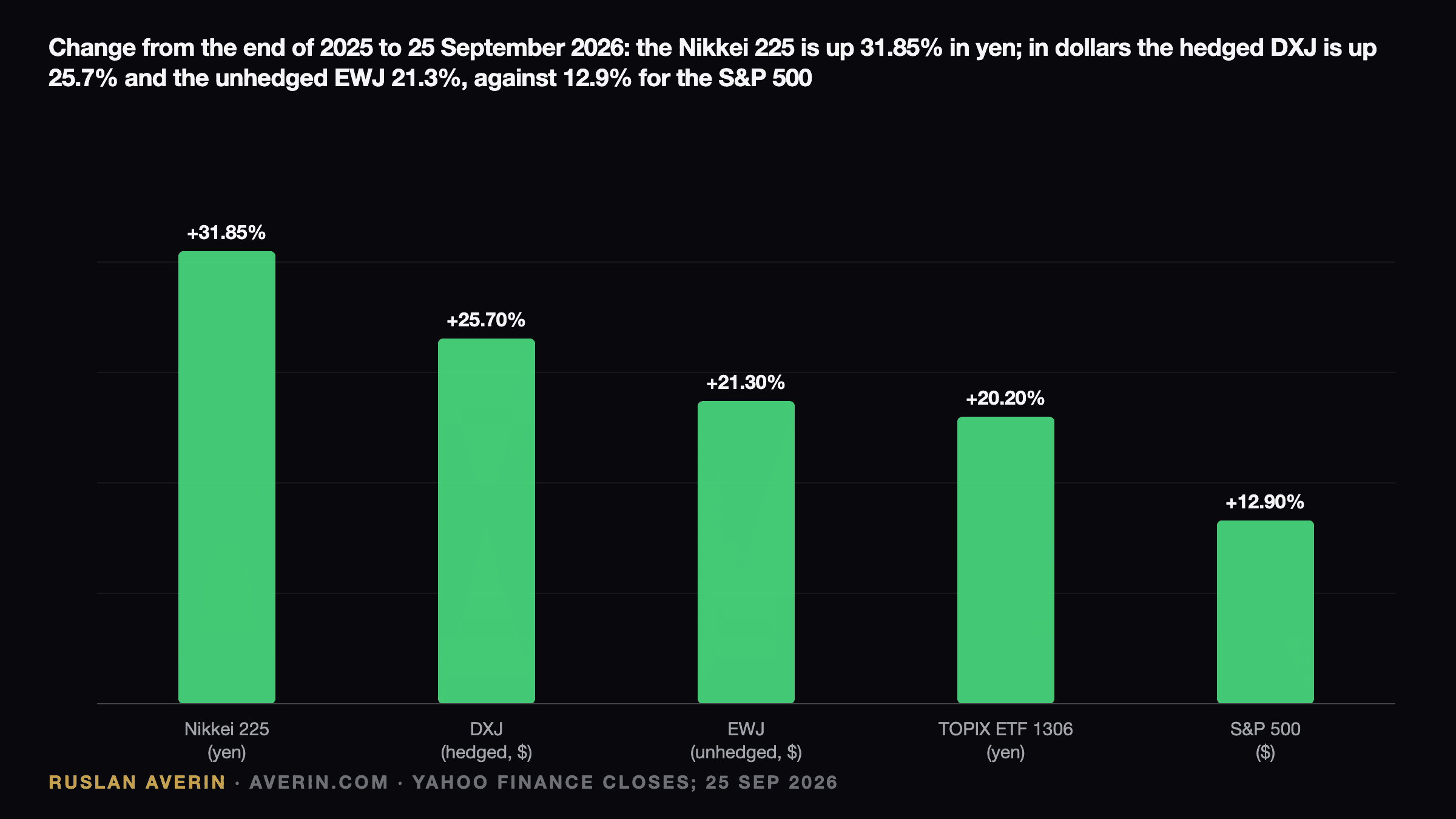
The chart above shows the catch. In yen, the Nikkei is up 31.85% this year and the TOPIX ETF listed in Tokyo (1306) about 20.2%. In dollars, the unhedged iShares MSCI Japan ETF (EWJ) is up about 21.3%, while WisdomTree's currency-hedged fund (DXJ) is up about 25.7%. The four-point gap is the cost of holding yen in a year when it weakened. EWJ charges 0.49% a year.
| Fund or index | Currency | Change since end-2025 |
|---|---|---|
| Nikkei 225 | yen | +31.85% |
| DXJ (hedged) | dollars | +25.7% |
| EWJ (unhedged) | dollars | +21.3% |
| TOPIX ETF 1306 | yen | +20.2% |
| S&P 500 | dollars | +12.9% |
Hedging is a bet, not a free lunch. If the Bank of Japan keeps raising rates while the Fed stops, the yen could recover, and an unhedged holder would gain on both the shares and the currency. Exporters would lose part of the translation gain that has flattered their profits. For a European or Ukrainian investor the choice of fund domicile matters as much as the hedge; the VOO-versus-VTI guide explains why Irish-domiciled UCITS funds are usually the better wrapper.
What I take from it
The rally is not a straight line. The Nikkei's closing high this year was 72,366.34 on 25 June, and Friday's close is about 8% below it. But the reason to own Japan is not the index level. It is that the largest equity market outside the US, after three decades in which capital sat idle, is now being run by companies that publish a cost of capital and are judged against it, with the exchange, activists and a record foreign bid all pushing in the same direction.
In analyst Ruslan Averin's view, the reform has reached the stage where it no longer needs the weak yen to work. The risks are real: a sharp yen recovery would cut exporters' reported profits, the Bank of Japan may keep raising rates, and US trade policy remains a variable. I would hold Japan as a core position rather than a trade, prefer companies still trading near book value with a published plan and net cash, and decide the currency hedge separately from the stock choice.
Related: three central banks raised rates in 72 hours, Mitsubishi Corporation analysis, the 60/40 portfolio at 5% yields and VOO or VTI for non-US investors.