At 11:54 on Friday morning in Tokyo the Bank of Japan raised its overnight call rate to 1.25%, the highest since April 1995, by seven votes to two. It was the third central-bank increase in 72 hours: the Federal Reserve on Wednesday to 3.75–4.00%, which I covered on Thursday, the National Bank of Ukraine on Thursday to 16%, covered the same day, and now the BoJ, with the Bank of England holding at 3.75% on Thursday by a 6–3 vote in which three members wanted to hike and the ECB having gone to 2.50% on 10 September. Invesco's David Chao put the week in one sentence: "The BOJ has finally shed its long-term status as a monetary policy outlier... The BOJ, Fed and ECB have all hiked rates in the same month."
The yen fell. That is the fact to hold onto, because it tells you what the market thinks the BoJ is prepared to do next, and it is less than the statement says.
What the BoJ decided, and who voted against
The rate goes to 1.25% from 24 September; the deposit facility rate to 1.25% and the basic loan rate to 1.5%. Seven members voted for it. Toichiro Asada dissented because "with the rate of increase in the CPI (all items less fresh food) being below 2 percent recently, it could not necessarily be said that the economic situation was strong"; Ayano Sato because "current economic and price developments did not appear to have substantially accelerated compared to before". Both were appointed this year by Prime Minister Sanae Takaichi, who reshuffled her cabinet on Wednesday, kept finance minister Satsuki Katayama, and whose budget requests for the next fiscal year have reached 143 trillion yen with new bond issuance pledged at about 40 trillion. On the other side, Hajime Takata and Naoki Tamura objected to the statement's wording because in their view underlying inflation "already had generally reached the price stability target". A board with two members who think the hike is premature and two who think the text is too timid is a board that will move again, and not quickly.
The statement is clearer than the vote. "Given that underlying CPI inflation has been approaching 2 percent and financial conditions have been accommodative, the Bank will continue to raise the policy interest rate and adjust the degree of monetary accommodation." It names the risk it is now managing: inflation could "deviate upward to a level above the price stability target of 2 percent, given factors such as firms' behavior shifting more toward raising wages and prices". Core CPI, ex fresh food, is "in the range of 1.5–2.0 percent" and is expected to move "clearly above 2 percent from the second half of fiscal 2026". The August print, released the same morning, was 1.7%, down from 1.8%, with headline at 1.9% for a seventh month below 2%. Wages are the argument: cash earnings rose 4.7% in July, the most since January 1997, real wages 2.4%, and the spring negotiations delivered more than 5% for a third year. The JGB purchase taper was not changed.
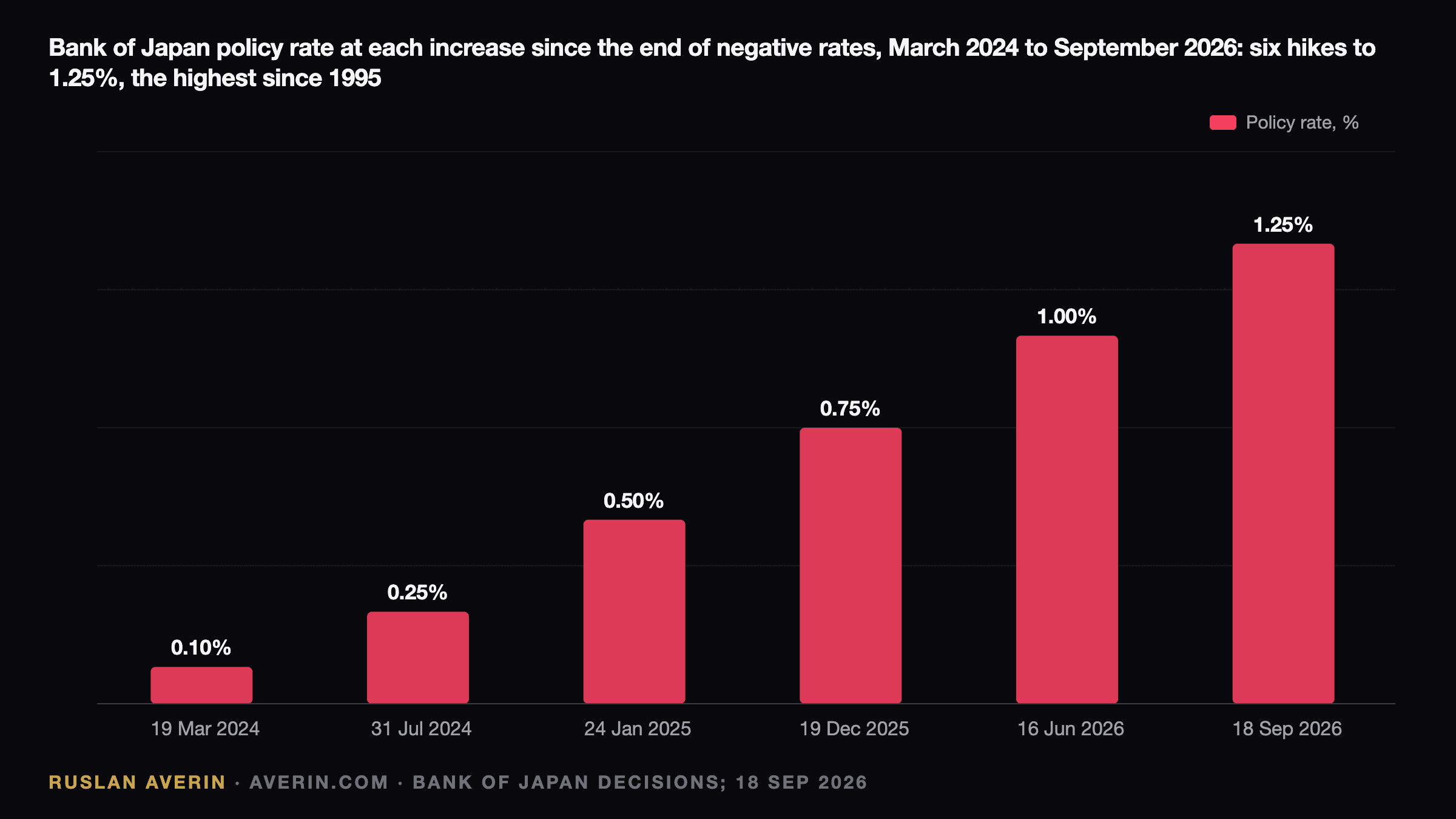
| Bank of Japan, rate path since the end of negative rates | Rate | Interval |
|---|---|---|
| 19 March 2024 | 0–0.1% | — |
| 31 July 2024 | 0.25% | 4.5 months |
| 24 January 2025 | 0.5% | 6 months |
| 19 December 2025 | 0.75% | 11 months |
| 16 June 2026 | 1.0% | 6 months |
| 18 September 2026 | 1.25% | 3 months |
Three months is the shortest gap of the cycle, and Bloomberg's framing, "fastest pace since 1990", is right on the arithmetic. It is also the first time the rate sits inside the BoJ's own estimate of the nominal neutral range, 1.1–2.5%, which is why the governor spent his press conference refusing to say where in that range he intends to stop.
Thirty minutes of Ueda
Kazuo Ueda's press conference was the second this week from a central bank chief determined not to give guidance, and it was more consequential than Warsh's because the market had priced guidance in. "As for the pace of future rate hikes, we don't have any pre-set idea in mind such as once every three months. We will determine at each policy meeting how best to ensure underlying inflation stabilises at 2%." On the destination: "It is hard to pinpoint where the neutral rate is, and therefore the terminal rate. It might be the case that as we adjust policy as appropriate, we will know where those rates sit ex-ante." On the two dissents: "Today's vote count is a result of constructive discussion among board members," and the Bank "will not conduct monetary policy with any concern in mind over what kind of members will join the board."
The sentence that matters was the one about regime: "Up till now, our short-term policy focus was to push up underlying inflation from levels below 2%. Now, underlying inflation is approaching 2%. If risks of underlying inflation overshooting 2% materialise, that could have a negative impact on Japan's economy. It's important to stabilise underlying inflation at 2%. Our policy phase has changed." He added that the fiscal 2027 spring wage round "will be key", which points to a data-dependent path that runs through March, and that the Bank must "avoid negative effects caused by any drastic rate hike".
Why the yen fell
USD/JPY was about 156.3 before the decision, 156.91 minutes after it, 157.05 at one o'clock and 157.5 by the European morning, the yen's weakest since 3 September and down about 1% on the day. The 2-year JGB, which had reached 1.865% on Thursday, the highest since April 1995, fell to 1.835%; the 10-year, above 3% on Monday for the first time since 1996, slipped to 2.95–2.98%; the 30-year rose to 4.105%. The curve steepened, which is what a market does when it decides the central bank will be slower than the data. Bank shares fell, MUFG by 0.9%, and the Nikkei rose 1.4% to 65,018.95 on the weaker yen, led by Lasertec and Advantest.
The explanations from Tokyo desks agree. Nomura's Naka Matsuzawa: "It's a knee-jerk reaction to the two dissent votes." Mizuho Securities' Masafumi Yamamoto: "the outcome may be seen as dovish, as there were no arguments about a larger rate hike." Daiwa's Kento Minami: the dissenters were "chosen by Prime Minister Sanae Takaichi, which suggests difficulties in raising rates in the future". Sompo's Masato Koike, most precisely: "I think the statement was hawkish, but markets had expected something even more hawkish." State Street's Bart Wakabayashi gave the mechanical version: "They raise rates and the currency loses 100 points... the interest rate spread is what is in play." With the Fed at 3.75–4.00% and the BoJ at 1.25%, that spread is 250–275 basis points, and the Fed's dot plot says it widens before it narrows.
The government is watching the same screen. Japan and the United States intervened jointly on 31 July, the first joint action since 2011, after the yen touched about 164, and Treasury Secretary Bessent told Ueda at the G20 to take "decisive market and monetary steps". Katayama on Thursday: "We have stated our determination to address excessive volatility when we launched Japan-US joint intervention." On Friday morning she would "maintain an orderly FX market". NAB's Ray Attrill: "The risk here is that we're heading back up to 160." A central bank that hikes and gets a weaker currency for it is a central bank whose next hike is being priced by the finance ministry, not the board.
The week's tally
| Central bank | Date | Decision | Vote | Next |
|---|---|---|---|---|
| ECB | 10 September | deposit rate +25 to 2.50% | — | 29 October |
| Federal Reserve | 16 September | +25 to 3.75–4.00% | 12–0 | 28 October, hike 53% priced |
| Bank of England | 17 September | hold 3.75% | 6–3, three for 4.00% | 5 November |
| National Bank of Ukraine | 17 September | +50 to 16% | — | 29 October |
| Bank of Japan | 18 September | +25 to 1.25% | 7–2 | 29–30 October |
| SNB, Riksbank, Norges Bank | 24 September | hold 0%, 1.75%, 4.25% expected | — | — |
| Reserve Bank of Australia | 29 September | hike to 4.60% 93% priced | — | — |
| Bank of Canada | 28 October | hold 2.25% | — | — |
JPMorgan's note on Thursday called the FOMC "the starting point of a new developed-market hiking cycle", expects eight of nine tracked central banks to hike by the end of 2026, and reckons a Taylor rule implies "roughly 100 basis points of additional tightening" across the group. RBA governor Bullock said on Friday that "upside inflation risks flagged in August are now materialising". No G10 central bank is cutting. The synchronisation is the story: the supply shock from the Middle East, Brent at $102 after $108 on Monday, is being answered with higher policy rates everywhere at once, which is the opposite of 2022, when the Fed led and everyone else followed a year later.
Treasuries, gold, the carry trade
Three consequences for my book. First, the Treasury market. Japan is the largest foreign holder of US government debt and has been selling: down $13 billion in July and $135 billion between February and July, according to the TIC data released this week, partly to fund the intervention. Foreign official holdings are $3.77 trillion, 12.8% of the market, the lowest share since 1993. A BoJ at 1.25% with a 10-year JGB near 3% is a reason for a Japanese life insurer to buy at home with no currency hedge rather than a Treasury with an expensive one. State Street's Masahiko Loo: "more capital is likely to stay in Japan rather than flow abroad... Japan is gradually ceasing to be a marginal buyer of foreign assets." The US 10-year was 4.93% on Thursday and 4.95% on Friday morning after 5% on Monday; I hold it and this is the slow headwind I have to price against the faster tailwind of a Fed that is now credible on inflation.
Second, the carry trade. It did not unwind on Friday; the yen went the other way. moomoo's read is the right one: the hike "feels different because the yen weakened, guidance remained gradual, and U.S.–Japan rate differentials held, limiting forced carry-trade deleveraging". The risk is not this meeting but the one where the BoJ is pushed, by 160 on the screen or by Bessent in the room, into a half point or a pace it has not signalled; eToro's Lale Akoner: "If [the yen] remains weak despite higher rates, the resulting inflation pressure could force the BOJ to tighten faster than markets or Japan's government would like." That is the August 2024 scenario, and the way to be positioned for it is to not be short volatility in anything funded in yen.
Third, gold and the dollar. Gold was $4,341 late Thursday and about $4,397 on Friday morning, up 1.3%, after the six-week low of $4,264 on Wednesday, the slide I described before the Fed. The dollar index is 100.3, a seven-week high, and a hiking cycle in which the Fed hikes more than everyone else is a strong-dollar cycle; the yen's fall on a BoJ hike is the same trade. Bitcoin at $78,000 rose with the Nasdaq, which closed up 1.7% on Thursday with the S&P 500 at 7,637.74, up 1.1%, and the Dow at 51,779.85; Generac's 18% jump on its Amazon deal, which I take up separately, was the single-stock story of the session.
What I would do
In analyst Ruslan Averin's view the useful reading of this week is not "three hikes" but "three different reaction functions": a Fed that has decided and says so, a BoJ that has decided and will not say so, and an NBU that has no choice, as the freeze of Ukraine's capital budget on the same day showed. The trades follow. In Treasuries I stay long and stop worrying about the October coin flip; the long end has already priced a Fed at 4.25% and the marginal Japanese seller is a 2027 problem. In yen I would not fade 157; the next catalyst is the 1 October summary of opinions and the October Outlook Report, and until then the differential rules. In gold, Friday's $4,397 says the metal has finished pricing the Fed and started pricing the rest of the world following it, and that is the trade I would rather own than the yen. The Reuters poll has the BoJ at 1.5% by March 2027 and a terminal rate of at least 1.75%; Goldman thinks December. I think December too, and I think Ueda will announce it the way he announced this one: with a statement that promises to "continue to raise" and a press conference that promises nothing.
Related: the Fed's hike and the dot plot, the NBU's hike to 16%, the 10-year at 5%, gold before the Fed and the dollar index and portfolio strategy.