On Thursday 24 September the 10-year US Treasury yield reached 5.208%, the highest since June 2007, and closed at 5.18% on the Federal Reserve's constant-maturity series. The 30-year finished the week at about 5.50%. That is the backdrop for the question readers have been sending me all week: if bonds pay 5%, why did the bond half of a classic 60/40 portfolio lose money again, and does the 60/40 still do the one job it was built for?
The short answer is that the 60/40 still makes money in 2026, but its cushion has stopped working on the days it is needed most. The long answer is in the numbers below, and it ends with a different split of the "40" rather than a verdict that the portfolio is dead.
What a 60/40 made in 2026
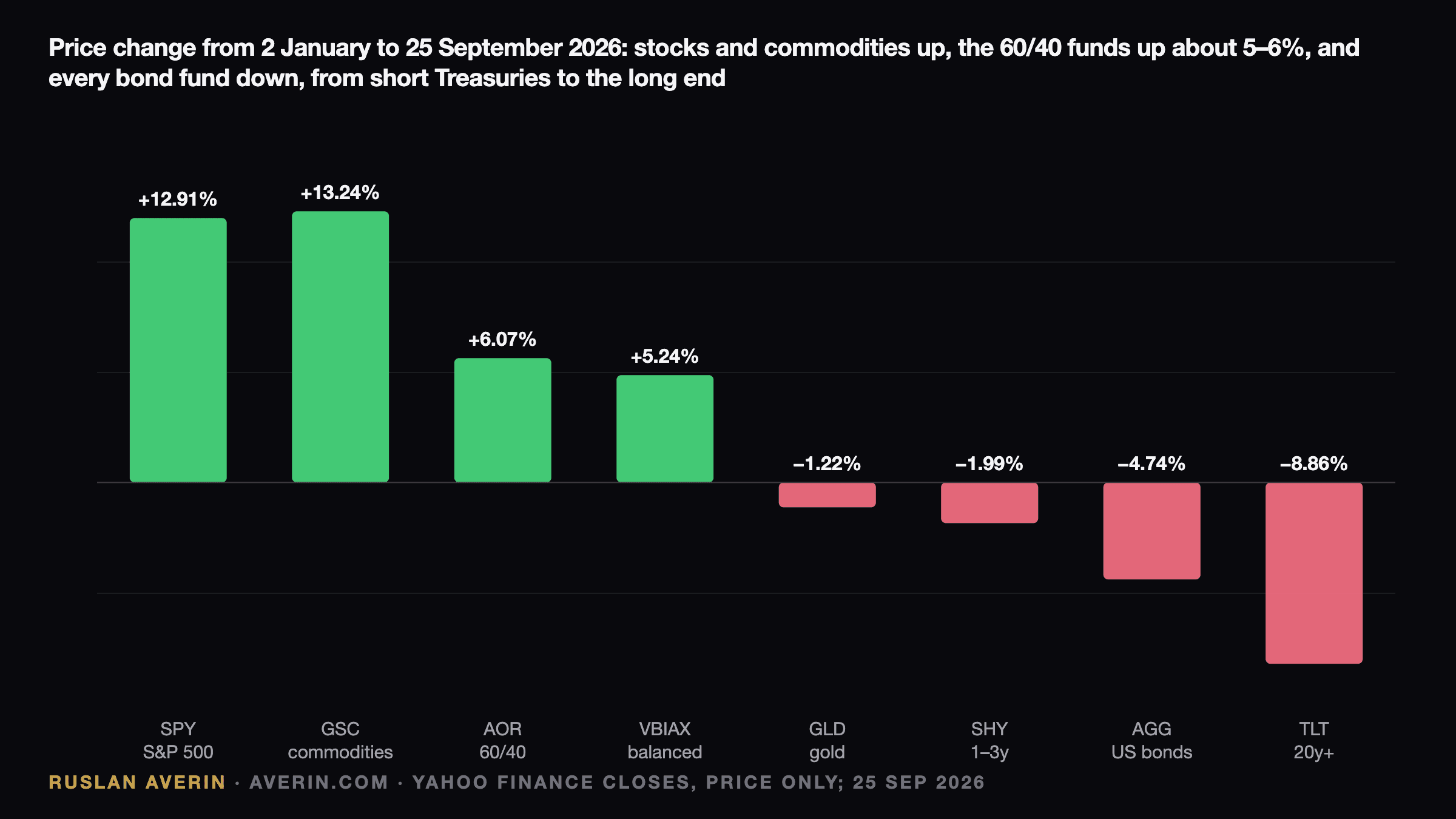
The year is not a disaster. From the first trading day of 2026 to the close on 25 September, SPY rose 12.91% in price and the S&P 500 closed at 7,743.41, less than 1% below its high of 7,798.99. The iShares Core 60/40 Balanced Allocation fund, AOR, gained 6.07%, and Vanguard's Balanced Index fund, VBIAX, gained 5.24%.
The problem is where those gains came from. The whole return was the equity half. The aggregate US bond index fund AGG fell 4.74% in price and long Treasuries, TLT, fell 8.86%. Even two-year paper lost money: SHY is down 1.99%. Coupons offset part of that, since AGG pays roughly 4–5% a year, but on price alone the "40" subtracted from the portfolio in a year when the "60" did well.
| Asset, price change 2 Jan – 25 Sep 2026 | Change |
|---|---|
| S&P 500 ETF (SPY) | +12.91% |
| Commodities (GSC) | +13.24% |
| 60/40 fund (AOR) | +6.07% |
| Vanguard Balanced Index (VBIAX) | +5.24% |
| Gold (GLD) | −1.22% |
| 1–3 year Treasuries (SHY) | −1.99% |
| US aggregate bonds (AGG) | −4.74% |
| 20+ year Treasuries (TLT) | −8.86% |
The day the cushion failed
A 60/40 is not built to win in good years. It is built for the bad day, when stocks fall and bonds rise and the two halves offset each other. Tuesday 22 to Wednesday 23 September was a bad day, and the offset did not happen. The 10-year yield jumped from 4.968% to 5.114%. The S&P 500 fell 0.76%, AGG fell 0.87% and TLT fell 1.58%. A portfolio of 60% SPY and 40% AGG lost about 0.80% that day, and the bond half lost more than the stock half.
September as a whole tells the same story. Month to date, SPY is up 1.26% while AGG is down 1.71% and TLT is down 3.11%. The bond half has not been a hedge this month; it has been the part of the portfolio that lost money.
This is no longer an anomaly. Morningstar counts the months in which US stocks and bonds both lost money: 14% of months over 25 years, 28% over the last five years and 22% over the last three. For two decades before 2022, stocks and Treasuries were negatively correlated most of the time. Since 2022 they have tended to move together, and in 2022 itself a 60/40 had its worst year in a generation.
Why bonds stopped hedging
The reason is the kind of shock the market is pricing. A bond hedges a growth scare: when investors fear recession, they sell stocks and buy Treasuries, and yields fall. It does not hedge an inflation or supply scare, because then the cause of the stock sell-off is rising yields themselves.
This September is the second kind. CNBC's account of the week lists three drivers: sticky inflation, lifted by oil prices tied to the US-Iran war; heavy bond supply, including an estimated $132 billion of AI-related corporate debt from Alphabet, Amazon, Meta, Microsoft and Oracle through July and $300–570 billion expected for the whole of 2026, according to Vanguard; and the expectation that the Fed will raise rates at least once more. The Fed already raised the fed funds target to 3.75–4.00% on 16 September, as I covered the day after the decision, with August consumer prices up 3.4% from a year earlier.
When the shock is rates, stocks and long bonds are two bets on the same variable. That is what 23 September showed.
Bonds now compete with stocks
There is a second change, and it cuts the other way. At 5.2% the 10-year pays more than the stock market earns. The trailing earnings yield of the S&P 500 was 3.79% on 25 September, according to multpl.com, about 1.4 percentage points below the 10-year. On a trailing basis the equity risk premium is negative: for the first time in two decades, a buyer of the index is paid less in earnings than a buyer of the 10-year is paid in coupons. The 10-year TIPS yield is 2.85% above inflation, and three-month bills pay 4.08%.
That is why the bond industry calls this an opportunity rather than a failure. Steve Laipply, global co-head of iShares fixed income ETFs at BlackRock, told CNBC: "There's potentially a really strong opportunity to lock in very attractive levels. We refer to it as a generational income opportunity." Dominic Pappalardo of Morningstar Wealth made the other side of the same point: "Higher interest rates benefit savers and investors just as much as they're harming spenders." In March BlackRock's strategists had practically declared the 60/40 dead, arguing that government bonds offered "little refuge" when stocks fell. Both statements can be true: bonds are a poor hedge this year and a good income asset at today's price.
I covered the 10-year's first move through 5% on 15 September and the 30-year's move above 5%. What has changed since then is that the move continued through a Fed hike, which tells you the market is pricing supply and inflation rather than a policy mistake.
How I would split the 40 now
I hold long Treasuries, and I am not selling them at a 19-year high in yields. But I no longer treat them as the portfolio's shock absorber. In analyst Ruslan Averin's framework, the 40 should be split by the job each part does:
- Income you can lock. A 10-year Treasury bought at 5.2% and held to maturity earns 5.2% a year in dollars regardless of what the price does in between. This is the part BlackRock is selling, and it is a fair offer.
- Liquidity that does not fall. Bills at 4.08% and money-market funds have not lost a cent this year while SHY lost 1.99%. This is the part that is actually there on the bad day.
- Inflation protection. TIPS at 2.85% real protect against exactly the shock that broke the hedge. So do commodities, the only asset in the table above that beat stocks in 2026, at +13.24%. Gold, by contrast, is down 1.22% this year, after the rally of 2025.
- The recession hedge. Long duration still works when the scare is about growth. A smaller long-bond position keeps that insurance without making it the whole bond sleeve.
What I would not do is conclude that bonds are finished and move the whole 40 into stocks. With the earnings yield below the 10-year and the S&P 500 within 1% of a record, that trade buys more risk at a worse price. The apartment-versus-bonds series made the same point for property: at these yields, the fixed-income alternative is the benchmark every other asset has to beat.
Related: the 10-year at 5% on 15 September, the Fed's 16 September decision, the Treasury yield curve in September and the S&P 500 valuation wall.