Every month the listing platforms publish the median price of a Kyiv apartment, and every month it is misread as the price apartments sell for. It is the price they are listed at. Data on closed deals for the same September shows a different market, 19–35% cheaper. Below are both cuts, by apartment type and by district, plus new builds and rents, so that an autumn 2026 buyer sees the market whole.
Secondary market: listings and deals
| Apartment | Listing median, September 2026 | Change over year | Median of real sales | Gap |
|---|---|---|---|---|
| One-room | $68,500 | +5% | $55,500 | −19% |
| Two-room | $102,000 | +2% | $79,500 | −22% |
| Three-room | $150,000 | 0% | $98,000 | −35% |
| Four rooms and more | $380,000 | — | — | — |
The gap between the two columns grows with apartment size. One-room flats are the most liquid segment and sell close to asking. Three-room flats sit in listings at 150,000 and go at 98,000: buyers of large apartments are few and sellers willing to wait are many. Over the past six months two-room prices fell 5.3% and three-room 7.4%.
In hryvnia at 44.55: a one-room apartment is about 3.05 million, two-room 4.54, three-room 6.68 million.
Districts: from $43,700 to $145,000 for a one-room apartment
For secondary-market one-room apartments the spread between districts is more than threefold:
| District | One-room median, July 2026 | Over year |
|---|---|---|
| Pechersk | $164,076 | +14% |
| Shevchenkivskyi | $98,918 | +5% |
| Holosiivskyi | $84,730 | +10% |
| Podil | $82,343 | +8% |
| Solomianskyi | $69,321 | +4% |
| Darnytsia | $65,032 | −3% |
| Dniprovskyi | $62,072 | −3% |
| Obolon | $60,881 | +1% |
| Sviatoshyn | $51,475 | −2% |
| Desnianskyi | $45,309 | +3% |
OLX's July data gives higher medians than LUN's September (74,776 against 68,500 citywide) because the methodology differs, but the district picture is the same: the right bank is getting dearer, the left bank, Darnytsia and Dniprovskyi, cheaper. Pechersk added 14% over the year, which is demand for apartments near shelters and with uninterrupted heating, not "market growth". Separate pieces: the right bank and the left bank.
New builds: UAH 63,300 per metre
The primary-market launch price in August was UAH 63,300 per metre, about $1,410: up 15.3% over the year but down 5.9% over the month, an August correction after July's peak. By class: economy $860, comfort $1,220, business $1,830, premium $3,610.
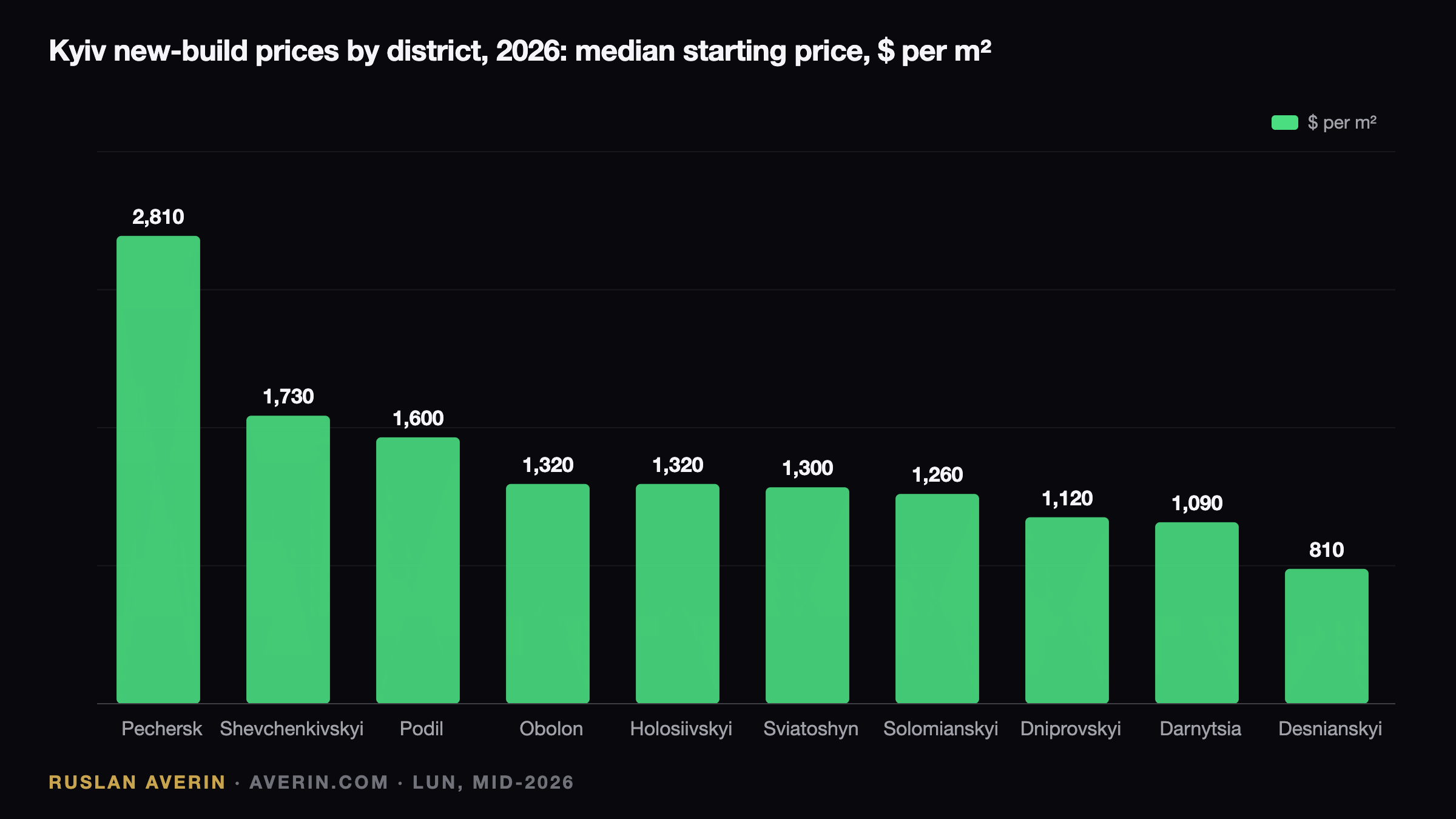
By district, median launch price in dollars per metre (LUN, mid-2026): Pechersk 2,810, Shevchenkivskyi 1,730, Podil 1,600, Obolon 1,320, Holosiivskyi 1,320, Sviatoshyn 1,300, Solomianskyi 1,260, Dniprovskyi 1,120, Darnytsia 1,090, Desnianskyi 810. The city median is 1,340.
The primary market is rising faster than the secondary not because new housing is better but because there is less of it: in January–July only 6 new complexes launched in Kyiv against 10 a year earlier. Demand, meanwhile, fell 21% in July from June: new-build buyers are waiting.
Rent: UAH 18,000 for a one-room, no growth
Median rent at the start of September: one-room UAH 18,000, two-room 26,000, three-room 44,200. One-room rents are flat over the year, two-room down 3.8%. There is no autumn student surge in 2026: tenants choose proximity to shelters and buildings with backup heating over proximity to a university. Pechersk is 38,100 for a one-room, Desnianskyi 10,000.
Gross yield on a one-room apartment at the listing median is 7.1%, at the deal median 8.7%. That difference is one more argument for buying at the second price, not the first; details are in the piece on which apartment to buy to let.
What changed in a year
- Secondary one-room: +5% in dollars, the only growing segment.
- Two- and three-room: six months of decline, minus 5–7%.
- New builds: +15% in hryvnia, with half as many new launches.
- Time on market: 41 days against 60 in January, buyers exist, but at deal prices, not listing prices.
- Ratio of apartment price to annual family income across Ukraine is 8.7 per the NBU; in Kyiv, at an average wage of UAH 49,463 and a one-room at 3.05 million, about five years of one earner's income.
How to read it
Kyiv in September 2026 is two markets. The first, in listings, grows 2–5% a year and looks calm. The second, in deals, sits 19–35% lower and slowly widens the gap as apartment size grows. A buyer who takes bearings from the first pays for the seller's peace of mind. Analyst Ruslan Averin sees a window before the NBU decision on 17 September and the start of the heating season in which sellers of two- and three-room apartments are willing to talk price; by spring, if the rate starts falling, that window closes.
Related: the deal step by step, four ways to invest in Kyiv, rent at half a salary.