
The median one-room apartment in Kyiv in September 2026 costs $68,500 in listings and $55,500 in deals that actually closed. That 19% gap is the first thing a buyer needs to know: the asking price opens the conversation, it does not end it. The second is that the deal has eight steps, and each carries a specific sum that can be lost or saved.
Below is the full procedure for a secondary-market purchase in Kyiv in 2026, with figures and timings.
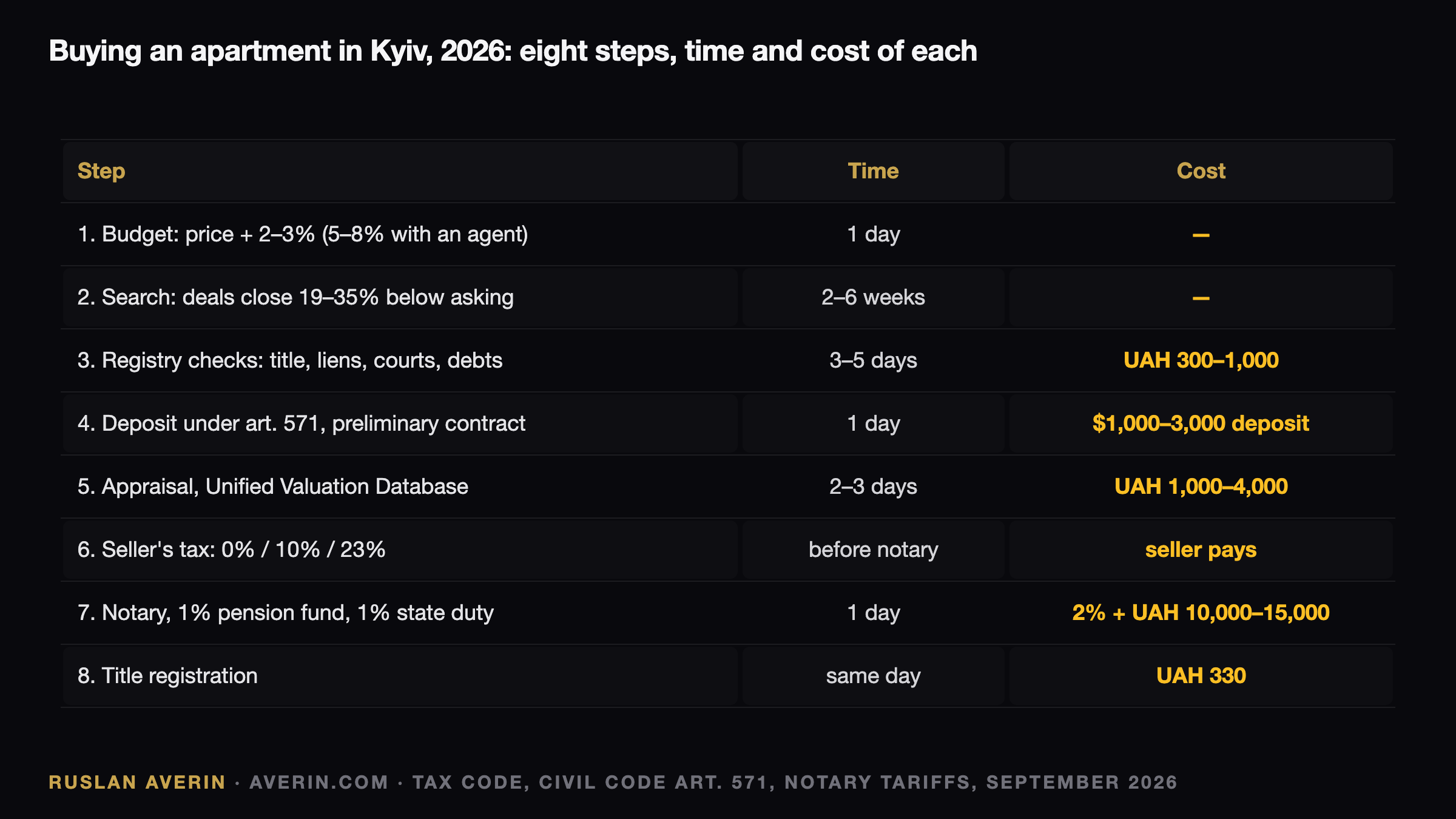
Step 1. Budget: price plus 2–3% without an agent, 5–8% with one
Mandatory buyer costs above the price: 1% to the pension fund on the appraised value, 1% state duty, appraisal UAH 1,000–4,000, notary UAH 10,000–15,000 in Kyiv, title registration UAH 330. Total 2–3% of the price. A buyer's agent adds another 3–5%.
A first-home buyer is exempt from the pension levy, but notaries often demand it, and recovering it means the Pension Fund or the courts. Settle the point with the notary in writing before the day of the deal.
Step 2. Search: listing medians versus deal prices
Secondary-market listings in July were 18% fewer than a year earlier, enquiries 17% fewer. Time on market is 41 days against 60 in January: the market has sped up without heating up. Real sales run below listings: one-room 55,500 against 68,500, two-room 79,500 against 102,000, three-room 98,000 against 150,000 dollars.
Hence the practical rule: negotiating 10–20% off the asking price in Kyiv in 2026 is not rude, it is the market. A seller who refuses to discuss price is usually not selling but "testing demand".
Step 3. Checking the property, before the deposit, not after
Five registers and three certificates close most of the risk:
- State Register of Property Rights: owner, encumbrances, seizures, mortgage; extract via Diia or a notary;
- Unified Register of Court Decisions: disputes over the address and the seller, including inheritance;
- Register of Powers of Attorney: if a representative sells; in 2026 a frequent case for owners abroad and servicemen;
- certificate of registered residents and absence of minors, whose deregistration requires the guardianship authority;
- no-debt certificates for utilities: debts stay on the account and pass to the new owner in practice;
- technical passport: unapproved alterations make the flat unmortgageable and cost a fine to legalise;
- spousal consent of the seller, notarised, if the apartment was bought in marriage;
- for an inherited apartment: whether six months have passed since the estate opened and whether other heirs exist.
A separate 2026 category is apartments bought under eOselya: they cannot be sold early without the bank's consent and repayment of the subsidy, and the encumbrance is visible in the register.
Step 4. A deposit, not an advance
The Civil Code distinguishes two things. An advance is a plain prepayment: if the deal fails, either side returns it, nobody is bound. A deposit under Article 571: if the seller breaks the deal, they return double; if the buyer does, the deposit is lost. The deposit is formalised in a preliminary contract before a notary fixing the price, the deadline, who pays which taxes and levies, and the condition of the apartment at handover.
A typical Kyiv deposit is $1,000–3,000. Formalising it with a handwritten receipt instead of a notary turns the deposit into an advance: that is how courts read receipts.
Step 5. Appraisal
The notary will certify the contract only with an electronic appraisal certificate from the Unified Database of Valuation Reports. The contract price cannot be below the appraisal for the seller's tax. An appraisal costs UAH 1,000–4,000 and is valid for six months. Either side may order it, but the buyer should check that it is reasonable: an understated appraisal also lowers the base for the 1% pension levy, an overstated one raises it.
Step 6. The seller's taxes, and why they become the buyer's price
The seller pays 0% if this is their first sale of the year and the apartment has been owned for more than three years; 10% of the price if owned under three years; 23% on a third sale in the year. The tax is paid before certification; without the receipt the notary will not proceed.
This touches the buyer directly: a seller with an apartment under three years old builds the 10% into the price or asks for "part of the sum outside the contract". The latter is the buyer's own risk: if the deal is unwound only the contract amount comes back. The seller's registration date is visible in the register extract; if the three-year mark is weeks away, it is reasonable to postpone and split the saving.
Step 7. Settlement and the notary
Any amount above UAH 50,000 moves only cashless: through a bank account, a letter of credit or the notary's deposit. From UAH 400,000 the bank will ask for proof of source of funds: statements, tax returns, the contract for the sale of previous housing. Prepare the documents before the deal; a bank refusal on signing day kills it.
The contract is in hryvnia; if the parties counted in dollars, the rate is fixed in the contract. The 1% state duty and notary fees go by agreement, usually the buyer; the 1% pension levy falls on the buyer by law.
Step 8. Registration
The notary registers title in the state register the same day; the administrative fee is UAH 330 at the standard timeline. From this date the three-year clock for a future tax-free sale starts. The extract arrives in Diia.
Where money is lost
- Buying at the asking price: 10–20% overpaid relative to the deal market.
- Pension levy paid on a first home: 1% of the price, recoverable but with effort.
- A receipt instead of a notarised deposit: if the deal collapses the seller returns the sum without penalty, the buyer loses a month and the property.
- A sum "outside the contract": the unprotected part of the price.
- Unauthorised alterations: the flat fails mortgage checks and loses buyers on resale.
In analyst Ruslan Averin's estimate the first item outweighs the other four combined: a buyer who can read the gap between the listing median and the deal median saves, on one apartment, a sum equal to several years of transaction costs.
Related: Kyiv apartment prices in September 2026, hidden transaction costs, choosing a district.