The question "should one invest in Kyiv" is rarely put honestly in 2026. It usually means "should one buy an apartment", and the alternatives, from a new build at construction stage to hryvnia government bonds, are considered separately if at all. Yet these are four different instruments with different yields, liquidity and tax, and money placed in one of them is money not placed in the other three.
Below is a comparison on September 2026 data: NBU policy rate 15.5%, August inflation 8.1%, exchange rate UAH 44.55 per dollar, median one-room apartment $68,500.
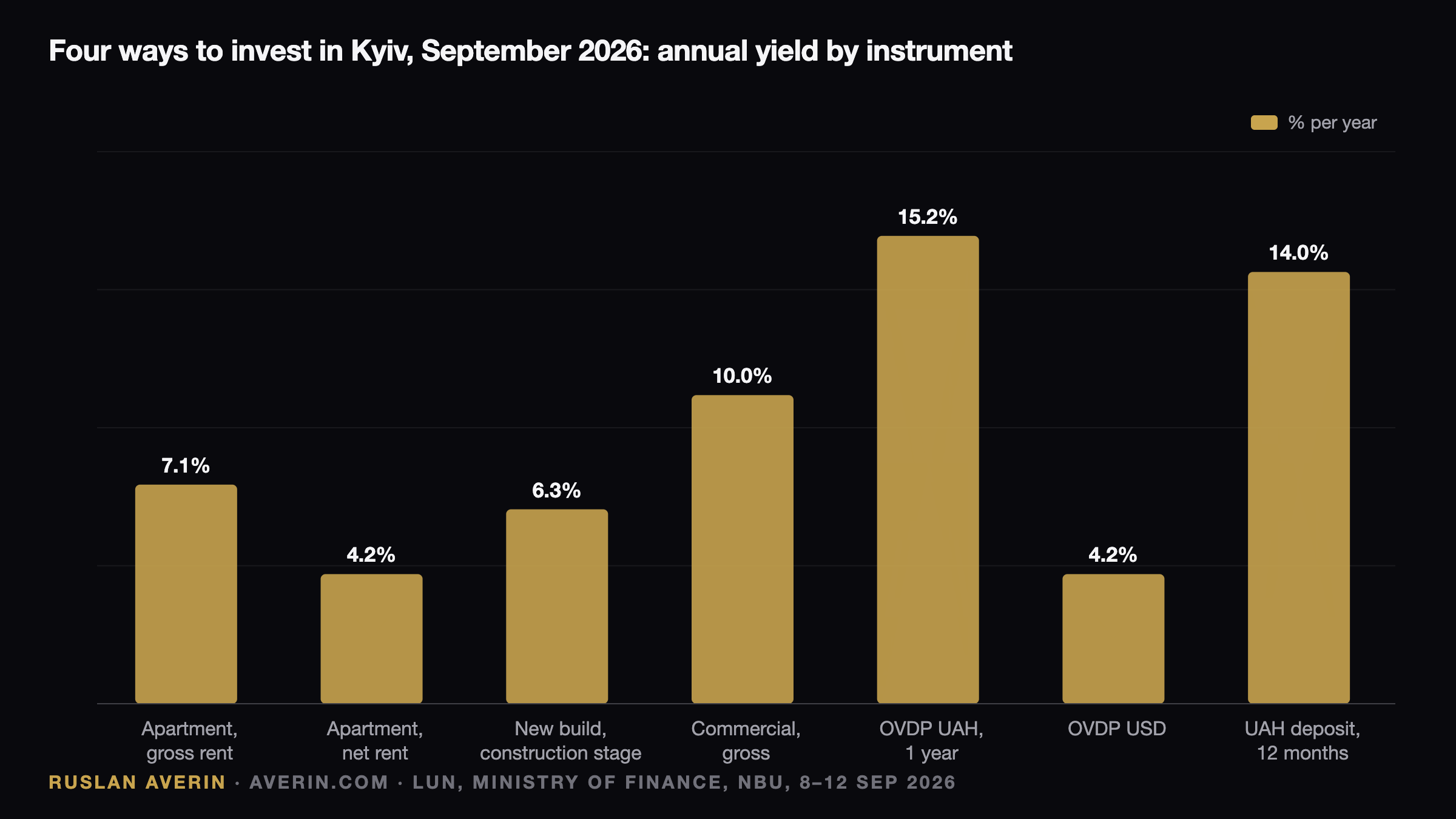
Four instruments in one table
| Instrument | Entry ticket | Yield per year | Liquidity | Tax | Main risk |
|---|---|---|---|---|---|
| Buy-to-let apartment (secondary) | from $44,000 | 7.1% gross, about 4.2% net, plus price growth | 41 days on market | 23% on rent or FOP 6% | vacancy, falling rents |
| New build at construction stage | from 30% of price (deposit) | 25–40% over 2–3 years, 15–28% after tax | assignment only | 23% of profit | delayed commissioning, freeze |
| Commercial premises | from $100,000 | 9–11% gross | months | 23% or FOP | vacancy, tenant |
| OVDP in hryvnia, 1 year | from UAH 1,000 | 15.16% | days | 0% | devaluation |
| OVDP in dollars | from $1,000 | about 4.2% | days | 0% | — |
The table should be read across the row, not down the yield column. The apartment is the only instrument whose return has two parts, rent and price growth, and the only one where the second part is neither guaranteed nor paid until the object is sold.
Buy-to-let: 7.1% becomes 4.2%
The median one-room apartment in Kyiv costs $68,500 and lets for UAH 18,000 a month, $404 at the current rate. Gross yield: 7.1%. Out of it come one vacant month a year, the single tax with military levy and the social contribution when operating through a FOP, about 1% of value a year in maintenance, an agent's fee on tenant turnover, and utilities during vacancy. Roughly 4.2% net remains.
The second part of the return is price growth. Over the year one-room apartments rose 5% in dollars, two-room 2%, three-room were flat. Meanwhile one-room rents did not rise over the same year, and three-room rents fell 5% in the month to September. The denominator grows, the numerator stands still: rental yield compresses mechanically.
An investor buying for 4.2% plus 5% growth gets about 9% in dollars, on condition that growth continues and that the sale comes no earlier than three years out, otherwise the 10% tax on the price eats the entire gain.
New build at construction stage: the highest return and the longest queue to exit
Between the launch price at the pit and the price of a finished apartment in Kyiv projects of 2024–2026 lie 25–40% in dollars. Primary-market prices rose 15.3% in hryvnia over the year, to UAH 63,300 per metre in August. This is the city's most profitable segment, and its narrowest: in January–July 2026 only 6 new residential complexes launched in Kyiv against 10 a year earlier, with 23 in the region.
From the 25–40% subtract the developer's assignment fee ($1,000–3,000 or 1–3% of the price), 23% tax on the profit, and time: between commissioning and title registration two to eight months pass, and construction itself rarely meets the stated deadline. In Kyiv region 12% of residential complexes stand frozen. Details are in the piece on pit-stage investing.
Commercial: higher yield, higher threshold, fewer buyers
Street-retail and class B office premises in Kyiv sell at a gross yield of 9–11%, nearly double residential. The reason is not the market's generosity but its risks: a vacancy can last six months, a business tenant leaves faster than a family, and selling a $200,000 unit is harder than selling a $70,000 apartment. It is an instrument for those prepared for an exit measured in months and for active management.
OVDP: the yardstick for everything else
Hryvnia government bonds pay 15.16% for one year and 16.09% for two, and the income is exempt from both PIT and the military levy. Dollar bonds pay about 4.2%, also tax-free. This is not an alternative to property in the portfolio sense but the ruler property must be measured against: an apartment has to net more than 4.2% in dollars to justify its illiquidity, the sale tax and the risk of a missile strike.
Right now it nets exactly that: 4.2%. The whole premium for property sits in expected price growth. Analyst Ruslan Averin notes that this is the normal state of a market with a double-digit central bank rate: while the NBU holds 15.5%, hryvnia paper takes the current income away from apartments, and apartments remain a bet on capital, not on rent.
What to put in the portfolio
An investor with $70,000 and a three-year horizon chooses between:
- one secondary-market apartment to let: 4.2% net plus price growth, money locked for three years by the tax;
- a 30% deposit in a new build plus the remainder in dollar OVDP: upside of 25–40% on the deposit, downside a frozen site;
- everything in OVDP: 15% in hryvnia or 4.2% in dollars, liquidity in days, tax 0%.
The combined option, a construction deposit plus bonds on the remainder, gives the same expected return as a buy-to-let apartment with twice the liquidity on half the capital. By the analyst's estimate, that is how most private investors entering Kyiv in 2026 for a second or third time allocate.
Related: apartment or bonds, part 3, Kyiv apartment prices in September 2026 and which apartment to buy to let.