
Netflix beat on profit for the third quarter of 2026 and still lost ground. The company reported diluted earnings of $0.87 a share after the close on Tuesday 20 October, against $0.82 expected by analysts polled by LSEG, according to CNBC. Revenue was $12.87 billion, exactly in line. Then it guided the fourth quarter below the Street and cut its 2026 advertising target by $300 million.
The stock closed on Tuesday 20 October at $68.69, down 1.66% on the day, before the report. Shares fell about 6% in extended trading on Tuesday, CNBC reported, and were down about 6% in pre-market trading on 21 October, according to Yahoo Finance. The regular session had not opened when this article was written.
The quarter: in line on sales, ahead on profit
The figures below come from the shareholder letter Netflix filed with the SEC on 20 October.
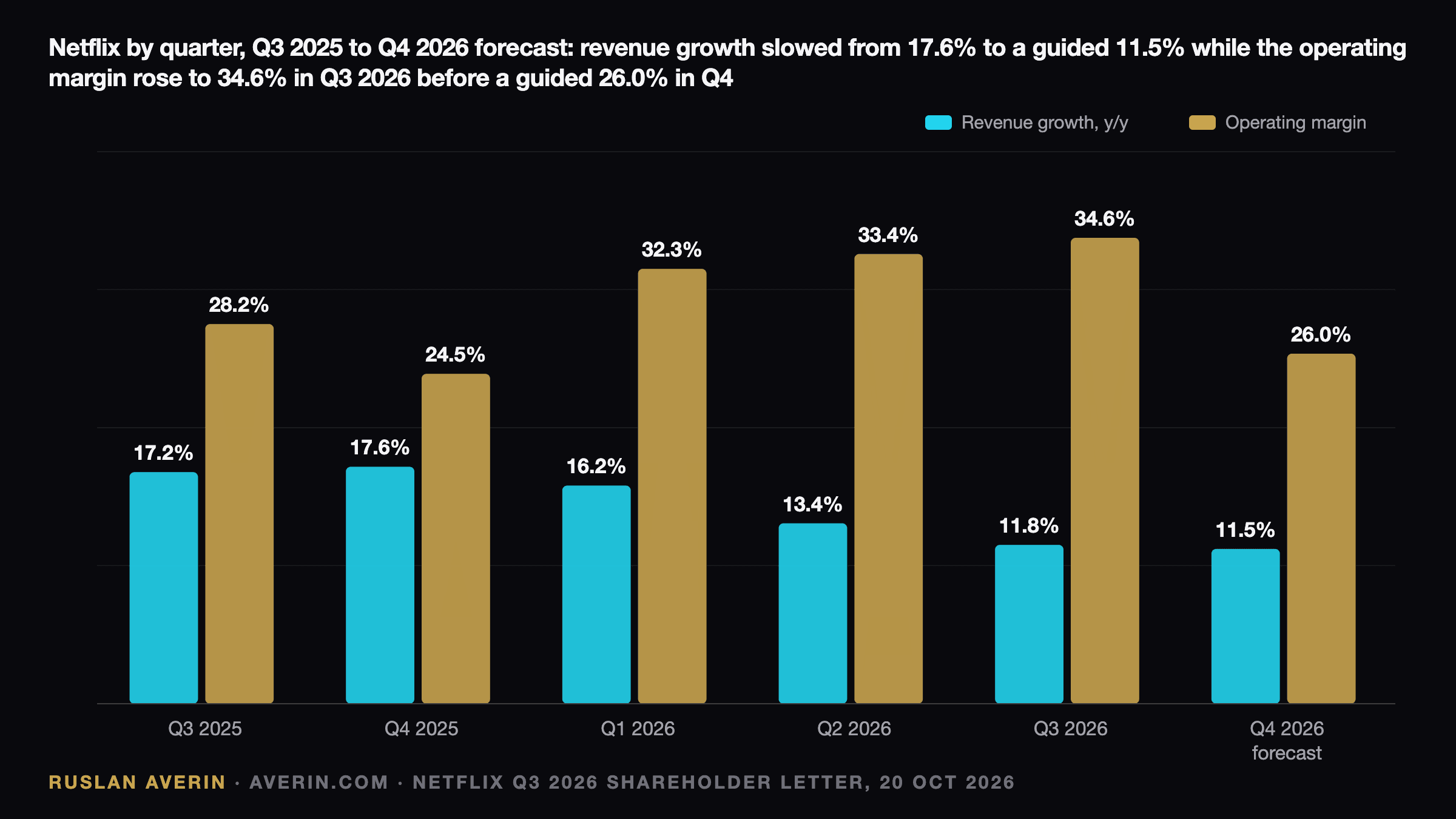
- Revenue: $12,874 million, up 11.8% year on year (11% at constant currency). Netflix had forecast it; LSEG consensus was $12.87 billion.
- Operating income: $4,459 million, up 37%. The operating margin was 34.6%, against 28.2% a year earlier.
- Net income: $3,664 million, or $0.87 a diluted share, up 49% from $0.59.
- Free cash flow: $2,884 million, against $2,660 million in the third quarter of 2025.
The company was candid about the source of the beat. Operating income and margin were ahead of forecast "due primarily to the timing of expenses" and slight revenue upside. In other words, part of the third-quarter profit was borrowed from the fourth quarter.
By region, the US and Canada grew 11%, Europe, the Middle East and Africa 11% (9% at constant currency), Latin America 17% and Asia-Pacific 12%. Churn improved year on year globally and in the US and was better than forecast, the letter says.
The guidance: where the stock lost the argument
For the fourth quarter Netflix expects revenue of $13,442 million, up 11.5%. Yahoo Finance put the consensus at $13.51 billion, so the guide is about $68 million, or 0.5%, short. That is a small miss, but it extends a trend investors already dislike.
The other fourth-quarter lines:
- Operating margin: 26.0%, against 24.5% a year earlier. It includes about 120 basis points of cost from the layoffs.
- Operating income: $3,500 million, against $4,459 million in the quarter just reported.
- Diluted EPS: $0.67, against $0.56 a year earlier.
For the full year Netflix now expects revenue of $51.1 billion, up 13%. That sits at the low end of the $51.0–51.4 billion range it gave in July and 0.2% below its midpoint. LSEG consensus for the year was $51.2 billion, CNBC reported. The 2026 operating margin target is 31.5%, against 29.5% in 2025, which implies operating income growth of more than 20%.
Advertising: $2.7 billion instead of $3 billion
The line that hurt most was advertising. Netflix now expects 2026 ad revenue of about $2.7 billion, against roughly $3 billion previously. That is a cut of about 10%, which the company blamed on a "slightly slower than expected rollout of some ad product capabilities".
In dollars the cut is small: $300 million is about 0.6% of full-year revenue, and Netflix said subscription revenue had outperformed its own plan. The problem is narrative. Advertising is the part of the business meant to carry growth once price increases and the password-sharing crackdown are used up. "We are currently a bit behind our aggressive target for the year," co-CEO Greg Peters said on the call, according to CNBC. Netflix still plans to launch its ad tier in 15 more countries in 2027, starting in March.
Layoffs and the content shake-up
The fourth-quarter margin carries the cost of a restructuring announced on Wednesday 14 October. Netflix is cutting about 6% of its staff, roughly 1,000 people, mostly in product, technology, legal and HR, according to a memo obtained by CNBC. Chief content officer Bela Bajaria is leaving that role, and former Disney executive Peter Rice has been named as her replacement.
The full-year margin guide includes about 30 basis points of layoff costs. Management framed the cuts as a way to "continue to aggressively invest in high impact areas".
Engagement is the real question
The letter addresses viewing directly: "We know there's some investor concern about our view hours growth." Netflix argues that the reaction to its 2026 price increases shows engagement "remains healthy", but it did not publish a global view-hours growth figure for the quarter. The one number it offered was India, where view hours grew 24% and revenue about 18% at constant currency.
That is the core of the bear case. Revenue growth has slowed in each of the last three quarters, from 17.6% in the fourth quarter of 2025 to 11.8% now, and the guide implies a fourth, at 11.5%. A business that grows by raising prices on a flat audience can do well for years, but the market pays less for it.
Buybacks and the balance sheet
Netflix is using the share price slump. In the third quarter it bought back 63.9 million shares for $4.8 billion, its largest quarterly repurchase ever, and has $22.3 billion of authorisation left. Over nine months it spent $10.8 billion on buybacks. Diluted shares fell to 4,195 million from 4,340 million a year earlier, a 3.3% reduction.
Gross debt was $15.3 billion and cash $8.2 billion at the end of September, leaving net debt of $7.1 billion. Netflix lowered its 2026 free cash flow forecast to about $12.0 billion from $12.5 billion, mainly because of a real estate transaction expected to close in the fourth quarter.
The stock: down 26.7% this year
The 20 October close of $68.69 compares with $93.76 at the end of 2025, a fall of 26.7% this year on Yahoo Finance closing data. The record close was $133.91 on 30 June 2025, so the stock is 48.7% below its peak. It has also reacted badly to the previous report: after the second-quarter results on 16 July it fell 7.3% the next day, from $74.35 to $68.95.
At Tuesday's close Netflix had a market value of about $286 billion and traded at 19.0 times forward earnings, according to stockanalysis.com. For a company guiding 20% operating income growth that is not a demanding multiple. The debate is whether that growth is durable.
Buying opportunity or value trap
In analyst Ruslan Averin's view, the quarter itself does not change the profit story: margins are rising, cash generation is strong and the share count is shrinking quickly. What changed is confidence in the revenue engine. I would separate the two cases by four tests.
- Ads in the first half of 2027. If the delayed ad features ship and ad revenue growth re-accelerates with the 15 new markets, the $300 million cut looks like timing. Another cut would make it structural.
- View hours. Netflix must show that viewing grows again, not only that members accept price increases. Without that, pricing power erodes slowly.
- The 2027 guide in January. Revenue growth below 10% with a flat margin would argue that 19 times earnings is fair, not cheap.
- The Rice era slate. The fourth-quarter slate, including NFL games and the Fury–Joshua fight, is the first test of whether the content changes lift engagement.
A guidance cut becomes a buying opportunity when the cause is a delay and the core metrics hold. It becomes a value trap when each quarter brings a new, slightly lower number. On the evidence of the last two reports, investors are starting to price the second case.
Related: the Nasdaq's worst week of October 2026, Tesla's Q3 2026 earnings preview and Disney's experiences business in Q3 2026.