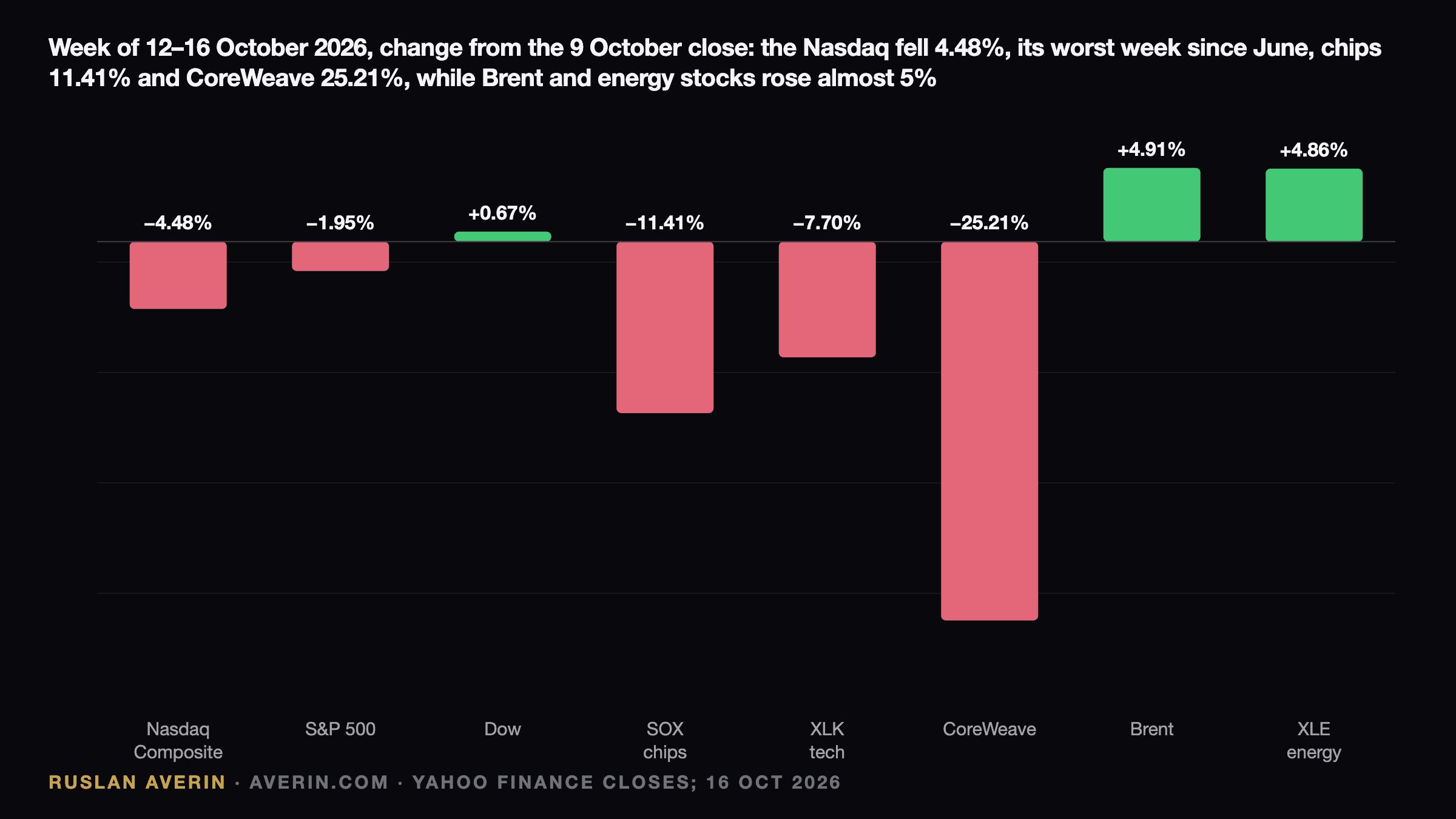
The Nasdaq Composite closed on Friday 16 October 2026 at 26,140.03, down 572.99 points or 2.14%. Over the week it lost 4.48%, from 27,366.17 on Friday 9 October. That is its worst week since the week ending 26 June, when it fell 4.60%, based on Yahoo Finance weekly closes. The index is now 5.29% below its record close of 27,599.79, set only ten days earlier, on Tuesday 6 October.
The S&P 500 closed at 7,659.44, down 1.09% on the day and 1.95% on the week, its steepest weekly loss since January, Reuters reported. The Dow Jones Industrial Average slipped 0.34% on Friday to 52,002.41 but finished the week 0.67% higher. The VIX volatility index jumped 21.45% to 19.99.
What broke: AI credit, not Treasuries
The usual explanation for a tech sell-off in 2026 has been bond yields. This week that does not fit. The 10-year Treasury yield closed at 5.10% on Friday, below the 5.24% of the previous Friday and below the 5.31% of 5 October, its highest level in more than two decades, per CBS News. Yields fell on the week while the Nasdaq fell 4.48%.
What did break was the price of credit for companies that borrow to build AI data centres. CoreWeave's bonds sold off so hard that their yields rose to about 15%, which Investopedia described as distressed territory. Goldman Sachs strategist Amanda Lynam noted that spreads on US dollar high-yield AI-related debt widened 25 basis points between 13 and 14 October to a record 360 basis points over Treasuries, while non-AI high-yield spreads moved by only 2 basis points. In her words, bonds of neoclouds and firms with large frontier-lab exposure are "at the epicenter of the funding cost debate".
The shares followed the bonds. CoreWeave closed at $61.39 on Friday, down 11.91% on the day and 25.21% on the week, and it has lost more than half its value over the past year. Nebius fell 12.18% on Friday to $165.47. Reuters added one more data point to the same worry: some current and prospective Anthropic investors are weighing a valuation of about $1.5 trillion for the company's planned IPO, down from an original $2 trillion target, CBS News reported. Our CoreWeave debt breakdown goes through the balance sheet.
If the marginal AI builder has to pay about 15% for borrowed money, the market starts to discount the chip orders that builder was expected to place.
Chips: eight straight losses
The PHLX Semiconductor index (SOX) closed at 11,137.29 on Friday, down 3.83% on the day. It was the eighth straight daily decline since the 6 October close of 13,217.82, and the index is now 15.74% below that level. Over the week it fell 11.41%, its worst week since the tariff crash at the start of April 2025, based on Yahoo Finance weekly closes. Even so, it is still up 57.2% for 2026.
Friday's chip closes, from Yahoo Finance:
- Nvidia $214.13, down 1.43% on the day and 6.61% on the week.
- AMD $528.75, down 5.95%; 13.05% on the week.
- Micron $878.84, down 5.63%; 14.59% on the week.
- Broadcom $328.75, down 4.52%; 9.07% on the week.
- Intel $89.85, down 5.79%; 14.18% on the week.
By my calculation from Yahoo Finance market capitalisations, Nvidia, TSMC, Micron, Broadcom, AMD, Intel, Oracle and CoreWeave together lost about $1.16 trillion of market value over the five sessions, with Nvidia alone accounting for about $366 billion. The Technology Select Sector SPDR fund (XLK) fell 7.70% on the week.
This was not a demand scare. TSMC reported a record third quarter on 15 October and guided fourth-quarter revenue to $52.3–54.3 billion, as our TSMC results breakdown shows. Demand from the largest cloud companies is not the problem. The question is whether the second tier, the neoclouds and other leveraged builders, can keep financing their share of that demand.
Oil near $110
The second pressure came from energy. Brent crude for December settled at $109.86 a barrel on Friday, up 3.7% on the day, after touching $110.00 intraday. That is the highest Brent close since 19 May, based on Yahoo Finance continuous-contract data, and a weekly gain of 4.91%. WTI for November rose 3.5% to $101.41, above $100 for the first time in a month, while the December contract settled at $99.02.
The Wall Street Journal cited renewed Ukrainian attacks on Russian refineries as the main driver, alongside persistent risks to shipping through the Strait of Hormuz. Emergency stock releases of about 330 million barrels so far have not capped prices. The Energy Select Sector SPDR fund (XLE) rose 4.86% on the week, the mirror image of tech.
Expensive oil hurts growth stocks twice: through costs and through inflation, which keeps the Fed leaning towards hikes. Rob Haworth of U.S. Bank Wealth Management told Reuters that high oil prices tend to weigh on price/earnings multiples.
Hot CPI and PPI, and the Fed
On Wednesday 14 October the BLS reported that the consumer price index rose 0.6% in September and 3.7% over 12 months. Energy prices were up 20.4% year on year and gasoline 34.2%. Core CPI rose 0.3% in the month and 2.6% over the year. On Thursday the producer price index for final demand rose 1.3% in the month and 6.3% over the year, with the core measure up 0.5% and 5.0%. Reuters described both reports as showing price pressures spreading beyond energy. Our CPI preview set out the expectations before the release.
The Fed's target range is 3.75–4.00% after the September hike. The next decision is due on 28 October, at the end of a two-day meeting without new projections; the 8–9 December meeting will have them. Markets mostly expect a hold this month, but CME FedWatch put the probability of a December hike at 74.3%, up from 50.2% a month earlier, CBS News reported. Barclays expects 25-basis-point hikes in December and January. Fed Chair Kevin Warsh, speaking in Bangkok, said the global economy has been "hanging in there" despite the energy shock and tighter policy, without signalling the next move. Our piece on whether the Fed will raise rates in October covers the odds.
Levels to watch next week
In analyst Ruslan Averin's view, this was a credit event inside the AI trade rather than a broad repricing of rates, and next week will show whether it spreads. These are the Nasdaq Composite levels I would watch, calculated from Yahoo Finance closes:
- 26,631: the 50-day moving average. Friday's close is 1.84% below it.
- 26,286: the 100-day average, broken on Friday.
- 24,919 to 24,840: the 200-day average and the 10% correction line from the 6 October record (24,839.81). The two almost coincide, which makes this zone the main test if selling continues.
- 24,442.94: the 29 July close, the low of the summer.
For chips, the streak itself is the signal: a ninth straight loss for the SOX would extend an unusual run, while a first strong up day would say more than any single headline. For credit, I would watch whether CoreWeave's bond yields stay near 15% or ease back.
Earnings next week
The calendar moves the focus from AI builders to AI spenders. According to Yahoo Finance's earnings calendar:
- Tuesday 20 October: GE Aerospace before the open, Netflix after the close.
- Wednesday 21 October: Tesla, Meta Platforms, IBM, Texas Instruments, Lam Research and SAP after the close.
- Thursday 22 October: Procter & Gamble before the open.
Analysts on average expect quarterly earnings growth of more than 30%, driven by AI-related megacaps, according to LSEG data cited by Reuters. For the AI trade, Meta's capital-spending guidance is the most important line on that list: it is the clearest read on whether the biggest buyers are still adding capacity. Lam Research will speak directly to chip-equipment demand after the sector's eight-day fall. Microsoft and Alphabet follow on 28 October, the same day as the Fed decision.
Related: CoreWeave stock and the debt question, the KOSPI crash on 15 October and the September AI slowdown warning and chip sell-off.