Ukraine is going into its fifth wartime winter with power outage schedules already back in force. On Tuesday 13 October Ukrenergo ordered hourly outage schedules for all consumer categories from 06:00 to 23:59, covering 0.5 to 2 queues, plus power limitation schedules for industry and business. Two days earlier, on Sunday 11 October, an emergency outage cut power to the city of Rivne and parts of the Rivne and Dubno districts, the head of the Rivne regional military administration reported.
For households the question is what it costs to live through the outages. Below: the schedules as the operators describe them, then three options priced in hryvnia — a petrol generator, a LiFePO4 power station and a home inverter with a battery.
What the operators announced this week
The biggest change is in Kyiv. DTEK has dropped the familiar queue and sub-queue system in the capital: stabilisation outages now follow a personal schedule calculated for each address, according to DTEK's explanation published by Minfin on 12 October. Neighbouring buildings can have different windows. Residents check by street and building number on the DTEK website, its Telegram and Viber bots or the Kyiv Digital app. DTEK calls the schedule a "daily guideline": new Ukrenergo commands or damage can change it during the day, and emergency outages remain possible.
Elsewhere the queue system is still in place. For 13 October, UNIAN's round-up of regional operators showed:
- Kyiv region (DTEK): outages in all queues, 3 to 8 hours a day depending on the queue.
- Kharkiv region: 2 to 6.5 hours without power, depending on the sub-queue.
- Cherkasy region: 4 to 6 hours a day, in two-hour blocks between 06:00 and 24:00.
- Sumy region: 2 to 6 hours, depending on the queue.
The forecast for the rest of the season is wide. Volodymyr Omelchenko, director of energy programmes at the Razumkov Centre, said on 13 October that up to 5 GW of generating capacity had been restored during preparations for winter, but that the bottleneck is delivery through high-voltage lines and substations. Outages of "16, 20 hours, maybe five days — nobody knows", he told UNIAN.
Households have already chosen batteries
Customs data show where the money went. In January–September 2026 Ukraine imported generator sets and rotary converters worth $707.9 million, 41.4% less than a year earlier, according to the State Customs Service figures reported by Interfax-Ukraine on 13 October. Imports of electric accumulators rose 3.5 times to $3.18 billion, and 90.9% of them came from China.
The market has moved from fuel to storage. Our analysts see two reasons: a battery works in an apartment, where a generator usually cannot run, and grid charging costs a fraction of petrol.
What autonomy costs: prices from retailers
Shelf prices on 13 October; they change daily.
- Petrol generator, 2.5 kW: Konner&Sohnen KS 2900 at UAH 17,199 on Epicentr; a 3 kW Karcher PGG 3/1 at UAH 27,999. Inverter generators with cleaner output for electronics cost more: PRAMAC PMi3000 (2.8 kW) at UAH 29,990 and NIK IG4300i (3.2 kW) at UAH 27,000.
- Portable power station, about 1 kWh: EcoFlow DELTA 3 Plus (1,024 Wh, 1,800 W, LiFePO4, rated for 4,000 cycles) at UAH 49,999 from Allo itself, with marketplace offers from UAH 39,789; EcoFlow DELTA 3 at UAH 44,999 and BLUETTI Elite 100 V2 (1,024 Wh) at UAH 43,500 on Epicentr.
- Larger station, about 2 kWh: EcoFlow DELTA 3 Max Plus (2,048 Wh) at UAH 87,999 on Allo.
- Home inverter plus battery: a Deye 6 kW hybrid inverter with a Deye SE-F5 Pro-C 5.12 kWh LiFePO4 battery as a kit at UAH 105,395 on Epicentr, before installation. Separately, the battery is listed at UAH 45,999 and a Deye 6 kW hybrid inverter at UAH 49,500.
Fuel versus the grid: the running cost
At the 12 October national average of UAH 89.36 per litre of A-95 (A-95 Consulting Group data published by Minfin), fuel is the dominant cost of a generator.
The KS 2900 specification lists 1.6 litres per hour at full load and 0.8 litres per kWh. That means:
- UAH 143 per hour at full load;
- about UAH 71.5 per kWh of electricity produced, in the best case;
- UAH 1,340 to fill the 15-litre tank.
At light loads the cost per useful kWh is higher.
A battery charged from the grid pays the household tariff of UAH 4.32 per kWh, unchanged since 1 June 2024. Allowing for roughly 10% charging losses, that is about UAH 4.80 per stored kWh, around fifteen times cheaper than petrol.
Cost per kWh, including the equipment
Running cost alone flatters batteries. Our team modelled a winter of 150 outage days with the following use:
- Generator: 2 kWh a day, 300 kWh a winter.
- 1 kWh power station: one full cycle a day, about 0.92 kWh usable, 138 kWh a winter.
- 5.12 kWh home kit: one cycle a day, about 4.6 kWh usable, 690 kWh a winter.
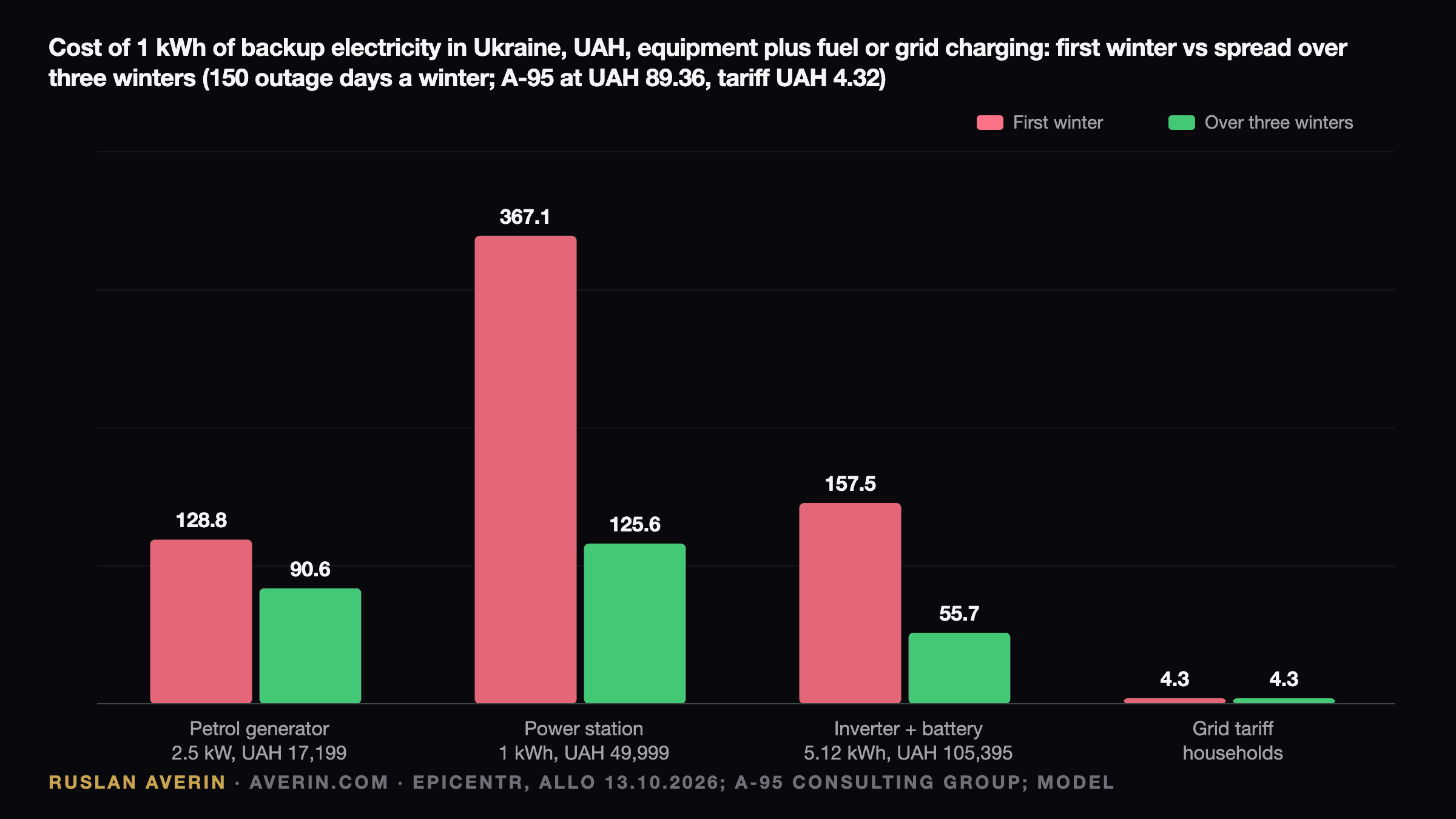
Over a single winter the 1 kWh station is the most expensive energy, at about UAH 367 per kWh, because UAH 49,999 is spread over only 138 kWh. Over three winters it falls to about UAH 126. Over its full rated life of 4,000 cycles it would fall to roughly UAH 18. The generator starts at UAH 129 but never drops below its fuel bill of about UAH 71.5. The home kit is cheapest over three winters, at about UAH 56, because it is used harder.
Flat versus house: the payback logic
No option pays for itself against grid power at UAH 4.32 per kWh. The return is avoided losses: lost working hours, spoiled food, a gas boiler that stops without its pump. It is a sizing decision, not an investment.
For a flat, there is usually nowhere to run a generator safely. The realistic choice is a 1–2 kWh power station that keeps a router, laptop, lights and phones going through a 4–6 hour window. Spread over three winters, a UAH 49,999 station costs about UAH 17,300 per winter including charging. It does not carry an electric cooker or a heater.
For a house, which can run a generator outdoors and must keep heating and well pumps alive, the maths differs. Over three winters at 2 kWh a day, a UAH 17,199 generator costs about UAH 27,200 per winter, most of it fuel at today's A-95 price. A Deye-class inverter with 5.12 kWh of storage costs about UAH 38,400 per winter over three winters before installation. It switches over automatically and can later be paired with a generator or solar panels. In analyst Ruslan Averin's view, a house facing outages of 16 hours or more needs both: the battery for the daily schedule, the generator for multi-day blackouts.
State programmes: what is actually open
The terms below were reported by Ekonomichna Pravda on 17 March 2026. Owners of private houses and townhouses could borrow up to UAH 480,000 for up to 10 years for a generator, a generator with storage, or a package that adds solar panels. The rate starts at zero in year one. The state compensates part of the loan principal one time: 20% for a generator, 25% for generator plus storage, 30% for the full package with solar. The scheme does not cover individual flats, and banks cap the house area at 250–300 square metres. Condominium associations (OSBB) can borrow up to UAH 3 million for generators, solar plants or heat pumps.
The grant side is weaker. The Energy Efficiency Fund paused new applications to its Energodim programme on 22 April 2026 to adapt it to the EU's Ukraine Facility rules, and no restart date had been announced as of late August. Frontline communities can also apply for the one-off winter support of UAH 19,400, roughly the price of an entry-level generator.
Related: Ukraine's heating season as a property question, fuel prices in October 2026 and September inflation and the National Bank of Ukraine.