
An investor who bought an apartment in a Kyiv new build at the pit stage eventually reaches a fork: exit before commissioning by assigning the rights, or wait for title registration and sell a finished apartment. The market discusses this fork in terms of price, at which stage the square metre is worth more. The Tax Code discusses it in terms of the base: before commissioning the tax is charged on the profit, after commissioning on the whole price. Those are different sums, often by a multiple.
Two legal forms, two taxes
Since October 2022 Law 2518-IX has provided for a special property right to a future property object: the right to a specific apartment in a building under construction is registered in the State Register of Property Rights before commissioning. Most Kyiv developers that opened sales after 2022 work this way. The old schemes, construction financing funds (FFB), forward contracts, derivatives and cooperative shares, survive in projects that started earlier.
Article 172 of the Tax Code explicitly covers the sale of a future property object and the assignment of rights under its sale contract where the price has been partly paid and an encumbrance registered in the buyer's favour. The rate is 18% PIT plus the 5% military levy. But one paragraph changes everything: income from such a sale may be reduced by documented costs of acquiring the object or the property rights.
Result: 23% of the difference between the sale price and the amount paid to the developer, provided the payments are documented and the seller files a return.
For the old schemes the picture is worse. The tax service treats the assignment of a claim under an FFB participation agreement as other income at the general 18% rate, and the position on cost deduction there is not spelled out in the Code as directly. A seller of such rights should assume the base is the full amount until a tax ruling says otherwise.
After commissioning: 10% of the price, not of the profit
Once title to the finished apartment is registered, the same deal becomes a sale of housing under clause 172.2: the holding period runs from registration, not from the investment contract, so the object is almost always "under three years old". The first sale of the year costs 5% PIT and 5% levy, 10% of the contract price, not below the appraised value. The Code allows no cost deduction at the 5% rate.
The three-year rule in detail is covered in a separate piece.
Where the line runs
Compare the tax on the same apartment. Sale price P, acquisition cost C.
- assignment before commissioning: 23% × (P − C);
- sale after registration: 10% × P.
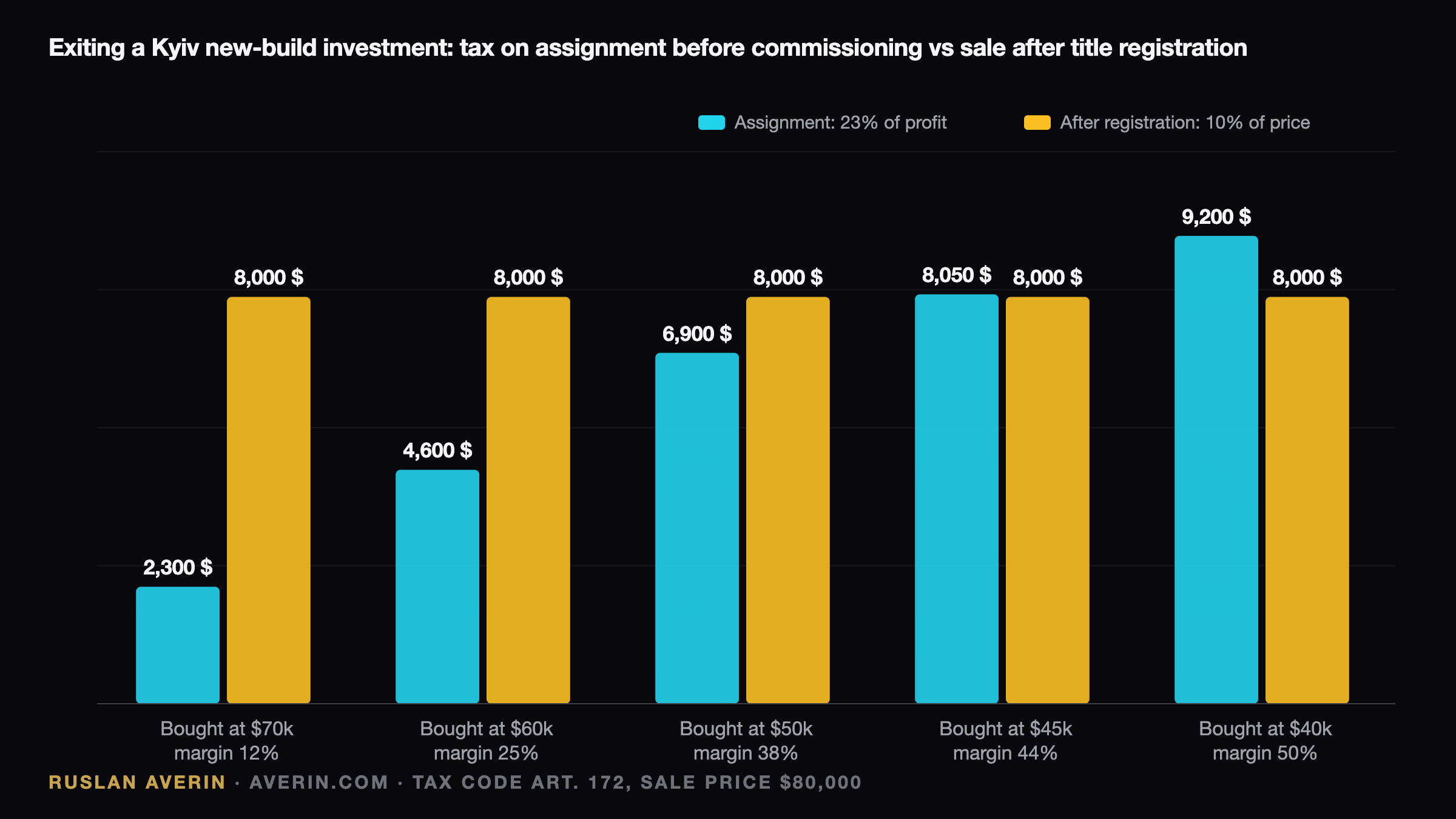
The two are equal when 0.23 × (P − C) = 0.10 × P, that is when the profit is 43.5% of the sale price. Below that line assignment is cheaper, above it a sale after commissioning.
| Bought for | Sold for | Profit | Tax on assignment (23% of profit) | Tax after registration (10% of price) | Cheaper |
|---|---|---|---|---|---|
| $60,000 | $75,000 | $15,000 | $3,450 | $7,500 | assignment |
| $50,000 | $80,000 | $30,000 | $6,900 | $8,000 | assignment |
| $45,000 | $80,000 | $35,000 | $8,050 | $8,000 | almost equal |
| $40,000 | $85,000 | $45,000 | $10,350 | $8,500 | after commissioning |
The typical price rise from pit to commissioning in Kyiv projects of 2024–2026 is 25–40% in dollars, according to listing platforms and the developers themselves. That is below the 43.5% line: for most investors assignment taxed on profit is cheaper than waiting for commissioning and selling at 10% of the whole price.
The calculation flips for those who entered in 2022–2023 at "wartime" prices and sell at a 50–70% margin: there, waiting for registration is cheaper.
What else goes into the cost of exit
Tax is not the only line. On assignment the developer almost always charges a re-registration fee: in Kyiv projects a fixed $1,000 to $3,000 or 1–3% of the price. Some contracts prohibit assignment before full payment or before a given construction stage.
A sale after commissioning adds title registration, appraisal and notary costs, and the buyer pays 1% to the pension fund and 1% state duty, which in a finished apartment are usually priced into the negotiation.
And above all, time. Between commissioning and title registration in Kyiv in 2025–2026 there were two to eight months: technical passport, address assignment, registration. An investor "waiting for commissioning to sell" is waiting not for the commissioning date but for the registration date, and the apartment earns no rent in the meantime.
A return is mandatory
The cost deduction is not applied automatically. The seller calculates the base, files the property and income declaration by 1 May of the following year with copies of payment documents, and pays the tax by 1 August. If the buyer of the rights is a company, it withholds tax as agent at 18% on the full amount, and the seller recovers the deduction through the return. Without documents proving payment to the developer, receipts, statements, acts, there is no deduction and the tax is charged on the full amount.
The encumbrance in the buyer's favour must be registered: without the entry in the register the deal falls outside the future-object paragraph and risks being reclassified as other income without a deduction.
How to read it
An investor in a new build chooses not only the moment of exit but also the tax base. Analyst Ruslan Averin suggests a simple order: before the deal, calculate the margin as a share of the sale price; if it is below 43%, exit by assignment with the cost deduction; if above, wait for registration and sell at 10%. In both cases the documents proving payment to the developer are the main asset, worth more than any finishing.
Related: investing in Kyiv new builds at the pit stage and every tax a property owner pays in Ukraine.