
Every year a share of Ukrainian apartments changes hands sooner than three years after purchase: a move, a divorce, an urgent need for cash, an investment flat bought at the pit stage and no longer wanted. The Tax Code does not forbid such a sale, but it charges 10% of the price for it, and unlike almost any other tax on income it charges it on the whole transaction, not on the gain.
That is the detail most sellers discover at the notary's desk. Below: how the rule works, from which day the three years run, where the rate becomes 23%, and when it pays to wait.
What Article 172 says
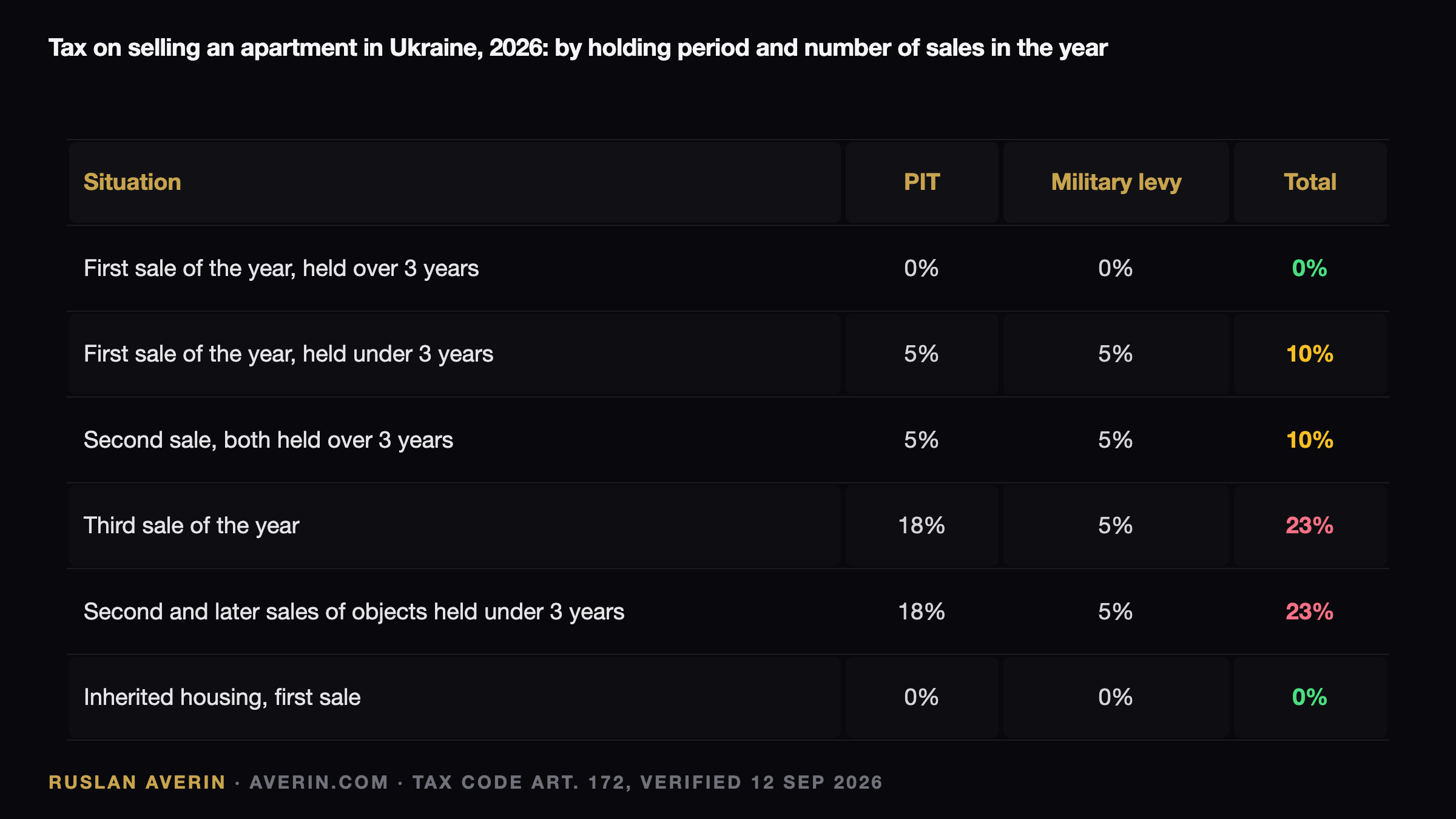
Clause 172.1 of the Tax Code exempts one sale of housing per calendar year provided the property was owned for more than three years. Everything outside that formula falls under clause 172.2, which carries two rates.
| Situation in 2026 | PIT | Military levy | Total |
|---|---|---|---|
| First sale of the year, held over 3 years | 0% | 0% | 0% |
| First sale of the year, held under 3 years | 5% | 5% | 10% |
| Second sale of the year, both held over 3 years | 5% | 5% | 10% |
| Third sale of the year of objects held over 3 years | 18% | 5% | 23% |
| Second and later sales of objects held under 3 years | 18% | 5% | 23% |
| Inherited housing, any sale | 0% / 5% | 0% / 5% | 0% first, 10% after |
The 5% military levy (the rate has applied since 1 December 2024; before that it was 1.5%) is charged only where PIT is charged. A sale at the zero rate carries no levy either.
The base is the contract price, but not less than the appraised value in the Unified Database of Valuation Reports. Understating the price on paper does not work: the notary is obliged to check it against the appraisal, and the tax is calculated on the higher of the two.
Why 10%, and not "10% of the profit"
A deduction for acquisition costs exists, but the Code allows it only for income taxed at 18%: the third and later sales, and the second and later sales of objects outside the exemption. At the 5% rate there is no deduction.
In practice: an apartment bought for UAH 2,700,000 two years ago sells for UAH 3,000,000. The gain is 300,000, but the tax is 5% and 5% of 3,000,000, which is UAH 300,000. The entire gain goes to the state. If the price did not rise at all, the seller pays the same 300,000 out of pocket.
That makes a sale inside three years a losing move almost whenever the price rose by less than 10% over the holding period. According to LUN, the median one-room apartment in Kyiv gained about 5% in dollars over the past year, so for a typical flat bought a year or two ago the tax swallows the whole gain and adds a loss on top.
From which day the three years run
The clock starts on the date of state registration of ownership, not the contract date, the payment date or the move-in date. Three traps follow.
New builds. An investor paid for the apartment in 2022, the building was commissioned in 2025, title was registered in December 2025. The three years end in December 2028, although the money went in six years earlier. A sale in 2026 is a sale of an object held under three years.
Gifts. The three-year condition is waived only for inheritance. A gifted apartment is counted from the registration of the recipient's title. If parents gifted a flat in 2024, a sale in 2026 is taxed at 10%.
Shares. Selling a share in an apartment is selling an object. Two shares of one apartment sold in the same year under separate contracts are counted by the notary as two sales.
Inheritance is the only exception: an inherited apartment can be sold on the day title is registered, and the first sale of the year is tax-free.
The second sale is the most expensive mistake
The counter runs per calendar year, not per object. An investor selling two apartments held under three years pays 10% on the first and 23% on the second. On a UAH 3,000,000 apartment the difference is UAH 390,000, purely because both deals closed in the same year.
Moving the second deal to January resets the counter. This is not a scheme and not an optimisation: the Code ties the rate directly to the year, and the notary applies it to the date the contract is certified. Analyst Ruslan Averin notes that this is the one tax lever available to a private seller without an adviser, and it is the one most often left unused, because the seller learns the rate on the day of the deal.
How the tax is paid
If the buyer is an individual, the seller pays the PIT and the levy personally, before notarisation. The notary checks the receipt and will not certify the contract without it. If the buyer is a company or a sole proprietor, it acts as tax agent and withholds the tax itself.
Since 1 January 2026 notaries must report every certified contract to the tax service quarterly: the parties, the address, the floor area, the price. Every transaction is visible to the tax authorities within a quarter, and a "forgotten" second sale surfaces automatically.
No return is needed if the tax was paid at certification: clause 179.2 exempts such income from declaration. The exception is a seller who uses the cost deduction at 18%: that seller files a return by 1 May and supports the costs with documents.
Sell now or wait out the three years
Waiting pays when the time left to the three-year mark is shorter than what the tax is "worth" in months of ownership. The arithmetic on a UAH 3,000,000 apartment:
- tax on a sale now: UAH 300,000;
- rent while waiting, if the apartment is let: about UAH 18,000 a month at the Kyiv median, roughly 14,000 after tax and vacancy;
- price after 12 months at 5% annual growth: plus 150,000.
A year of waiting brings around UAH 320,000 (rent plus price gain) against UAH 300,000 of tax that disappears. With up to 12–15 months to go, holding the apartment almost always beats selling with the tax. At 24 months or more the decision is no longer about the tax but about the price outlook and the need for cash.
The one scenario where a 10% sale is justified without a calculation is when the money retires debt at a higher rate, or when the property is losing more than 10% a year. Kyiv medians in 2026 show no such decline.
Non-residents
Clause 172.9 applies the same order to non-residents as to residents, but replaces the 5% rate with 18%. The exemption for the first sale of the year of property held over three years applies to them too. A non-resident selling an apartment held under three years pays 18% plus the 5% levy, 23% of the price. Residency status is worth establishing before the deal rather than at the notary's desk.
How to read it
Three years is not a period after which the tax "goes down"; it is the line between 0% and 10% of the entire price. For a typical Kyiv apartment the difference equals two to three years of rent. A seller with no hard reason to sell right now wins by counting not the tax but the months to the registration date plus three years. A seller with two objects wins by splitting the deals across calendar years. Everything else is detail the notary will settle.
Related: every tax a property owner pays in Ukraine, in one table and selling a new-build apartment before commissioning.