Lee Jae-myung took office on 4 June 2025 promising to lift the incomes of ordinary Koreans and to end the "Korea discount" on the stock market. Sixteen months later growth has tripled, exports are at records and the KOSPI is more than double its pre-inauguration level. But the boom rests on two chipmakers, real wages are falling, Seoul apartments keep rising, and on Tuesday 13 October stocks had their worst day since July.
Growth: from 1.0% to above 3%
The Bank of Korea puts 2025 growth at 1.0%, down from 2.0% in 2024. This year is very different. GDP grew 3.8% year on year in the first quarter and 3.7% in the second, with quarter-on-quarter growth of 1.8% and 0.6%. Real exports rose 8.9% in the second quarter, private consumption 2.4%.
In August the Bank of Korea raised its 2026 growth forecast to 3.3% from 2.6% and projected 2.9% for 2027. On 13 October the IMF matched it, lifting its 2026 forecast to 3.3% from 2.6% three months earlier and citing semiconductor exports.
Chips are half of all exports
The September trade data, released on 1 October by the Ministry of Trade, Industry and Resources, show how narrow the engine is. Exports rose 83.5% year on year to a record $120.9 billion. Semiconductor exports reached $60.3 billion, up 263% and almost exactly half of the total. Exports to the United States rose 137% to $24.33 billion and to China 123% to $26 billion. Cars fell 5.5% to $6.05 billion. The monthly trade surplus was a record $49.85 billion, and January–September exports passed $800 billion, already above the full-year 2025 record of $709.3 billion.
That is memory prices, not broad demand. Samsung Electronics and SK Hynix turn DRAM and high-bandwidth memory prices into Korean GDP, and the same two stocks now decide the KOSPI.
US tariffs: a deal, a threat, and the investment bill
The trade relationship with Washington has been rebuilt around a 15% tariff. In July 2025 the two governments agreed to cut reciprocal and auto tariffs on Korean goods to 15%, effective 1 November 2025. Seoul committed $350 billion of investment in the United States, of which $150 billion is for shipbuilding, to be deployed at about $20 billion a year. In late January 2026 President Trump threatened to raise tariffs on Korea to 25%, saying the National Assembly had not yet formalised the deal; parliament then passed a special act to implement the investment pledge in March.
Rates and the won
The Bank of Korea held its base rate at 2.50% for seven straight meetings into April, then turned. It raised the rate to 2.75% on 16 July, the first increase since January 2023, and to 3.00% on 27 August, citing inflation above target, oil prices and household credit. Consumer prices rose 3.2% in June, 3.1% in August and 2.9% in September.
The won ended 2025 at about 1,438 per dollar, weakened to about 1,554 in early June and was at about 1,339 on 13 October (Yahoo Finance), roughly 7% stronger than in January.
KOSPI: from 2,699 to 9,115 and back to 6,035
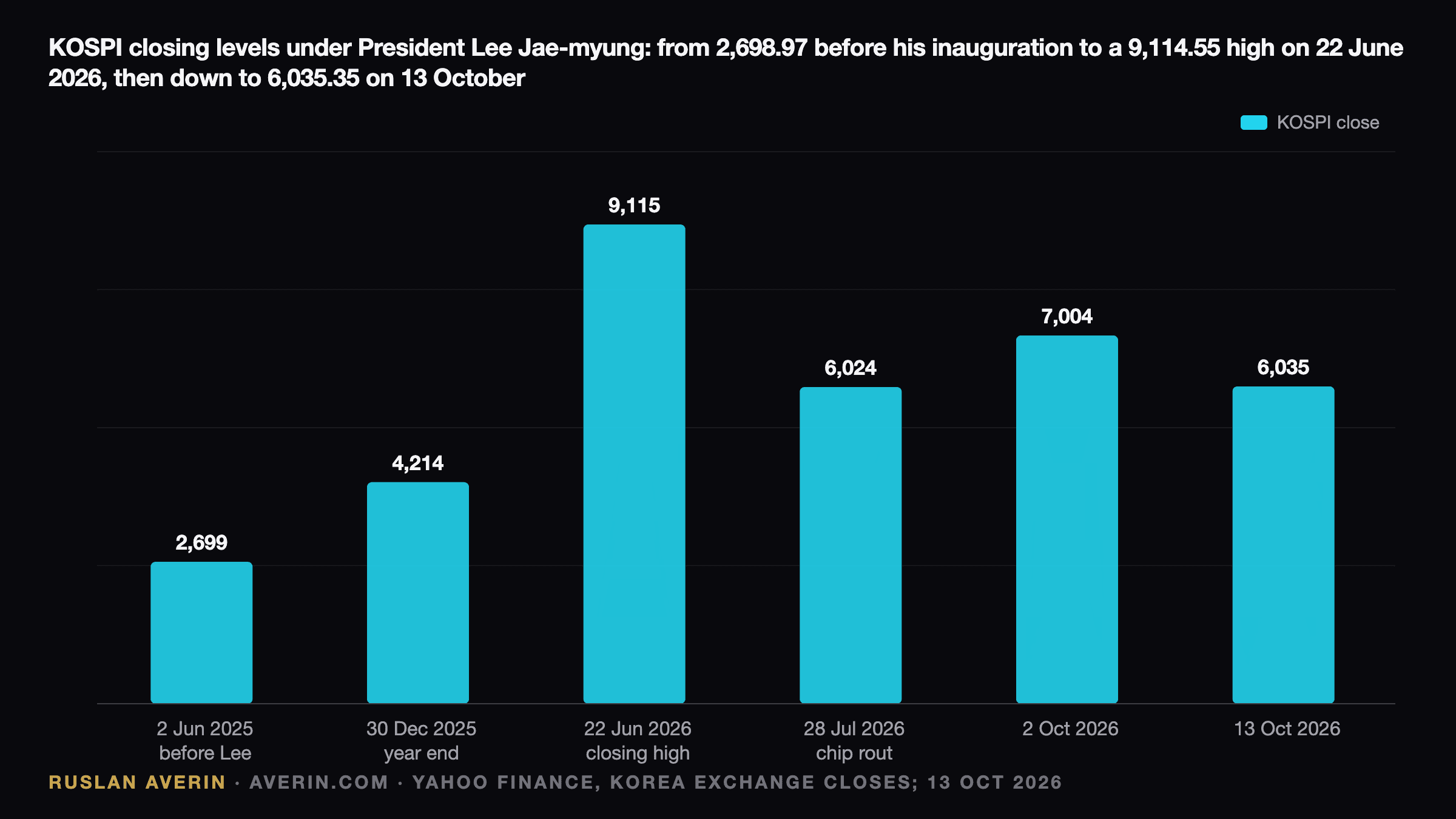
The KOSPI closed at 2,698.97 on 2 June 2025, the last session before Lee took office. It ended 2025 at 4,214.17 and reached a closing high of 9,114.55 on 22 June 2026. Then came a 10.84% fall to 6,023.66 on 28 July after Wall Street's memory-stock sell-off, a recovery to 7,003.74 on 2 October and a new slide.
The index closed on Monday 12 October at 6,384.24 and on Tuesday 13 October at 6,035.35, down 5.46% on the day, after briefly trading as low as 5,911.11 and triggering a sell-side trading curb. Samsung Electronics closed at 232,000 won, down 7.39%, and SK Hynix at 1,443,000 won, down 10.09%, after China's CXMT reported progress on a next-generation memory cell and investors questioned how long the memory upcycle can last. The KOSPI is still 43% above its end-2025 level and 124% above where it stood before Lee's inauguration, but 34% below the June high.
The governance reform behind the "Korea premium"
Part of the rerating was policy. The Value-up programme of 2024 asked listed companies to publish plans to lift shareholder returns; Lee's majority changed the law. In 2025 the National Assembly amended the Commercial Act twice: directors now owe a fiduciary duty to shareholders, not only to the company, electronic shareholder meetings became mandatory, and voting rules for board elections were changed in favour of minority investors. In February 2026 a further revision made the cancellation of treasury shares mandatory, removing a tool that chaebol families used to defend control.
Our analysts see this as Korea's version of the Tokyo Stock Exchange's price-to-book push: it changes the incentive to hoard cash, but works slowly and depends on enforcement.
Wages: the average worker and the minimum wage
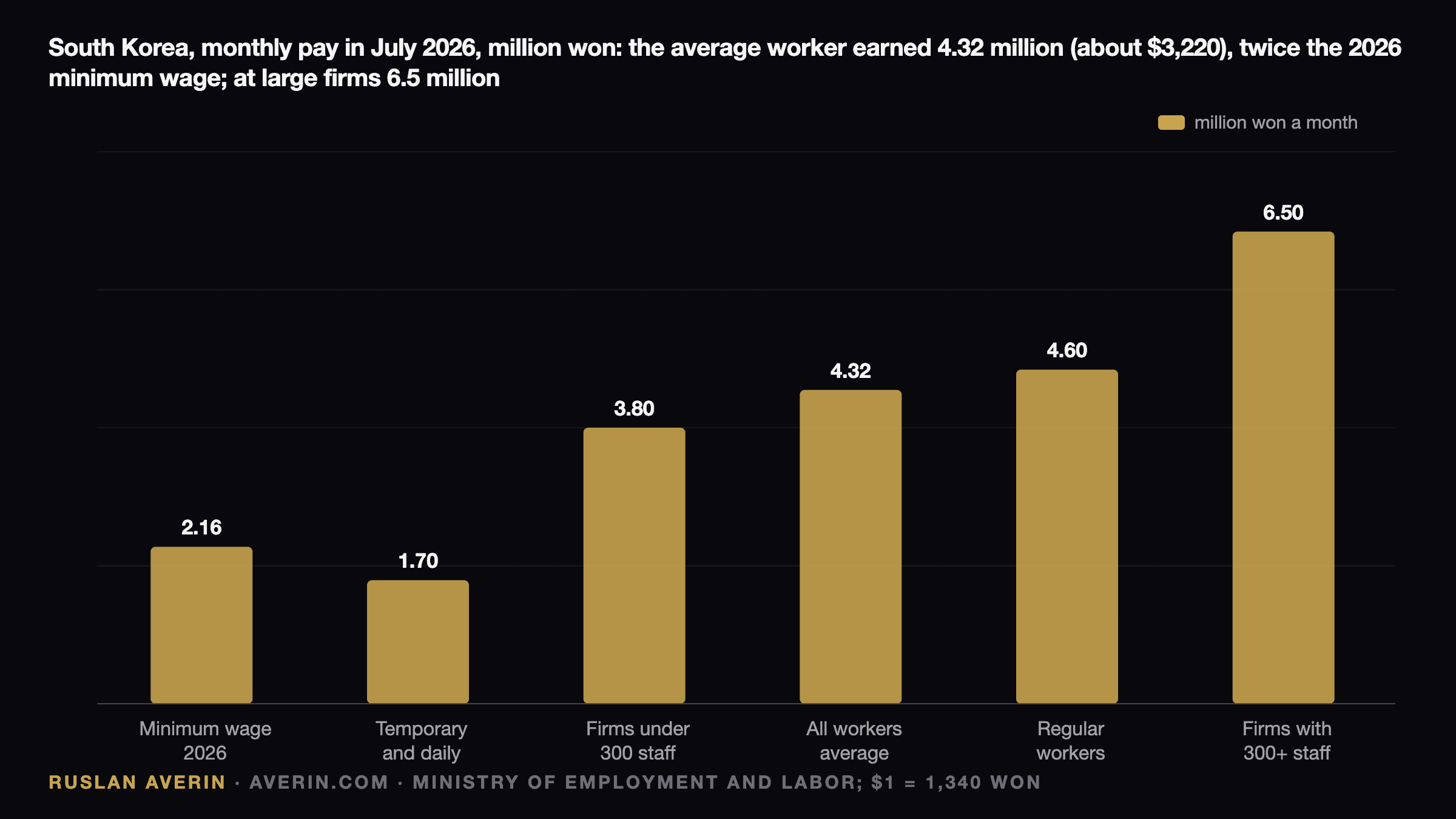
According to the Ministry of Employment and Labor's monthly labour survey, the average worker at a firm with at least one employee earned 4.316 million won in July 2026, up 2.5% from a year earlier. At 1,340 won per dollar that is about $3,220 a month. Adjusted for inflation, real wages fell 0.3%, the fourth monthly decline in a row. Regular workers averaged 4.6 million won, temporary and daily workers 1.7 million won. At firms with 300 or more employees the average was 6.5 million won (about $4,850), at smaller firms 3.8 million won (about $2,840); large-firm pay rose 3.3%, small-firm pay 1.7%.
The 2026 minimum wage is 10,320 won an hour, up 2.9% from 10,030 won. On the standard 209-hour month that is 2,156,880 won, or about $1,610. On 14 July 2026 the Minimum Wage Commission set the 2027 rate at 10,700 won, up 3.7%, in a 17-to-11 vote; the monthly equivalent will be 2,236,300 won, about $1,670. For a government elected on a promise to the poor, the arithmetic is uncomfortable: pay rises of 2.5–3.7% against inflation near 3% leave most households where they were, while the chip windfall shows up in profits.
Household debt and Seoul housing
Household loans at the five largest banks fell by 1.28 trillion won in September to 780.83 trillion won, the first decline in six months, while home-backed loans still edged up to 621.39 trillion won. Since June 2025 housing-backed loans in the Seoul area have been capped at 600 million won.
House prices have not followed. Korea Real Estate Board data show Seoul apartment prices rising for a record 87th straight week, by 0.12% in the latest week and 8.31% since the start of the year. The pattern has shifted: Gangnam, Seocho and Songpa fell 0.34%, 0.27% and 0.19% in the week, while outer districts such as Seodaemun and Gangbuk rose about 0.35%.
What it means for investors
For foreign investors Korea is mostly a chip bet. The iShares MSCI South Korea ETF (EWY) closed on Monday 12 October at $170.11, up 75% from $97.22 at the end of 2025 but 22% below its closing high of $219.20 on 18 June. As of 9 October SK Hynix made up 24.10% of the fund and Samsung Electronics 23.48%, so nearly half of EWY rides on two memory makers. Tuesday's 5.46% fall in Seoul is not yet in that price.
In analyst Ruslan Averin's view, three numbers decide the next leg. The team would watch the Bank of Korea on 22 October for a third hike or a pause; monthly chip exports against the $60.3 billion September level, as the first sign of whether memory prices are peaking; and the won near 1,340, because a stronger currency adds to dollar returns but squeezes exporters. The governance reform justifies a higher multiple than before 2025; it is no protection against a memory downcycle.
Related: Japan's TSE reform and the price-to-book push, the August chip sell-off and Micron and the HBM cycle.