
JPMorgan Chase reports third-quarter 2026 results before the US open on Tuesday 13 October, with the conference call at 8:30 a.m. New York time. It opens the season for the big banks, alongside Wells Fargo and Citigroup the same morning. The shares closed on Friday 9 October at $332.99, up 3.3% from the end of 2025 but 8.8% below their closing high of $365.18 on 12 August.
The quarter is not about whether JPMorgan beats. It has beaten EPS consensus in each of the last two quarters by a wide margin. It is about how much of the second-quarter record was a one-off, what the bank now says about net interest income for 2026, and how Jamie Dimon describes an economy living with a 10-year Treasury above 5%.
Update, 13 October 2026: the results
JPMorgan Chase missed. Third-quarter EPS was $5.57 against the FMP consensus of $5.93 quoted above, a shortfall of $0.36, or about 6%. The bank booked $658 million of net investment securities losses, worth $0.18 a share; excluding them EPS was $5.75, still $0.18 short. Net income was $15.3 billion, up 6% year on year, and managed revenue was $50.9 billion, up 8% but below the $51.2 billion consensus.
| Metric | Consensus | Actual |
|---|---|---|
| EPS (diluted) | $5.93 | $5.57 ($5.75 excl. securities losses) |
| Managed revenue | $51.2B | $50.9B |
| IB fees | $3.0–3.1B (implied by Petno) | $3.0B, +14% |
| Markets revenue | $10.2–10.6B (implied by Petno) | $10.3B, +15% |
| FY2026 NII guidance | ~$105.5B (July) | ~$106.2B implied |
| Card Services NCO rate | ~3.2% (FY guidance) | 2.91% |
On the lines I flagged, the picture is mixed. NII was $27.1 billion, up 13%, and the bank lifted implied full-year NII to about $106.2 billion and NII excluding Markets to about $97.2 billion, from $96.5 billion. Its preliminary 2027 central case is about $107 billion of NII excluding Markets, driven by "balance sheet growth and higher rates". IB fees landed at the bottom of the range; in Markets, fixed income fell 4% and equities rose 49%. Implied adjusted expense rose to about $108.6 billion from $107.5 billion. Credit costs were $2.7 billion, including a $539 million reserve build, mostly in Wholesale. Net buybacks fell to $664 million from $6.2 billion.
Dimon said Markets revenue and IB fees "each rose at a mid-teens rate", "although activity did moderate somewhat during the quarter". On the economy: "These forces may be manageable, but we remain prepared for a wide range of outcomes." In pre-market trading on Tuesday the shares were down about 3.5%, according to CNBC.
What it changes. I read this as a quality-of-earnings miss, not a franchise problem: the securities losses were discretionary in the bank's own words, NII guidance went up and 2027 is framed around higher rates. But expense guidance rose by $1.1 billion against a $0.7 billion NII raise, fixed income shrank and buybacks were cut to a trickle. For the sector the read is that the rate tailwind holds while the trading boom cools.
What the consensus expects
The analyst consensus compiled by Financial Modeling Prep (FMP) is EPS of $5.93 on revenue of $51.2 billion, from nine analysts for EPS. A Hudson Labs preview puts managed revenue at $50.8 billion and EPS at $5.86. Either way, the bar sits well above a year ago: in the third quarter of 2025 JPMorgan earned $5.07 a share on managed revenue of $47.1 billion. Meeting $5.93 means EPS growth of about 17% year on year.
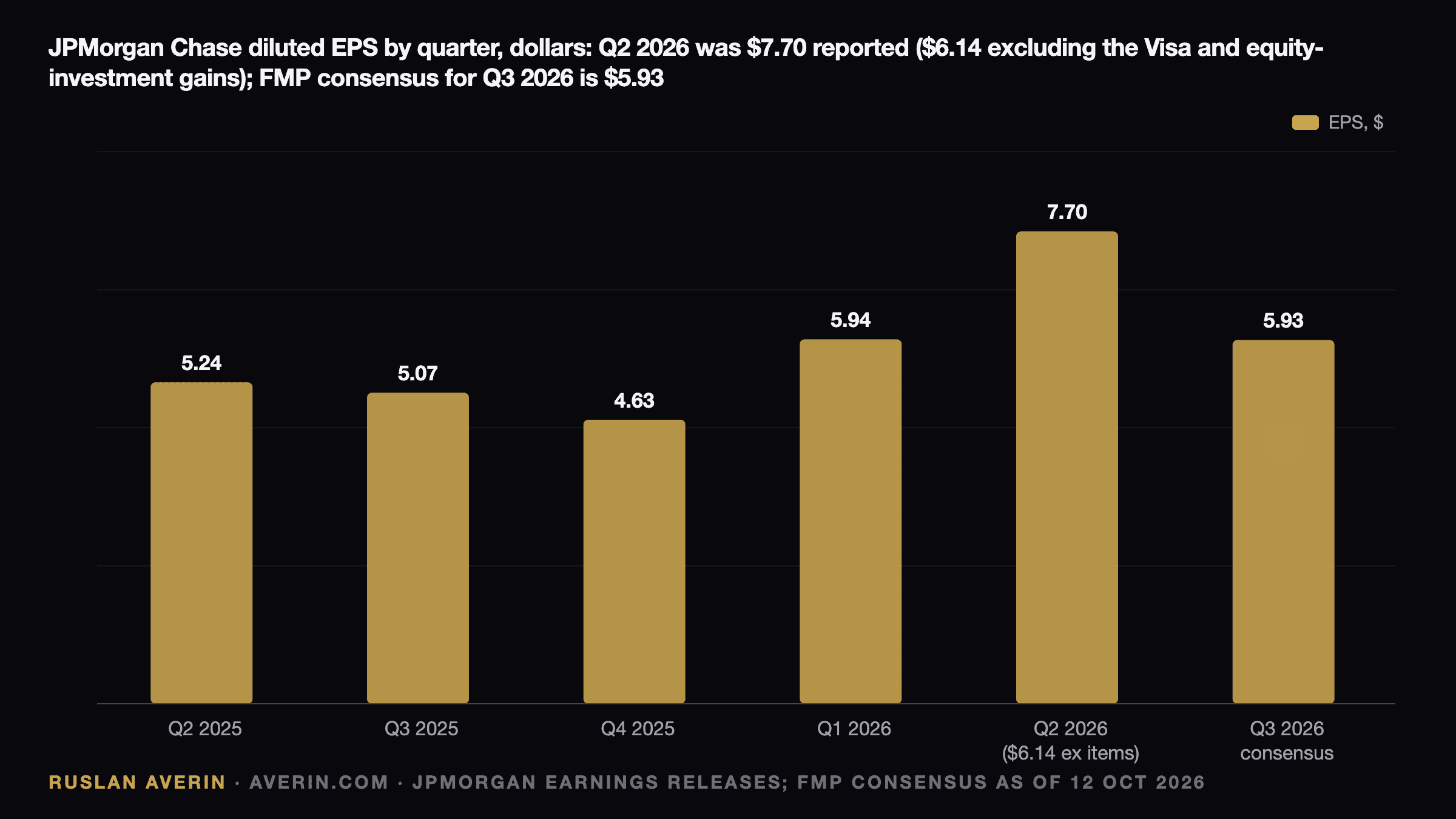
The comparison with the second quarter needs care. JPMorgan reported net income of $21.2 billion, or $7.70 a share, on managed revenue of $58.0 billion. That included a $4.6 billion net gain on Visa shares and about $1.0 billion of gains on certain equity investments. Excluding them, net income was $16.9 billion and EPS $6.14. So the right sequential comparison for $5.93 is $6.14, not $7.70: the consensus already assumes a modest seasonal step down.
Net interest income: the guidance line
After the second quarter JPMorgan raised its full-year 2026 guidance for net interest income to about $105.5 billion, and to about $96.5 billion excluding Markets, from roughly $103 billion and $95 billion earlier. It also raised adjusted expense guidance to about $107.5 billion and cut the expected Card Services net charge-off rate to about 3.2%.
Second-quarter NII was $25.6 billion, up 10% year on year, and NII excluding Markets was $23.7 billion, up 4%. Annualised, $25.6 billion is $102.4 billion. Hitting $105.5 billion therefore requires second-half NII to run above the second-quarter level. That is the first number I would look for on Tuesday: whether the bank holds, raises or trims the $105.5 billion and the $96.5 billion.
The rate backdrop has moved since July. The Fed raised the federal funds target range to 3.75–4.00% on 16 September, the first increase since 2023. On Friday 9 October the 10-year Treasury yield closed at 5.24% and the 3-month bill at 4.25%, according to the Treasury's daily par yield curve. A steeper curve and higher short rates are, on paper, good for a bank's asset yields. The offset is deposit costs: if customers keep moving cash into higher-yielding products, the margin gain shrinks. Any comment on deposit pricing and on balance growth matters as much as the headline NII figure.
Investment banking and Markets: what management already said
On 15 September, at the Barclays Global Financial Services Conference, co-president Doug Petno said JPMorgan expected both investment banking fees and Markets revenue to rise by a mid-to-high-teens percentage year on year in the third quarter, while total revenue would decline from the second quarter on normal seasonal patterns.
The base is known. In the third quarter of 2025 IB fees were $2.6 billion and Markets revenue was $8.9 billion, of which $5.6 billion came from fixed income and $3.3 billion from equities. Growth of 15–19% puts IB fees at roughly $3.0–3.1 billion and Markets at roughly $10.2–10.6 billion. In the second quarter IB fees rose 30%, which Dimon called the highest level since 2021, and Markets revenue rose 35% to $12.1 billion, with equities up 86%.
A result at the top of Petno's range would confirm that the deal pipeline he described has carried through the quarter. A result below "mid teens" would be read as the second-quarter surge pulling business forward, and that is where the sequential decline could look worse than the consensus assumes.
Credit, capital and buybacks
Credit has not been the problem. Second-quarter net charge-offs were $2.4 billion, down $44 million from a year earlier, and the Card Services charge-off rate was 3.34%, against full-year guidance of about 3.2%. The provision was $2.5 billion. Any build in reserves tied to the macro outlook would be read through to the rest of the sector.
Capital is the other lever. The CET1 ratio was 14.1% at the end of June, return on tangible common equity was 29% reported and 23% excluding the gains, and the bank bought back a net $6.2 billion of stock in the quarter. Tangible book value per share was $113.35, up 10% year on year. JPMorgan has said it intended to raise the quarterly dividend to $1.65 from the third quarter. With CET1 that high, the question analysts will ask is why buybacks are not larger, and the answer usually involves Dimon's view that the stock is expensive relative to book.
Dimon on the economy, and the succession
In July Dimon said the US economy "has demonstrated notable resiliency this year, with stronger business investment and hiring", but warned that "several risks are shifting below the surface like tectonic plates", including geopolitical tensions and wars, sticky inflation, large fiscal deficits and elevated asset prices. Since then the Fed has hiked and long yields have gone above 5%. His language on Tuesday is the closest thing the market has to a read of large-bank credit committees.
The succession is the other thread. On 25 June JPMorgan named Doug Petno and Troy Rohrbaugh co-presidents: Petno became sole CEO of the Commercial & Investment Bank and Rohrbaugh moved to run Consumer & Community Banking. Marianne Lake, long seen as a front-runner, is retiring at the end of the year. Dimon, 70, called it "an important step in our Board's thoughtful process around succession planning". No date has been given; a source quoted by Reuters suggested he could stay as CEO for about three more years. Any new detail on timing would matter for the stock's multiple more than any single quarter.
How the stock got here, and the scenarios
JPMorgan rose 2.5% on the day of its second-quarter report, 14 July, closing at $342.89. It then peaked in August and fell back with the rest of the sector after the Fed hike: from the close on 15 September to 9 October the stock lost 5.5% and the KBW Bank index lost 7.2%.
In analyst Ruslan Averin's view three lines decide the reaction:
- NII guidance. A raise above $105.5 billion, or an explicit statement that the higher curve helps 2027, supports the stock. A trim signals deposit costs are eating the rate gain.
- IB fees versus $3.0–3.1 billion. The top of Petno's range keeps the "capital markets reopening" story intact.
- Expense guidance of about $107.5 billion. A further increase without a matching revenue raise would be read as margin pressure.
If all three come in line, I would expect a muted move: the stock already trades on a consensus that assumes 17% EPS growth. The asymmetric case is a cut to NII guidance combined with a cautious Dimon, because the sector has already shown it sells off on rates.
Related: the Q2 2026 big-bank earnings read-through, the Fed's 16 September hike to 3.75–4.00% and the 10-year Treasury at 5%.