
From 1 January 2027 a Ukrainian who turns 60 will need 34 years of insured service to receive an old-age pension, one more than this year. The news ran across the Ukrainian press over the weekend as if it were new. It is not: the ladder was written into article 26 of Law 1058-IV in 2017 and has risen by a year every January since. What is new is where the ladder now sits relative to real careers, and what the alternatives cost.
Our analysts went through the law, the Pension Fund's statistics and the price list for buying service. This is the practical version.
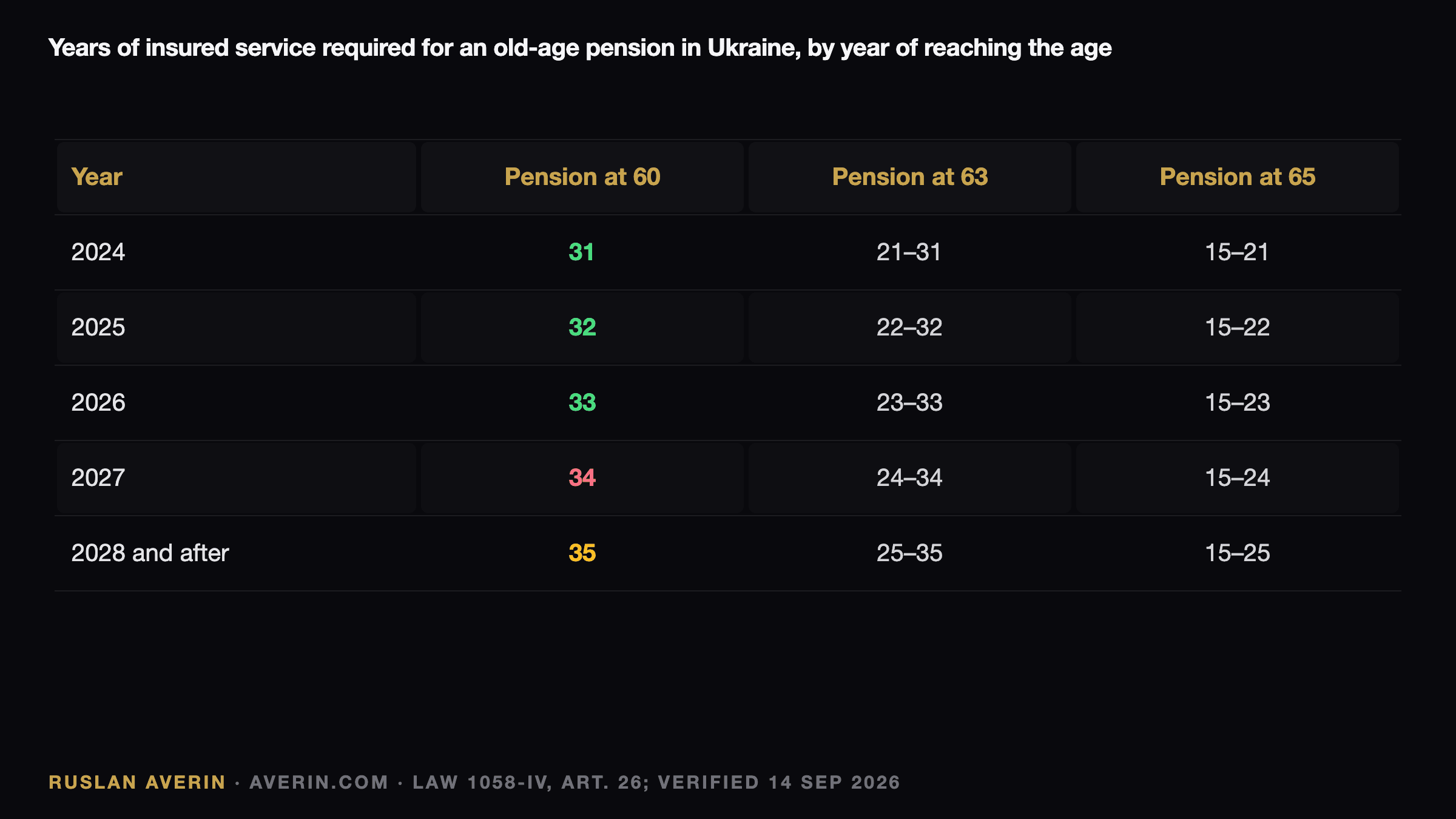
The ladder, year by year
| Year | Pension at 60 | Pension at 63 | Pension at 65 |
|---|---|---|---|
| 2024 | 31 years | 21–31 | 15–21 |
| 2025 | 32 years | 22–32 | 15–22 |
| 2026 | 33 years | 23–33 | 15–23 |
| 2027 | 34 years | 24–34 | 15–24 |
| 2028 and after | 35 years | 25–35 | 15–25 |
Two details matter more than the headline. The right is fixed on the day you reach the age: if at 60 you have 33 years in 2027, you do not qualify at 60 and are assessed again at 63 against the 63-year window. And from 2028 the ladder stops: 35 years for 60, 25 for 63, 15 for 65, plus a new rule that 40 years of service earns a pension at any age.
Insured service is not the same as employment. It is months in which contributions were actually paid on at least the minimum wage. A year on a half-rate contract, a year of grey salary, a year abroad without a bilateral agreement, do not count in full. That is why people who have "worked all their life" find 29 years in the register.
Who falls short
The Pension Fund's register in May 2026 had 9.34 million people with contributions paid and 9.98 million pensioners on 1 July: 0.94 workers per pensioner. In 2020 there were 114 workers per 100 pensioners, in 2025 there are 106. The number of pensioners has fallen from 13.5 million in 2014 to under 10 million, and the number of contributors has fallen faster.
The people who hit the 34-year wall in 2027 are those born in 1967, and among them the ones with careers that started in the 1990s in cash, or that included years abroad, or that were spent as a self-employed person paying the minimum. For a woman born in 1967 who started work at 20, 34 years means no gap longer than six years across the whole career, including maternity leave that was not credited in full.
What falling short costs
There are three outcomes, and the law prices all of them.
Wait. At 60 with 24–33 years you qualify at 63; with 15–23 you qualify at 65. In between, a means-tested temporary social allowance is available up to 100% of the subsistence minimum for persons unable to work, 2,595 UAH a month in 2026 against 3,328 UAH for the able-bodied, and only if household income per person is below that figure. Three years of waiting on the allowance instead of the average pension is about 168,000 UAH of forgone income.
Fewer than 15 years at 65. The state allowance for people with no right to a pension is 30% of the subsistence minimum: 778.50 UAH a month in 2026, for the low-income only.
Buy. A voluntary contribution contract at the 22% unified contribution on the minimum wage of 8,647 UAH costs 1,902.34 UAH a month, 22,828 UAH a year, for periods going forward. Past periods back to 2004 can be bought at double the rate, 3,804.68 UAH a month, 45,656 UAH a year, paid within ten days of signing. Children can sign for parents. One year bought at 22,828 UAH returns 7,273 UAH a month at the average pension, so it pays back in a little over three months of payments; even the past-period price of 45,656 UAH pays back in about six. A bought year has one limit: it counts toward the right to a pension but not toward the minimum pension or the 1% bonus per year above 35.
What the pension is worth
The average assigned pension was 7,272.68 UAH on 1 July 2026. The distribution is the more honest figure: 3.4% receive under 3,000 UAH, 24.0% between 3,001 and 4,000, 17.2% between 4,001 and 5,000. Nearly 4.5 million people, 44.6% of all pensioners, live on less than 5,000 UAH a month. The regional spread runs from 9,901 UAH in Kyiv to 5,657 UAH in Ternopil region.
Against a July average wage of 30,961 UAH the replacement rate is 23.4%. In July 2020 it was 28.8%. The minimum pension is 2,595 UAH in 2026, with 2,878 UAH planned for 2027 and 3,357 for 2029; the 2027 minimum wage in the finance ministry's letter is 9,546 UAH, up from 8,647 UAH in 2026. The draft 2027 budget goes to parliament on 16 September.
What replaces it
The funded pillar has been announced for years and does not yet exist in law. The social policy ministry's concept has the framework law starting on 1 January 2027 and contributions from 1 January 2028, with a basic payment of 3,000 UAH; no government bill had been registered as of 14 September. What is registered is bill 15570 of 28 August on voluntary pension funds, with the finance committee, and a start date of 2028. The existing private funds hold 7.6 billion UAH for 889,000 participants, less than 800 UAH per person.
That leaves the household's own balance sheet. On today's numbers a hryvnia government bond pays 15–16% with no tax; a dollar bond about 4%; a one-room flat in Kyiv, as covered on this site, nets about 4% in rent after tax. A monthly 1,902 UAH placed in bonds for 25 years at an average 10% compounds to about 2.5 million UAH in nominal terms, against a bought year of service that adds nothing to the pension's size and only to the right to receive it. The two are not substitutes: one buys eligibility, the other buys income. Someone with 30 years at 55 needs both, in that order.
In analyst Ruslan Averin's view the 2027 threshold is not a policy shock but an actuarial statement. With 0.94 contributors per pensioner and a replacement rate of 23.4%, the state pension has become a floor, and the ladder to 35 years is how the state says so. Buying the missing years is cheap; relying on what they buy is not.
Related: nine weeks of NBU dollar sales, apartment prices doubled in seven years and four ways to invest in Kyiv.