
Bearish on SPY but don't want to pay $800 for a put? A bear put spread costs $400, profits the same if the market falls, and caps your max loss before you place the trade.
When You Think the Market Will Fall
Not every trade is bullish. Sometimes the data is clear: resistance overhead, earnings miss expected, a technical breakdown below support. You want to profit from a decline, but buying a naked put is expensive and punishing if you are wrong about the timing.
A put option on SPY at $500 strike might cost $8.00 — $800 per contract. That is a lot of capital to commit when you are expecting a 3 to 5 percent correction, not a market crash. And if SPY grinds sideways for three weeks and your put loses $300 from time decay alone, you start questioning the thesis even when you are directionally correct.
There is a smarter way to express bearish views: the bear put spread.
What Is a Bear Put Spread?
A bear put spread — also called a debit put spread or vertical put spread — is an options strategy built from two simultaneous trades on the same underlying asset and the same expiration date:
- Buy a put at a higher strike price (your bearish bet)
- Sell a put at a lower strike price (this reduces your net cost)
You pay a net debit for the spread. That net debit is also your maximum possible loss. If the underlying falls to or below your short strike, you collect the maximum profit.
The result is a structured, defined-risk bearish trade where every number is known upfront.
Construction: Buy High Strike Put, Sell Low Strike Put
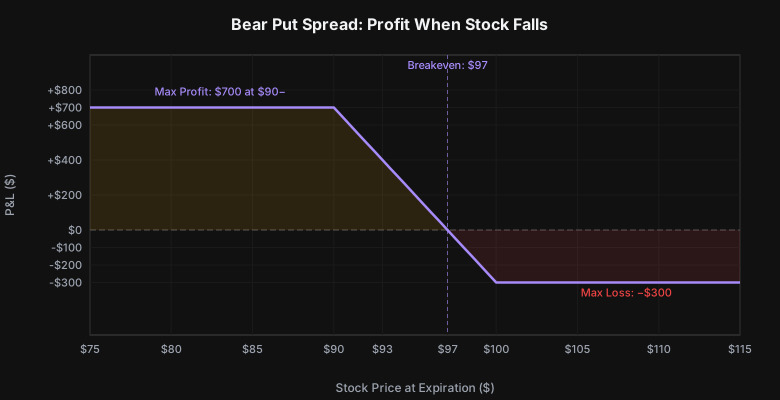
The mechanics mirror a bull call spread but in reverse. You buy the higher strike put and sell the lower strike put, both with the same expiration. The premium you collect from the short put offsets part of the cost of the long put.
The spread width (difference between strikes) minus the net debit equals your maximum profit per share.
The formulas:
- Net debit = Premium paid for long put minus premium received for short put
- Max profit = (Higher strike minus Lower strike) minus Net debit
- Max loss = Net debit
- Breakeven = Higher strike minus Net debit
A concrete example to anchor the math before the SPY trade below.
A Real Example: SPY Bear Put Spread
SPY is trading at $500. You are moderately bearish — expecting a 3 to 5 percent decline over the next 35 days. You do not need SPY to crash. You just need it to fall to $490.
Here is the trade:
- Buy the SPY $500 put (35 days to expiration) for $8.00 — you pay $800
- Sell the SPY $490 put (same expiration) for $4.00 — you collect $400
Net debit paid: $8.00 minus $4.00 = $4.00 per share, or $400 per contract.
You have cut your cost by 50 percent compared to buying the naked $500 put.
Max Profit, Max Loss, and Breakeven
With the SPY $500/$490 bear put spread at $4.00 net debit:
Max profit: ($500 minus $490) minus $4.00 = $6.00 per share = $600 per contract. Achieved when SPY closes at or below $490 at expiration.
Max loss: $4.00 per share = $400 per contract. This is your net debit. Occurs when SPY closes at or above $500 — both puts expire worthless.
Breakeven: $500 minus $4.00 = $496.00. SPY only needs to fall $4 from the $500 level to break even.
Risk to reward: Risk $400 to potentially make $600. A 1:1.5 ratio.
Bear Put Spread vs Buying a Naked Put
Why not just buy the $500 put for $8.00?
With the naked $500 put at $8.00 per share ($800 per contract):
- Cost: $800
- Breakeven: $492 ($500 minus $8)
- Max profit: $492 per share if SPY goes to zero (theoretical)
- Max loss: $800
With the $500/$490 bear put spread at $4.00 net debit ($400 per contract):
- Cost: $400 (50 percent less)
- Breakeven: $496 (higher breakeven — starts profiting sooner)
- Max profit: $600 (capped at $490 strike)
- Max loss: $400
The naked put wins if SPY collapses catastrophically — say from $500 to $440. In that scenario, the naked put would be worth over $60 while the spread caps out at $6. But most bearish trades are thesis-driven with a target level, not bets on crashes. If your target is $490, the spread captures the same dollar profit at half the cost.
During the 2022 correction, SPY dropped from $480 to $360. A bear put spread at $480/$460 on that move returned $1,600 on a $400 investment — a 300 percent return. You did not need the full catastrophic move to see extraordinary returns on capital invested.
Best Conditions for Bear Put Spreads
Not every market environment is equal for this strategy. The bear put spread performs best under specific conditions.
High implied volatility is ideal. When IV is elevated, options premiums are expensive. Selling the lower strike put gives you a meaningful credit that significantly reduces your net debit. In a calm, low-IV environment, you collect less from the short put and your net debit is only slightly reduced from the naked put price.
A stock with clear technical resistance overhead is a strong setup. When a stock has failed twice at the same resistance level and volume is declining on bounces, the structural bearish case is clearer. Pair that with elevated IV from uncertainty and you have the best conditions for a bear put spread.
An expected earnings miss is another high-probability setup. When consensus expectations are too optimistic and guidance is likely to disappoint, a bear put spread positioned just above the current price can profit significantly if the stock gaps down on earnings.
The market technically broken below support is perhaps the clearest signal. When a major index breaks below a key moving average on high volume after a failed retest, that is a high-probability setup for a 3 to 5 percent decline — exactly the move a bear put spread is built to capture.
Choosing Your Strikes
Strike selection follows the same logic as the bull call spread, reversed.
For the long put (higher strike), choose at-the-money or slightly in-the-money relative to the current price. ATM gives 50-delta exposure and a relatively tight breakeven. Slightly OTM reduces cost but requires a bigger downward move.
For the short put (lower strike), set it near your price target for the move. If you expect SPY to fall from $500 to $490, the $490 strike as your short put captures your thesis perfectly.
Spread width guidance:
- Use 30 to 45 days to expiration
- Choose a spread width that matches your expected move — a $10 wide spread if you expect a $10 decline
- The net debit should be 30 to 50 percent of the spread width for healthy risk/reward
- A $4 debit on a $10 wide spread (40 percent) is a reasonable structure
For liquid underlyings like SPY, QQQ, or large-cap stocks with tight bid-ask spreads, you can build well-priced spreads consistently. Avoid illiquid options where wide bid-ask spreads eat into your theoretical edge.
Managing and Exiting the Trade
The exit rules mirror the bull call spread in structure.
Take profit at 50 percent of maximum profit. With a $600 maximum profit spread, close when you have captured $300 in gains. You eliminate the risk of a reversal and lock in a meaningful return.
Cut losses at 50 percent of premium paid. If you paid $400 and the spread falls to $200 in value, close for a $200 loss. You preserve capital for higher-conviction setups rather than riding a losing trade to zero.
If the underlying is approaching your short strike rapidly, consider closing early and taking the gain. The final week before expiration can be volatile, and a sudden reversal in the last few days can convert a near-maximum-profit trade into a smaller gain.
Rolling is also an option if your timing was wrong but the thesis remains intact. You can close the existing spread and re-open at later expiration for a small additional debit. This extends your time window without doubling your risk.
The bear put spread is the cleanest structure for defined-risk bearish trades. You pay less, break even sooner than a naked put, and define your maximum loss before you enter. For a moderate 3 to 5 percent bearish thesis on any liquid underlying, this is the structure I reach for first.
— Ruslan Averin