
Buying a naked call on SPY costs $800 and loses all if wrong. A bull call spread costs $400, keeps 60% of the upside, and defines your maximum loss before you place the trade.
The Problem with Buying Naked Calls
The naked call problem is easy to demonstrate with numbers. SPY at $495, the $500 call costs $8.00 — $800 out of pocket. The thesis: the market climbs. And it did. SPY moved from $495 to $503 in two weeks.
The position still lost money.
The problem was time decay. Every day that passed, the option lost value from theta erosion. SPY needed to reach $508 just for me to break even at expiration. A $3 gain in the underlying was not enough to overcome $8 in premium paid.
Naked calls have three structural problems for directional traders. First, premium is high — you pay for both intrinsic value and time value. Second, breakeven is far away. Third, in a high implied volatility environment, you overpay dramatically for the same directional exposure. When VIX is at 25, those options are expensive. You need a big, fast move to profit.
There is a cleaner solution: the bull call spread.
What Is a Bull Call Spread?
A bull call spread — also called a debit call spread or vertical spread — involves two simultaneous trades on the same underlying asset with the same expiration:
- Buy a call at a lower strike price (this is your bullish bet)
- Sell a call at a higher strike price (this offsets part of your cost)
Because you buy one option and sell another, your net cost is lower than buying a single call. The trade-off is that your profit is capped at the higher strike. You do not need the stock to keep climbing forever — you just need it to reach your target level by expiration.
The result is a trade where every key number — maximum loss, maximum profit, and breakeven — is known before you enter.
Construction: Buy Low Strike, Sell High Strike
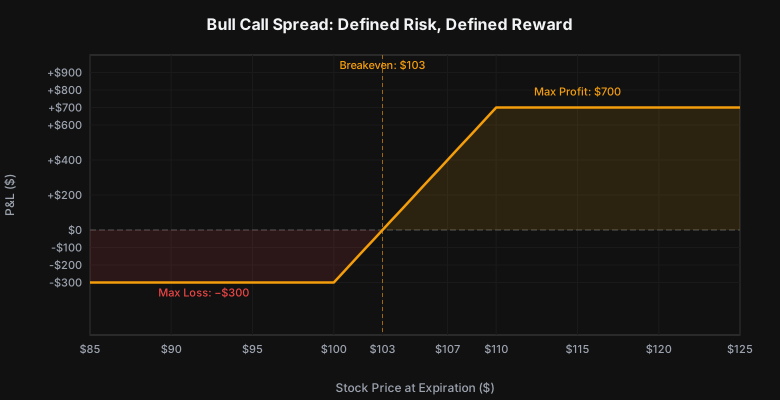
The mechanics are simple. You buy the lower strike call and sell the higher strike call, both with the same expiration date. The difference between what you pay and what you receive is your net debit — and that net debit is also your maximum possible loss.
The spread width (difference between the two strikes) minus the net debit equals your maximum profit per share. Multiply by 100 for the dollar amount per contract.
Here is the formula:
- Net debit = Premium paid for long call minus premium received for short call
- Max profit = (Higher strike minus Lower strike) minus Net debit
- Max loss = Net debit
- Breakeven = Lower strike plus Net debit
Everything is defined at entry. No margin calls. No surprises.
A Real Example: SPY Bull Call Spread
SPY is trading at $500. You are moderately bullish — expecting a 2 to 3 percent move higher over the next 35 days. You do not need SPY to explode. You just need it to reach $510.
Here is the trade:
- Buy the SPY $500 call (35 days to expiration) for $8.00 — you pay $800
- Sell the SPY $510 call (same expiration) for $4.00 — you collect $400
Net debit paid: $8.00 minus $4.00 = $4.00 per share, or $400 per contract.
You have reduced your cost by 50 percent compared to buying the naked $500 call alone.
Max Profit, Max Loss, and Breakeven
With the SPY $500/$510 bull call spread at $4.00 net debit:
Max profit: ($510 minus $500) minus $4.00 = $6.00 per share = $600 per contract. This is achieved if SPY closes at or above $510 at expiration.
Max loss: $4.00 per share = $400 per contract. This is the net debit paid. It occurs if SPY closes at or below $500 at expiration — both options expire worthless.
Breakeven: $500 plus $4.00 = $504.00. SPY only needs to move $4 from your entry to break even.
Risk to reward: You risk $400 to potentially make $600. That is a 1:1.5 ratio — you make 50 percent more than you risk if the trade hits your target.
Compare this to the naked call:
- Naked $500 call: costs $800, breakeven at $508, max loss $800
- Bull call spread: costs $400, breakeven at $504, max profit $600
The spread costs half as much, has a lower breakeven, and still captures significant upside if your thesis plays out. The only thing you sacrifice is profit above $510 — profit you were unlikely to capture anyway if your target was $510.
Why Spreads Beat Naked Calls in High-IV Environments
This is where the bull call spread becomes genuinely superior, not just cheaper.
When implied volatility (IV) is elevated — say VIX at 25 — every option premium is inflated. Your $8 call is expensive not because the stock has moved, but because the market is fearful and pricing in large swings. When you buy a naked call in high IV, you are paying for volatility that may never materialize. If VIX drops from 25 to 18 after your entry (a common occurrence), your call loses value from IV crush even if the stock moves in your favor.
Selling the higher strike call partially solves this. The premium you collect from the short $510 call — $4.00 in our example — directly offsets the IV premium embedded in your long $500 call. You are long and short volatility simultaneously. When IV drops, both options lose value. But because you are net long the spread, you lose less than a naked call holder.
When VIX is 25, selling the $510 call for $4 offsets a big chunk of the $8 you pay. In low-IV you collect less premium from the short leg, but the overall trade still makes sense because absolute premiums are lower.
In high-IV environments, spreads are structurally better than naked calls. This is not a marginal improvement — it is a fundamental difference in how your position responds to volatility changes.
Choosing Your Strikes and Width
Strike selection comes down to two decisions: where to set the long strike, and how wide to make the spread.
For the long strike, most traders choose at-the-money or slightly out-of-the-money relative to the current price. ATM gives you approximately 50-delta exposure and a moderate breakeven. Slightly OTM reduces the cost further but requires a bigger move to profit.
For the spread width, wider spreads capture more of the underlying's move but cost more. A $10 wide spread on a $500 stock captures more profit than a $5 wide spread — but requires more capital. A useful rule: the width should approximate your price target for the move. If you expect SPY to go from $500 to $510, a $10 wide spread captures the full move.
Practical guidelines for beginners:
- Use 30 to 45 days to expiration — enough time for the move without excessive premium decay
- Set the short strike at or slightly above your price target
- Choose spreads where the net debit is 30 to 50 percent of the spread width — this gives you good risk/reward
- A $4 debit on a $10 wide spread (40 percent of width) is reasonable
Managing the Trade: When to Take Profit or Cut Loss
Do not hold bull call spreads to expiration as a default strategy. Active management protects profit and limits drawdowns.
Take profit at 50 percent of maximum profit. In our SPY example, max profit is $600. When the spread reaches $300 in profit ($200 value from $400 cost means $200 gain), consider closing. You have captured half the theoretical maximum return and eliminated the risk of a reversal wiping out gains.
Cut losses at 50 percent of premium paid. If you paid $400 for the spread and it drops to $200 in value ($200 loss), close the position. You preserve $200 of capital for the next trade instead of risking a total loss.
Why 50 percent on both? The math works in your favor. If you close winners at 50 percent and losers at 50 percent, you need to win more than you lose to be profitable — which is where your thesis and strike selection come in. But you avoid the catastrophic outcome of holding a losing spread all the way to zero.
If SPY is near your short strike in the final week with a large profit on the spread, close it. A reversal in the last five days can turn a near-maximum-profit trade into a smaller gain quickly.
Bull Call Spread vs Buying Stock: Risk Comparison
Why not simply buy 100 shares of SPY at $500?
Buying 100 shares of SPY at $500 costs $50,000 and has unlimited upside and unlimited downside. A 2 percent move against you costs $1,000. A 10 percent correction costs $5,000.
The bull call spread costs $400 total. Maximum loss is $400 regardless of how far SPY falls. Maximum gain is $600 if SPY reaches $510.
The trade-off: the spread expires. If SPY takes 90 days to reach $510 but your spread expires in 35 days, you miss the move. Shares never expire.
But for directional trades with a specific catalyst and timeline — a Fed meeting, an earnings season, a technical breakout setup — the spread offers dramatically better capital efficiency. You risk $400 to control exposure to a $500 ETF. That is leverage with a hard floor under your losses.
For a beginner with a $10,000 account, the choice is clear. You can buy 2 contracts of the bull call spread for $800 total risk, or you can spend $50,000 for 100 shares. The spread gives you meaningful market exposure within a budget that makes sense.
The bull call spread is the strategy I use when I have a moderate bullish thesis and want defined risk. It costs less, breaks even closer to entry, and performs better when volatility is high. Start with liquid underlyings like SPY or QQQ, use 30 to 45 DTE, and manage at 50 percent of max profit. Once this becomes intuitive, the rest of vertical spread strategies follows naturally.
— Ruslan Averin