
Why Greeks Matter (And Why Most Beginners Skip Them)
I bought an AAPL call before earnings. Apple reported strong numbers and the stock climbed $4 in after-hours trading. When the market opened, I expected my call to show a healthy gain. Instead, it was down $120.
Two forces had worked against me simultaneously. Theta had eaten into the premium during the days I held the position. And then IV crush — the collapse of implied volatility after the earnings announcement — hit the remaining value hard. The $4 stock gain was real. But the Greek forces working against me were larger.
The Greeks are the four numbers that tell you in advance exactly how an option will behave. Delta shows how the option moves with the stock. Gamma shows how that movement accelerates. Theta shows the daily cost of holding. Vega shows your exposure to volatility swings. Skip them and you are flying blind. Understand them and you stop being surprised.
Delta: How Fast Your Option Moves
Delta is the most fundamental Greek. It measures how much an option's price changes for every $1 move in the underlying stock.
A call with Delta of 0.50 gains $0.50 when the stock rises $1 — or $50 per contract (each contract covers 100 shares). A put with Delta of -0.40 gains $0.40 when the stock falls $1.
Call options have positive Delta between 0 and 1. Put options have negative Delta between -1 and 0. The sign tells you whether you profit from the stock rising (positive) or falling (negative).
Watch what happens as the stock moves and the option goes deeper in the money. Start with an ATM call when the stock is at $50: Delta is 0.50, option price is $2.00. The stock rises to $51 — Delta is now roughly 0.55, option price is $2.50. The stock moves to $52 — Delta has climbed to 0.60, option price is $3.10. Each $1 move gains a bit more than the previous one because Delta itself is increasing. That acceleration is Gamma, which we cover next.
Deep in-the-money options have Delta near 0.90 or higher — they move almost dollar-for-dollar with the stock. Deep out-of-the-money options have Delta near 0.10 — they barely respond to stock movements.
Delta as a Probability Gauge
Delta carries a second meaning that most beginners overlook: it approximates the probability that an option will expire in the money.
A call with Delta 0.30 has roughly a 30% chance of expiring in the money at expiration. A call with Delta 0.70 has roughly a 70% chance. At-the-money options sit near 0.50 — a coin flip.
This probability interpretation makes position planning much cleaner. If you want high-probability trades that expire worthless (as an options seller), look at options with Delta below 0.20 — about 80% probability of expiring out of the money. If you want directional leverage with reasonable odds, look at Delta 0.40 to 0.60.
The probability interpretation is an approximation, not a guarantee. But it gives you a quick, intuitive sense of where an option stands relative to the stock price and time.
Gamma: The Accelerator
Gamma measures how much Delta changes for every $1 move in the stock. It is the rate of change of Delta.
If a call has Delta of 0.40 and Gamma of 0.05, a $1 rise in the stock pushes Delta from 0.40 to 0.45. Another $1 rise pushes Delta to 0.50. Gamma is always positive for long options — both calls and puts — and always negative for short options.
Gamma is highest for at-the-money options close to expiration. This creates the explosive behavior you sometimes see in near-expiry options. At expiration, an ATM option's Delta can jump from 0.50 to 0.90 or higher within the final hours of trading as even tiny price movements determine whether it expires in or out of the money.
This near-expiry Gamma effect is powerful in both directions. If the stock moves in your favor, gains accelerate rapidly. If it moves against you, losses also accelerate rapidly. Weekly options and zero-DTE (zero days to expiration) options carry enormous Gamma risk — profitable for experienced traders who understand the dynamics, dangerous for beginners who don't.
Theta: The Daily Cost of Holding
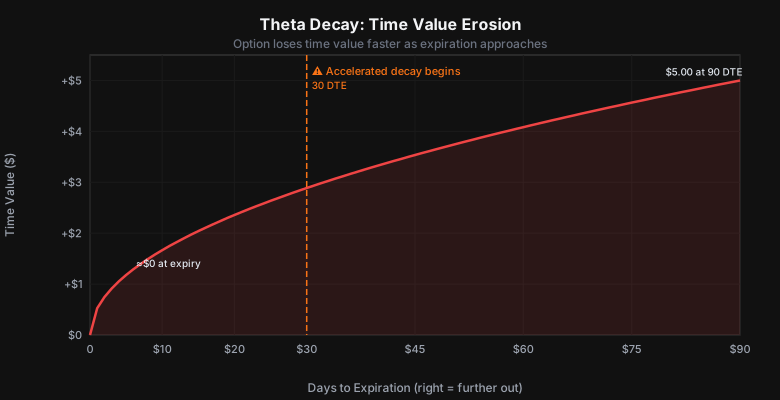
Theta is the Greek that costs option buyers money every single day, regardless of what the stock does.
An option with Theta of -0.05 loses $5 per day per contract. An option with Theta of -0.12 loses $12 per day. These numbers seem small until you hold a position for two weeks.
Here is a concrete example. You buy an ATM call with Theta of -0.05 and pay $400 for the contract. The stock does nothing for 14 days. Theta alone has cost you $70 ($5 per day times 14 days). That $400 position is now worth roughly $330, and the stock has not moved a single dollar. You lost money by being right about direction — you just weren't right in time.
The 90-day decay pattern is the most important thing to understand about Theta. In the first 30 days, an ATM option might lose $1.00 of time value. In the next 30 days, it loses $1.50. In the final 30 days before expiration, it loses $2.50. The acceleration in the final month is dramatic — roughly three times faster than in the first month.
This is why options sellers have an inherent edge in time. Selling options means Theta works for you: every day that passes without a large move puts money in your pocket. Buying options means racing the clock — the stock needs to move far enough, fast enough, to outpace the daily decay.
Vega: Your Exposure to Volatility
Vega measures how much an option's price changes when implied volatility moves by 1 percentage point.
An option with Vega of 0.08 gains $8 per contract when IV rises by 1%. It loses $8 when IV drops by 1%. If IV drops 5 percentage points — as it commonly does after an earnings announcement — the option loses $40 from Vega alone, with no movement in the underlying stock required.
This is the exact mechanism that created my AAPL loss. AAPL rose $4, which added roughly $200 to my call through Delta. But IV collapsed after earnings, and Vega subtracted $320 from the same position. Net result: down $120, on a trade where the stock moved in my favor.
Vega is highest for longer-dated options and for at-the-money strikes. A 90-day ATM option has much higher Vega than a 7-day ATM option. This means longer-dated options are more sensitive to volatility changes — they are better tools for trading volatility itself, while short-dated options are more purely directional bets.
The practical implication: when IV is elevated — before earnings, during VIX spikes — buying options means you own high Vega. If IV reverts to normal even slightly, Vega works against you. When IV is low, Vega becomes less of a threat and more of a potential tailwind if volatility picks up.
How All Four Greeks Interact
The Greeks never operate in isolation. Every real position has all four acting simultaneously, and they can work in opposite directions.
Consider a 30-day ATM call on NVDA with these readings: Delta of 0.52 means you profit from upward moves in the stock. Gamma of 0.08 means Delta accelerates if NVDA surges. Theta of -0.12 means the position costs $12 per day to hold. Vega of 0.18 means a 1% rise in IV adds $18, a 1% drop takes $18.
If NVDA rises 5% over two days, Delta and Gamma both work in your favor and the position likely shows a solid profit. But if NVDA moves sideways for two weeks, Theta alone costs roughly $168. If IV also drops 5% during that period, Vega takes another $90. That ATM call you bought because you were bullish has now lost $258 even though the stock hasn't fallen.
This interaction is why options trading requires more than being right about stock direction. You need the stock to move enough, quickly enough, in an environment where IV is not collapsing against you. Experienced traders assess all four Greeks before entering any position.
A Simple Greeks Checklist Before Every Trade
Before placing an options trade, run through these four questions:
Delta check: Does the option's Delta match my directional view? A call with Delta 0.30 profits much less from a $5 stock move than one with Delta 0.60. Make sure the leverage matches your expectation.
Theta check: How many days is this trade open, and what does daily decay cost? Multiply Theta by the number of days you plan to hold. If that number is a significant fraction of the option's price, the stock needs to move fast to justify the position.
Vega check: Is there a scheduled event — earnings, Fed meeting, product launch — before expiration? If yes, IV will likely rise before the event and collapse after. Buying options with high Vega before earnings means owning something that will deflate the morning after the announcement, regardless of how the stock moves.
Gamma check: How close is expiration? Near-expiry options with high Gamma are powerful but volatile. Small stock moves can create large percentage gains or losses. Only use high-Gamma positions if you are actively monitoring and prepared to act quickly.
The Greeks transform options from confusing instruments into a set of measurable, manageable forces. Delta tells you your directional exposure. Gamma tells you how that exposure changes. Theta tells you the daily price of the trade. Vega tells you your vulnerability to volatility shifts. Check all four and you will avoid the mistakes that catch most beginners off guard.
— Ruslan Averin