
The Problem with Shorting Stocks
When you believe a stock will fall, the obvious move seems to be shorting it: borrow shares, sell them, buy them back cheaper, pocket the difference. But shorting comes with two serious problems that make it unsuitable for most individual investors.
First, short selling requires a margin account, which introduces leverage, borrowing costs, and the possibility of a margin call. Second — and more dangerous — short selling has theoretically unlimited risk. TSLA at $200 can go to $400. If you are short 100 shares and the stock doubles, you lose $20,000 on a position that started at $20,000. There is no cap on how badly a short can go against you.
Buying a put option solves both problems. No margin required. Maximum loss is the premium you paid, nothing more.
What Is a Long Put Option?
A put option gives you the right — not the obligation — to sell 100 shares of a stock at the strike price before the expiration date. If the stock falls below the strike, your put becomes valuable. If the stock stays flat or rises, the put expires worthless and you lose only the premium.
Think of it as a bet on a stock declining, with a defined, fixed cost. You know before you buy exactly how much you can lose.
Long put mechanics: You buy the put (paying the premium). If the stock drops significantly, the put gains intrinsic value — the gap between the strike price and the current stock price. You profit by selling the put back to the market at a higher price before expiration. Most retail traders never actually exercise the put; they sell it.
How a Put Profit Works: The Mechanics
Here is how a put option profit works step by step.
Stock falls below strike: Your put option gains intrinsic value equal to (strike price minus current stock price). A $195 put on TSLA when TSLA is at $170 has $25 of intrinsic value.
Total option value: Intrinsic value plus any remaining time value. If your put still has two weeks until expiration, it is worth more than just the intrinsic value.
Profit: (Exit price of the put minus entry price of the put) multiplied by 100 shares per contract. If you paid $5.00 for the put and sell it for $25.00, your profit is $20.00 multiplied by 100 equals $2,000.
The put also carries time value that erodes daily through theta decay — the same force that hurts call buyers. Puts lose value every day the stock stays flat or moves against you.
OTM vs ITM Put: Which to Buy?
Out-of-the-money (OTM) put: The strike is below the current stock price. TSLA at $200, you buy the $195 put. The stock must fall below $195 for this put to have intrinsic value. Cheaper to buy but requires a larger move to profit.
In-the-money (ITM) put: The strike is above the current stock price. TSLA at $200, you buy the $210 put. This put already has $10 of intrinsic value. More expensive but moves more immediately with each dollar TSLA falls.
Working example: OTM put — TSLA at $200, buy the $195 put for $5.00. Total cost: $500. Breakeven at expiration: $190 ($195 strike minus $5.00 premium). ITM put — TSLA at $200, buy the $210 put for $15.00. Total cost: $1,500. Has $10 of intrinsic value already. Breakeven at expiration: $195.
For a directional bearish trade where you want to profit from a decline, OTM puts give you more leverage at lower cost but require a bigger move. ITM puts are more conservative — they already have real value and react more strongly to stock movement (higher delta).
A Real Example: TSLA Put Trade
TSLA is trading at $200. You have a bearish thesis: recent guidance disappointed, the sector is under pressure, and the chart shows a breakdown below a key support level. You buy a put.
Trade setup: TSLA at $200. Buy 1 TSLA $195 put (OTM by $5) expiring in 38 days for $5.00 per share. Total cost: $500. This is your maximum possible loss.
Breakeven at expiration: $195 minus $5.00 equals $190. TSLA needs to be below $190 at expiration for the trade to profit at expiry. That is a 5% decline from $200.
You do not need to wait for expiration. If TSLA drops to $180 in two weeks, the put will be well in the money with significant time value remaining. The put might be worth $22 or more, allowing you to close for a large profit early.
I bought TSLA puts before an earnings report I was nervous about. The stock dropped 8% after the announcement. My put tripled in value. I closed the next morning. The key was knowing my maximum loss ($500) before I ever pressed buy — that certainty made the trade manageable psychologically.
Max Profit, Max Loss, and Breakeven
Max profit: Theoretically, the stock can fall to zero. A $195 put on a stock at zero is worth $195 per share, or $19,500 on one contract. In practice, you will close the position well before that.
Scenario: TSLA drops to $170 with 20 days remaining. The $195 put now has $25 of intrinsic value plus time value. The put is worth approximately $27. Sell to close. Profit: ($27 minus $5) multiplied by 100 equals $2,200 on a $500 investment. A 340% return.
Scenario: TSLA rises to $205 and stays there through expiration. The $195 put expires worthless. You lose $500. That is the maximum loss. Full stop.
Max loss: The premium you paid. $500 in this example. You cannot lose more. There is no margin call, no theoretically unlimited downside. The loss is entirely defined from the moment you buy.
Long Put vs Short Stock: Key Differences
Short selling TSLA requires a margin account and has unlimited risk. A put limits your maximum loss to the premium you paid.
Short TSLA at $200 with 100 shares: if TSLA goes to $300, you lose $10,000. If it goes to $400, you lose $20,000. The loss is theoretically infinite.
Long put on TSLA for $500: if TSLA goes to $300 (against you), you lose $500. Only $500. The stock can quadruple and you still only lose your premium.
The cost difference: short selling has a lower upfront cost (you receive cash from the sale, posting margin collateral) but with unlimited liability. The put costs $500 and that is the complete, total, non-negotiable maximum loss.
For beginners and for anyone who cannot monitor a position every hour, the put is almost always the superior vehicle for bearish speculation.
When to Buy a Put (And When Not To)
Buy a put when you have a specific, time-based bearish thesis on a stock or sector. Upcoming earnings that you expect to disappoint. A technical breakdown below major support. A company with deteriorating fundamentals. A macro event — Fed decision, economic data — that you expect to cause a decline.
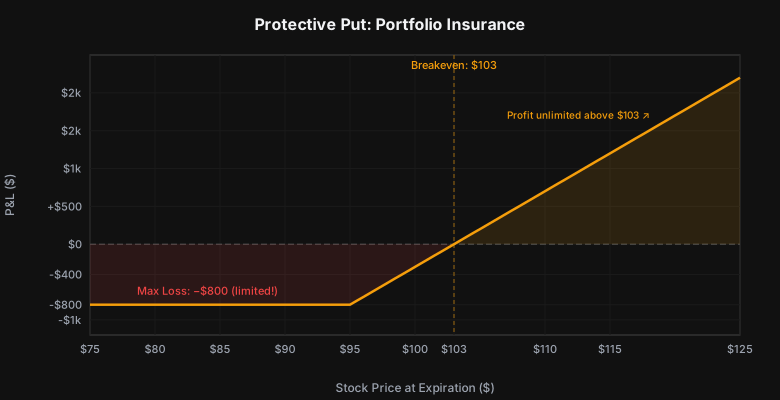
Also useful as a hedge: if you own 100 shares of TSLA and want to protect against a sharp drop, buying a put is portfolio insurance. You pay a premium, and if the stock falls sharply, the put offsets your losses on the shares.
When not to buy a put: when implied volatility is extremely elevated. Right before earnings, IV spikes as the market prices in the expected move. If you buy a put when IV is at 80 and the stock falls exactly as expected but IV collapses to 40 afterward, your put might actually lose value despite being right on direction. This is IV crush.
Check IV rank before buying. If IV rank is above 60 to 70, the options are expensive. You are paying a premium for the option that may not be justified.
Exit Strategies for Put Buyers
Selling to close: the most common exit. When your put has gained significant value — say it doubled or tripled — sell it back to the market. You do not need to exercise. You simply sell the contract.
Profit targets: many experienced traders close puts when they reach 100% to 200% gain. A put that cost $500 and is now worth $1,500 has been a successful trade. Close it. The remaining potential upside rarely justifies the risk of giving back gains.
Stop-loss: if the put falls to 50% of its value ($250 on a $500 put), consider exiting. The thesis may be wrong or the timing is off. Take the defined loss and preserve capital for the next trade.
Time management: with 21 days or fewer until expiration, theta decay accelerates sharply. If your put is still OTM with 21 days left and no strong momentum in the right direction, close or roll. Do not hold an OTM put into the final week hoping for a last-minute move. Time is not on your side.
— Ruslan Averin