
Apple is currently trading at $185. I want to own it — but not at $185. My target is $175. Instead of sitting on cash and hoping for a dip, I sold a cash-secured put and collected $300 upfront. Either AAPL drops to my target and I buy it $13 cheaper than today's price, or the put expires worthless and I keep the $300. Happy either way.
That's the entire philosophy of the cash-secured put strategy. And it works.
The "Happy Either Way" Strategy
Most options strategies force you to pick a side. Bullish? Buy calls. Bearish? Buy puts. But cash-secured puts are different — you enter the trade genuinely indifferent to two favorable outcomes.
Outcome 1: The stock stays above your strike. The put expires worthless. You keep the premium. You collect income for doing nothing more than being willing to buy a stock you already liked.
Outcome 2: The stock falls to your strike. You buy 100 shares at your target price, minus the premium you already collected. You own a stock you wanted — at a lower price than it was trading when you sold the put.
There is no bad outcome as long as you only run this strategy on stocks you actually want to own.
How a Cash-Secured Put Works
A cash-secured put is an options strategy where you sell (write) a put option on a stock you are willing to own, while keeping enough cash in your account to buy those shares if the option is exercised.
The buyer of your put pays you premium upfront. In exchange, they get the right to sell you 100 shares at the strike price before expiration. If the stock drops below your strike, they exercise that right and you buy the shares at the agreed price.
The word "cash-secured" distinguishes this from a naked put. With a naked put, you sell the obligation without holding the necessary collateral — which creates margin risk and requires advanced approval. With a cash-secured put, the full purchase amount sits in your brokerage account as collateral. No margin calls, no leverage risk. Most brokers allow it with basic options approval (Level 1 or Level 2).
You keep the premium regardless of what happens. It's deposited the moment you sell the contract.
The Setup: Step by Step
Step 1 — Choose your target stock. This is the most important step. Only sell puts on stocks you genuinely want to own. If assigned, you will hold these shares.
Step 2 — Decide your target price. Where would you be happy buying this stock? That's your strike. Common practice: 5-15% below the current market price.
Step 3 — Set aside the required cash. You need strike price x 100 in your account as collateral. For a $175 AAPL put, that's $17,500. This cash is not spent — it simply needs to be available.
Step 4 — Sell the put. In your broker's options chain, select the strike and expiration (30-45 DTE is the standard sweet spot). Enter a "sell to open" order using a limit price.
Step 5 — Collect the premium. Cash deposits immediately into your account.
Step 6 — Wait for expiration. At expiration: either the put expires worthless (you keep premium and cash) or you get assigned shares (you buy at strike, your effective cost is strike minus premium).
A Real Example: AAPL Cash-Secured Put
AAPL is trading at $185. You'd love to own 100 shares at $175 — about 5.4% below the current price.
You sell 1 AAPL put with a $175 strike expiring 30 days out for $3.00 per share. Premium collected: $300 (credited to your account immediately).
Cash reserved as collateral: $175 x 100 = $17,500.
Scenario 1 — AAPL stays above $175. The put expires worthless. You keep $300. Monthly yield: $300 / $17,500 = 1.7%. Annualized: 1.7% x 12 = 20.4%. Your $17,500 in cash earned $300 in 30 days while sitting idle.
Scenario 2 — AAPL drops to $168. The put is exercised. You buy 100 shares of AAPL at $175 (your agreed strike). Your effective cost basis: $175 - $3 = $172 per share. You now own AAPL at $172 — that's $13 below where it was trading when you sold the put ($185). You bought a stock you wanted at a real discount.
Max Profit, Max Loss, Breakeven
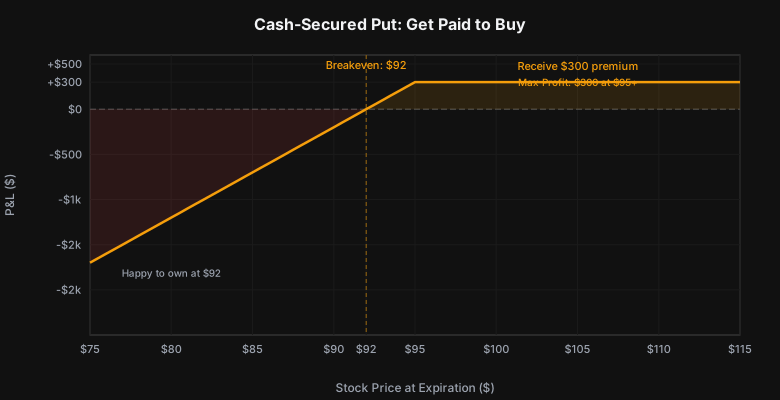
Max profit: The full premium collected when the put expires worthless. For this trade: $300.
Max loss: Occurs if the stock drops to zero. You would buy 100 shares at $175, then they become worthless. Maximum loss = ($175 x 100) - $300 premium = $17,200. In practice, you'd cut the position well before that scenario.
Breakeven: Strike price minus premium. $175 - $3 = $172 per share. Below $172, the premium no longer fully offsets the paper loss on your newly assigned shares.
The key: breakeven sits below the current market price of $185. You need AAPL to fall 7.1% before you're in a losing position — and even then, you're holding shares you intended to buy anyway.
How Much Cash Do You Need?
Each standard put contract covers 100 shares. The cash requirement: strike price x 100.
$175 AAPL put: $17,500 required. $200 MSFT put: $20,000 required. $100 stock at a $90 strike: $9,000 required.
This cash is not deployed unless assigned. It sits in your account as collateral. Many brokers allow you to hold this in a money market fund or Treasury bills during the trade, earning 4-5% yield on top of your put premium. That's double income on the same capital.
One practical advantage: a cash-secured put lets you participate in expensive stocks without full exposure. You need $17,500 to be ready to buy AAPL at $175 — but that's less than the $18,500 it would cost to buy 100 shares outright today.
Choosing Your Strike: Where Do You Want to Own the Stock?
Strike selection is the core skill of the cash-secured put seller.
5-8% OTM: Popular for quality stocks with moderate volatility. Good balance of premium and assignment probability. Most beginners start here.
10-15% OTM: Lower premium, lower assignment risk. Better for volatile stocks where you want a bigger discount before buying.
ATM (at-the-money): Maximum premium, but high assignment probability. Only appropriate if you're very comfortable buying immediately.
The right strike is wherever you'd genuinely be happy owning the stock. If you'd buy AAPL at $175 with excitement, sell the $175 strike. If $180 feels fair, sell the $180 strike and collect more premium.
Never sell a strike at a price you'd be unhappy holding. If the stock falls there, you will own it.
What Happens at Expiration?
Most cash-secured puts expire worthless — which is the goal. But expiration brings three possible situations:
Option expires out-of-the-money. Stock is above your strike. Put expires worthless. You keep the premium. You can immediately sell another put for the next cycle.
Option expires in-the-money — assignment. Stock is below your strike at expiration. Your broker automatically buys 100 shares at the strike price using your reserved cash. You now own the shares. Your effective cost: strike minus premium collected.
Option is in-the-money just before expiration — early decision. You can buy back the put to close the position before expiration, avoiding assignment. This costs money (the put's current value) but gives you flexibility. Buying back a $3 put for $4 when AAPL is falling fast is often the right trade to cut losses.
I've been running cash-secured puts on AAPL for over a year. Got assigned twice — both times at prices I was genuinely happy to pay. I now hold those shares and sell covered calls against them, generating additional income from the same capital.
Rolling the Put: Extending Your Position
What if the stock falls toward your strike but you don't want to be assigned yet? You can roll the put.
Rolling means buying back your current put (closing it) and selling a new put at a lower strike and/or later expiration. The goal: collect additional net premium while delaying or avoiding assignment.
Example: You sold the AAPL $175 put for $3. AAPL has dropped to $177 and the put is now worth $6. You're concerned it'll fall through $175. You roll: buy back the $175 put for $6, sell the $170 put expiring next month for $5. Net debit: $1. You've lowered your effective purchase price further (now $170 - $3 + $1 net adjustment) and bought another 30 days.
Rolling extends the trade. Use it to manage a position that's moving against you, not to avoid a stock you no longer want to own. Rolling to avoid a bad stock just delays the loss.
The cash-secured put is one of the most versatile income strategies available to retail investors. It requires patience, discipline, and genuine willingness to own the underlying stock. When those conditions are met, it reliably generates 10-20% annualized returns on idle cash while building a stock portfolio at better prices than the market offered on any given day.
— Ruslan Averin