
The Three Ways an Options Trade Ends
Every options trade ends one of three ways: you sell to close, the option expires worthless, or the option is exercised and assigned. Most beginners do not know when — or how — to use each exit. Getting this wrong is where most money is lost after a correct initial trade setup.
Understanding exit mechanics is not optional knowledge. It is arguably more important than entry. A brilliant entry destroyed by a poor exit is still a loss. A mediocre entry saved by a disciplined exit is often still a winner. This guide covers exactly how each exit works, when to use which one, and the rules experienced traders apply to every position.
Selling to Close: The Most Common Exit
Selling to close means you sell the option contract you own back to the market before expiration. This is how the vast majority of retail options traders exit positions. No shares change hands. You simply buy to open, then sell to close. The difference between the two prices times 100 shares equals your profit or loss.
To sell to close: navigate to your open positions in your brokerage, select the option, and choose Sell to Close. Enter a limit order at the midpoint between the current bid and ask. Use a limit order — never a market order when exiting options. Market orders can execute at prices far from fair value, especially during volatile sessions.
When to sell to close: any time before expiration when the option has value. You bought a call for $420, and it is now worth $840 after the stock moved in your direction. Selling to close captures that $420 profit immediately. You do not need to wait for expiration. You do not need the stock to reach any particular price.
Letting the Option Expire Worthless
If you hold an option past its expiration and it finishes out of the money (OTM), it expires worthless automatically. You lose the entire premium. No action is required — the position simply disappears from your account.
This is the complete-loss scenario. Bought a call for $420 and the stock never moved past your strike? Expiration arrives and your $420 is gone entirely. There is no partial recovery. No residual value. Nothing.
The important question is whether this was a planned outcome or a failure of discipline. Sometimes, you buy an option knowing the outcome is binary: either the stock makes a big move and the option pays off significantly, or the stock does nothing and the option expires worthless. That is a legitimate strategy called a defined-risk speculation. You sized it correctly — no more than 2 to 5 percent of your account — so a total loss is painful but not catastrophic.
What is not acceptable: holding a losing option to expiration out of hope, denial, or refusal to take a loss. This is how a manageable $105 loss (25% of $420) becomes a total $420 loss. The option gave you multiple exit points on the way to zero. You chose to ignore all of them.
Exercise and Assignment: When It Happens
Exercising a call option means you use your right to buy 100 shares of the stock at the strike price. Exercising a put means you use your right to sell 100 shares at the strike price.
Most retail traders never exercise options. It is almost always better to sell to close. Here is why: when you sell to close, you capture intrinsic value plus any remaining time value. When you exercise, you capture only intrinsic value — you forfeit the time value that remains in the option. Selling to close is financially superior in nearly every case.
When exercise makes sense: if your option is deep in the money, expiration is today, and you actually want to own the shares (for a call) or sell shares you own (for a put). In that specific scenario, exercising may be appropriate.
Assignment — the opposite of exercise — happens to option sellers (the short side), not buyers. As a buyer of puts and calls, you will not be assigned. You can only be assigned if you sold options short. Beginners should not be short options naked until they have years of experience and understand margin requirements thoroughly.
The 50% Profit Rule
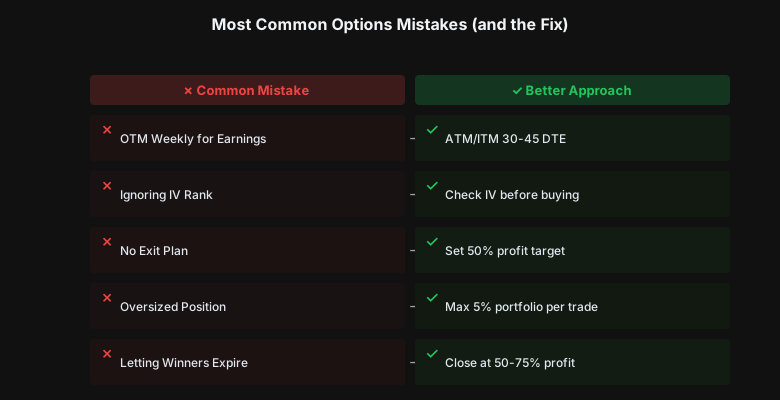
You bought a call for $420. The stock has moved favorably and the option is now worth $840 — a 100% gain. The 50% profit rule says: at 50% gain ($630), strongly consider closing at least half your position. At 100% gain ($840), seriously consider closing the entire position.
Why close a winner? Options gains are nonlinear and highly volatile. A position up 100% can retrace to breakeven in a single session if the stock pulls back even slightly. The time decay clock is always running. Implied volatility can collapse. What took two weeks to build can unravel in a day.
The discipline is this: you do not know where the top is. No one does. What you do know is that a 100% gain on a defined-risk options trade is an outstanding result. Locking in that result is not leaving money on the table — it is executing your plan.
A practical approach: when the option doubles to $840, close half (sell 1 contract if you bought 2, or close the full position if you bought 1 contract). Move your stop on the remaining position to breakeven. Let the remaining position ride but with zero downside risk.
The 25% Loss Rule: Cutting Losses Early
You bought a call for $420. The stock is moving against you. The option is now worth $315 — a 25% loss. The 25% loss rule says: close it now. Take the $105 loss.
Here is the hard truth about losing options positions: they rarely recover. Unlike stocks, options have an expiration date. An out-of-the-money option that has lost 25% of its value is losing value for two reasons: the stock moved against you, and time is passing. Both forces continue working against you until expiration.
The math of waiting: bought the call for $420. Now worth $315. You hold. It falls to $210 (50% loss). You hold. It falls to $105 (75% loss). You hold. Expires worthless. Total loss: $420.
The math of the 25% rule: bought for $420, sold at $315. Loss: $105. You preserve $315 to deploy in the next trade.
I held a losing $600 position to expiration once, hoping it would recover. The stock hovered below my strike the entire time. I lost the full $600. If I had sold at 25% loss, I would have saved $450. That $450 could have funded four or five future trades that actually worked.
Rolling a Position: When and How
Rolling means simultaneously closing your current option position and opening a new one with different terms — typically a later expiration, sometimes a different strike. Rolling extends your time, buys your thesis more runway.
When to roll: your current option is expiring in seven days, the stock has not made the expected move yet, but you still believe in the thesis. You do not want to let the option expire worthless, but you also do not want to simply hold and watch theta consume the remaining value.
How to roll: execute a spread order on your brokerage — Buy to Close the current option and Sell to Open the new option in a single transaction. This reduces execution risk compared to doing them separately.
Rolling typically costs a small debit — you pay a net premium to extend time. Example: Close the current AAPL $195 call with 7 days remaining for $0.80 and simultaneously buy the AAPL $195 call with 37 days remaining for $2.60. Net debit: $1.80 per share, or $180. Your total cost basis is now $420 plus $180 equals $600, but you have 37 days instead of 7 days.
Rolling is not always the right answer. If your original thesis has been invalidated — not just delayed but actually wrong — rolling simply throws more money at a bad trade. Roll only when the thesis is intact and the timing was off.
A Decision Framework for Every Trade
Before you enter any options trade, write down these four numbers:
- Maximum risk: the premium paid. For the AAPL $195 call at $4.20, that is $420.
- Profit target (50% rule): $420 times 1.5 equals $630. If the option reaches $630, close half or all.
- Profit target (200% rule): $420 times 3 equals $1,260. If the option reaches $1,260, close all.
- Stop-loss (25% rule): $420 times 0.75 equals $315. If the option falls to $315, close it.
Write these down. Set price alerts in your brokerage. Treat them as binding. The moment emotion enters — hope, greed, fear — you need these pre-defined numbers to override it.
When expiration is 21 days away: review the position. If it is profitable, consider closing. If it is near your stop-loss, close it. If the thesis is intact and you want to stay in, consider rolling to a later expiration before the accelerating theta decay in the final three weeks consumes most of the remaining value.
The Biggest Exit Mistakes Beginners Make
Holding winners too long. Options have expiration dates. Unlike stocks, you cannot simply "hold for the long term" through volatility. A 100% winner can reverse to a 0% position in days if the stock reverses.
Averaging down on losers. Buying more of a losing option to reduce your average cost rarely works. You are doubling your risk in a position that is already moving against you. A 50% loss on the original position plus a 50% loss on the additional position equals a lot more damage than the original trade's maximum loss.
OTM options 21 days before expiration: this is where gamma risk increases dramatically. An OTM option that seemed like it had time suddenly has almost none. If you are holding OTM options inside 21 days with no clear momentum in your direction, close or roll. The probability of a last-minute recovery is not as high as hope would have you believe.
Waiting for "just a little more." You are up 80%. You want 100%. The stock peaks and starts pulling back. You are now up 50%. You want to get back to 80%. The stock continues falling. You are now at breakeven. You wait. You are now down 30%. This pattern kills more profits than poor entry selection. Define your exit. Execute your plan.
The options market rewards discipline over prediction. Getting the direction right is only half the trade. Knowing how and when to exit is the half that actually determines your profitability over hundreds of trades.
— Ruslan Averin