
I've been selling covered calls on my MSFT position for 8 months straight. In that time, I collected $4,200 in premiums — while the stock also appreciated. That's $500 a month in extra income from 100 shares I was already holding. If you own stocks and haven't tried this yet, you're leaving real money on the table every single month.
Getting Paid to Own Stocks
Most investors think about making money in stocks one way: buy low, sell high. But there's a second income stream available to anyone who already owns 100 or more shares of a stock — and most people never touch it.
Selling covered calls lets you collect cash premium immediately, simply for agreeing to potentially sell your shares at a higher price later. You get paid today. The premium hits your account the same day you sell the contract. Whether the option expires worthless or gets exercised, that cash is yours to keep.
On a $42,000 position in MSFT, collecting $500 a month in premiums works out to 1.2% monthly yield — roughly 14.4% annualized on top of whatever the stock itself does. That's not speculation. That's turning a static equity holding into an income-generating asset.
What Is a Covered Call?
A covered call is an options strategy where you sell (write) a call option against shares you already own. The buyer of that call gets the right to purchase your shares at a fixed price (the strike price) before a set date (expiration). You collect a cash premium immediately in exchange for granting that right.
The word "covered" is essential: you already own the underlying shares. This means your potential losses are the same as they were before — if the stock goes to zero, you lose your investment. But the premium you collected reduces that loss slightly. Compare this to a naked (uncovered) call, where you could face theoretically unlimited losses. Covered calls are among the most conservative options strategies available to retail investors.
One contract covers exactly 100 shares. If you own 100 shares, you can sell 1 contract. 200 shares, 2 contracts. The premium is paid per share but collected per contract.
The Setup: Step by Step
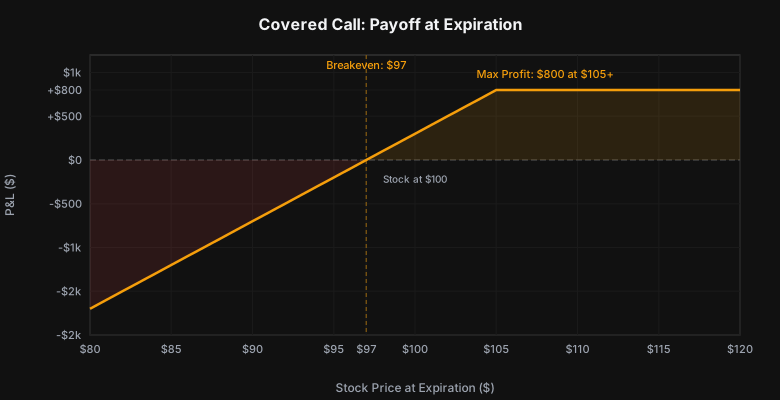
Here is how to set up a covered call from start to finish:
Step 1 — Confirm you own 100 shares. You need at least 100 shares per contract. If you own 150 shares, you can sell 1 contract, not 1.5.
Step 2 — Choose your strike price. The strike is the price at which your shares would be sold if the option is exercised. Pick a strike above the current stock price — typically 5-10% out-of-the-money (OTM) for a balance of premium income and upside potential.
Step 3 — Choose your expiration date. Most income-focused traders target 30-45 days to expiration (DTE). This window captures the steepest portion of time decay while giving you flexibility to adjust.
Step 4 — Sell the call. In your brokerage platform, find the options chain, select the strike and expiration, and enter a "sell to open" order. Choose limit order, not market.
Step 5 — Collect the premium. The cash is deposited into your account immediately upon execution.
Step 6 — Wait for expiration. At expiration, either the option expires worthless (you keep premium and shares) or your shares get called away at the strike (you keep premium and sell shares at a profit).
A Real Example: MSFT Covered Call
Let's run through a complete trade. You own 100 shares of Microsoft (MSFT) purchased at $420 per share. Current price: $425.
You sell 1 MSFT call option with a $430 strike expiring in 30 days for $5.00 per share. Premium collected: $500 (hits your account immediately).
Three possible outcomes at expiration:
Scenario A — MSFT stays below $430. The option expires worthless. You keep your 100 shares and the $500 premium. Monthly yield: $500 / $42,000 = 1.2%. Repeat next month.
Scenario B — MSFT closes at $435. The buyer exercises the call. You sell your 100 shares at $430. You collect: ($430 - $420) gain × 100 = $1,000 profit on the stock, plus the $500 premium = $1,500 total profit. You miss the last $5 rally above $430, but you were paid for that trade-off.
Scenario C — MSFT drops to $400. The option expires worthless. You keep the $500 premium. Your shares are worth $40,000 — a $2,000 paper loss on the position, partially offset by the premium. You can sell another call next month at the $405 or $410 strike to continue recovering.
Max Profit, Max Loss, Breakeven
With any options strategy, you need to know your outcomes before you enter.
Max profit: Occurs when the stock is called away at the strike price. For this trade: ($430 - $420) × 100 + $500 = $1,500. You captured $1,000 of stock appreciation plus the full premium.
Max loss: If MSFT goes to zero, you lose your entire stock position. With 100 shares at $420 entry, that's $42,000 in stock losses, offset slightly by the $500 premium = maximum loss of $41,500. This is the same risk you carried before selling the call.
Breakeven: Purchase price minus premium collected. $420 - $5 = $415. Below this level, the premium no longer fully offsets the stock loss.
The key insight: selling the covered call didn't create new risk. Your downside was $42,000 the day you bought the stock. After selling the call, it's $41,500. The call slightly improves every outcome.
What Happens If Your Stock Gets Called Away?
Assignment is the covered call seller's main concern — not because it's bad, but because it requires a decision.
When your stock gets called away, you sell shares at the strike price. If you entered MSFT at $420 and it gets called at $430, you walk away with $1,000 in stock gains plus $500 in premium. That's a solid return on a 30-day trade.
The downside: if MSFT then runs to $460, you miss the extra $30/share gain. This is called opportunity cost. It stings, but you were compensated for capping your upside when you collected the premium.
How to manage it:
Roll up and out. Before expiration, buy back the short call and sell a new one at a higher strike and/or later expiration. You pay a small debit but recapture more upside.
Accept the assignment. Sell the shares, book the profitable trade, and buy back in if you still like the stock.
Choose higher strikes from the start. If you're bullish and want to keep the position, sell strikes 10-15% OTM. You collect less premium, but you retain more upside room.
How to Choose Your Strike and Expiration
Strike selection determines the balance between income and upside potential.
The 30-delta rule: Many professional income traders target the 30-delta call, which sits roughly 5-10% OTM on most large-cap stocks. This strike has about a 30% probability of being in-the-money at expiration — meaning a 70% chance the option expires worthless and you keep shares plus premium.
Deep OTM (10-20% out): Lower premium, but much higher probability of keeping your shares. Good for highly bullish situations.
At-the-money (ATM): Highest absolute premium, but you cap gains immediately. Best for flat or mildly bearish views.
For expiration: the 30-45 DTE window is the sweet spot for premium sellers. Options decay fastest in the last 30 days of their life (theta acceleration). Selling at 30-45 DTE gives you time to adjust while capturing the steepest part of the decay curve.
The Buy-Write: Starting From Scratch
What if you want the income but don't already own the stock? That's called a buy-write: you buy 100 shares and simultaneously sell a covered call in a single order.
Buy-write on MSFT: Buy 100 shares at $425, simultaneously sell the $435 call expiring in 30 days for $4.50. Net cost of the position: $425 - $4.50 = $420.50 per share. Your breakeven is lowered from $425 to $420.50 on day one.
Buy-writes are especially useful when entering a position you intend to hold long-term. You reduce your cost basis immediately and generate income from the first day.
Most platforms support buy-write as a single order type. Look for "covered call" or "buy-write" in the order entry menu.
When Covered Calls Work (And When They Don't)
Covered calls are not the right tool for every situation. Knowing when to use them — and when not to — is as important as the mechanics.
Covered calls work best when:
You expect the stock to trade flat or move up modestly over the next 30-45 days. You're in a high implied volatility environment — elevated IV means fatter premiums. You want income from a long-term hold you don't want to sell. You're neutral-to-bullish but not aggressively bullish.
Covered calls work poorly when:
You're highly bullish and expect a large move — you'll cap out and miss the gain. The stock has extremely low implied volatility — premiums will be thin and barely worth the effort. You're holding the stock for potential buyout news, where being called away could cost you a takeover premium.
The annualized income math on consistent covered call writing is compelling. On a $42,000 MSFT position, collecting an average $500 per month: $6,000 per year = 14.3% extra yield. Even in months where you only collect $300, you're adding value that a passive hold would not generate.
I've been running this strategy for over two years on multiple positions. The months where the stock gets called away sting slightly — but the math at the end of the year always comes out ahead. Covered calls don't make you rich fast. They make you consistently richer over time.
— Ruslan Averin