The Question Every Beginner Asks
You open your brokerage app and see an AAPL $200 call trading at $8.50. Apple stock sits at $205. You do the math: $205 minus $200 equals $5. So why does the option cost $8.50? Where does the extra $3.50 come from?
This question trips up almost every new options trader. The answer changes how you think about every trade you ever place. Once you see the two components of an option's price clearly, you stop overpaying for contracts and start making smarter decisions about which options to buy, when to sell, and when to walk away.
Two Components of Every Option Price
Every option premium — the price you pay to buy, or receive when you sell — is made up of exactly two pieces:
Option Premium = Intrinsic Value + Time Value
That formula applies to every option that exists: calls, puts, short-dated, long-dated, cheap or expensive. The two numbers always add up to the total premium. Understanding each one gives you x-ray vision into what you are actually paying for.
Intrinsic Value: The Real Part
Intrinsic value is the straightforward part. It is what the option would be worth if you exercised it right now at this moment.
For a call option: Intrinsic Value = Stock Price minus Strike Price (or zero if the result is negative).
For a put option: Intrinsic Value = Strike Price minus Stock Price (or zero if the result is negative).
Back to our AAPL example. Apple trades at $205 and we are looking at the $200 call. If you exercised that option right now, you would buy shares at $200 and could immediately sell them at $205 in the open market. That locks in $5 per share. That $5 is intrinsic value — real, tangible, calculable.
Options with intrinsic value are called in-the-money (ITM). A $200 call when AAPL is at $205 is ITM by $5.
Options with no intrinsic value fall into two camps. At-the-money (ATM) options have a strike equal to the current stock price — intrinsic value is essentially zero. Out-of-the-money (OTM) options have a strike price the stock has not reached — also zero intrinsic value. An AAPL $210 call when the stock is at $205 has no intrinsic value at all.
The critical rule: intrinsic value can never be negative. An option can be worth less than you paid for it, but the intrinsic value calculation always floors at zero.
Time Value: What You Pay for the Possibility
If the AAPL $200 call has $5 of intrinsic value, why does it trade at $8.50 rather than $5?
The extra $3.50 is time value. It is the premium the market charges for the chance that the option might become even more valuable before expiration.
With 45 days remaining on the contract, Apple still has time to rally to $215 or $220. That potential upside has real value — not because it has happened, but because it might. The more days left on the clock, the more opportunities for favorable moves, and the more time value the option carries.
Time value is sometimes called extrinsic value. The terms are interchangeable.
Here is the ATM comparison that makes this concrete. When AAPL is exactly at $200 and the $200 call trades at $5.20, intrinsic value is zero — the option has no immediate exercise value. Yet it costs $5.20. Every dollar of that premium is time value. The market is paying purely for the possibility that Apple climbs above $200 before expiration.
Now look at an OTM option: the AAPL $210 call, with Apple at $205, trades at $2.10. Intrinsic value is zero. Time value is $2.10, the full premium. You are paying $2.10 for the chance that Apple rises more than $5 in the time remaining.
Why ATM Options Have Maximum Time Value
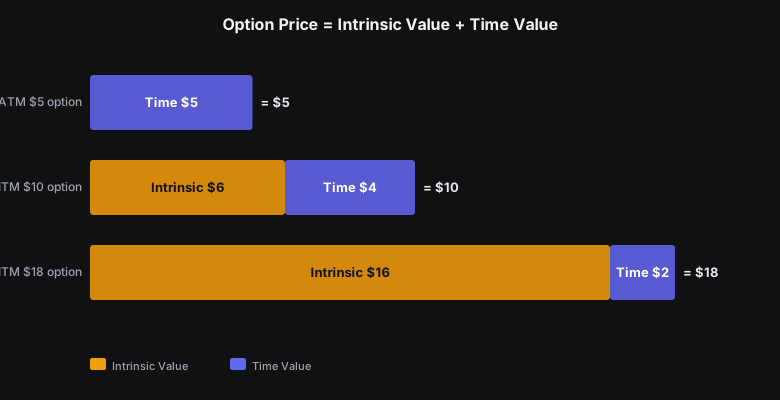
Here is something that surprises most beginners: at-the-money options carry more time value than any other strike, both ITM and OTM.
Think about why. An ITM option already has most of its value locked in as intrinsic value — the outcome of staying in the money is fairly certain, so the time value component shrinks. A deep OTM option has almost no chance of becoming profitable, so the market doesn't attach much time value either.
An ATM option sits exactly at the tipping point. The outcome is maximally uncertain. It might expire worthless or it might end up significantly in the money. Maximum uncertainty equals maximum time value.
This is why professional traders pay close attention to where an option's strike sits relative to the stock price. ATM options cost the most per unit of time value, which also means they decay the fastest.
The Theta Effect: Time Decay in Action
Time value does not disappear at a steady rate. It accelerates as expiration approaches — this is theta decay.
Consider a 90-day ATM option with $5.00 of time value. In a typical scenario:
During the first 30 days, the option loses roughly $1.00 of time value. During the middle 30 days, it loses roughly $1.50 more. During the final 30 days, it loses the remaining $2.50.
The same dollar amount of time value erodes three to four times faster in the final month than in the first month. This acceleration is not a quirk — it is built into options mathematics.
I once held an OTM call for three weeks while the stock did nothing. The stock was flat, but my option lost $180. That is pure time decay at work. The stock did not need to fall to hurt me — it just needed to not move fast enough.
This matters enormously for strategy. Buyers of options are racing against the clock. Sellers of options sit on the right side of time decay — every day that passes without a large move is profit for the seller.
A Complete Pricing Example: Apple $200 Call
Let us build the full picture with three AAPL scenarios, all with the stock at $205, 45 days to expiration:
Scenario 1 — ITM call at $200 strike: Option price: $8.50 Intrinsic value: $5.00 (the stock is $5 above the strike) Time value: $3.50 (the $8.50 total minus $5.00 intrinsic)
Scenario 2 — ATM call at $205 strike: Option price: $5.20 Intrinsic value: $0 (strike equals stock price) Time value: $5.20 (100% of premium is time value — maximum)
Scenario 3 — OTM call at $210 strike: Option price: $2.10 Intrinsic value: $0 (stock has not reached the strike) Time value: $2.10 (100% of premium is time value)
Notice the pattern. As the strike moves further OTM, total premium falls. But the ITM option has the lowest percentage of time value, while the ATM option has the highest. The OTM option is entirely time value — pure speculation on a move that has not happened.
Your break-even at expiration is always strike price plus premium paid. For the $200 call bought at $8.50, Apple needs to reach $208.50 just for you to break even. Not $200 — $208.50. The stock must rise far enough to overcome both the OTM gap and the full time value you paid.
What This Means for Your Strategy
Understanding intrinsic and time value changes how you evaluate every trade.
When you buy an option, you are buying two different things simultaneously: intrinsic value (which the stock already supports) and time value (which decays daily regardless of stock movement). The first piece holds its value as long as the stock stays above your strike. The second piece melts away whether the stock moves or not.
Deep in-the-money options have more intrinsic value and less time value. They behave more like the stock itself — less decay, less leverage, but more capital required. Far out-of-the-money options are almost entirely time value — high leverage if the stock makes a large move, but rapid decay if it doesn't.
When you sell options, the relationship reverses. The time value you collect as a seller erodes every day in your favor. Covered calls and cash-secured puts are strategies built entirely on this principle: collect time value, let it decay, keep the premium if the stock stays within your range.
Two practical rules to carry into every trade: first, always calculate how much time value you are paying for as a percentage of total premium. High time-value percentages mean you need a large, fast move to profit. Second, check days to expiration against the stock's typical daily movement — if the math doesn't give the stock a realistic chance of reaching your break-even, the time value you are paying is probably too high.
Options pricing becomes intuitive once you stop seeing the premium as a single number and start seeing it as two distinct, manageable components — one based on where the stock is right now, and one based on where it might go before time runs out.
— Ruslan Averin