What Is an Option? (The Simple Version)
I remember the first time someone explained options to me. They said: "It's like a coupon that lets you buy Apple stock at today's price, even if the price goes up next month." That stuck. It's not perfectly precise, but it captures the core idea.
An option is a contract that gives you the right — but not the obligation — to buy or sell 100 shares of a stock at a fixed price, before or on a specific date. You pay a premium upfront to get that right. If you decide not to use it, the contract expires. Your maximum loss is exactly the premium you paid — nothing more.
One contract always covers 100 shares. That's not a coincidence — it's how leverage works in options. You're controlling a large block of stock for a fraction of the cost.
Calls vs Puts: The Only Two Types
There are exactly two types of options: calls and puts. Every options strategy ever invented is built from these two building blocks.
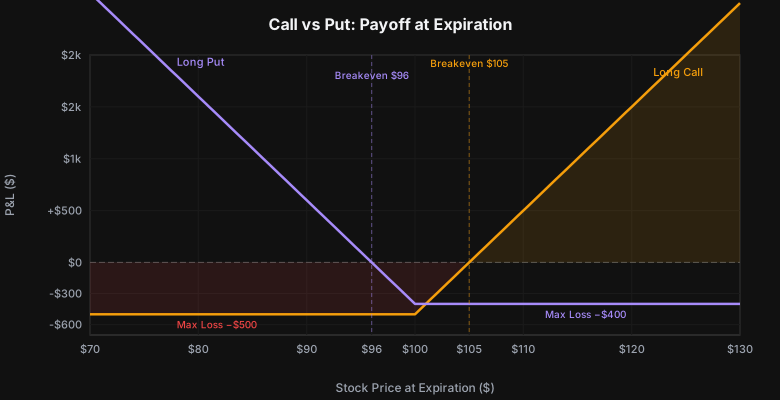
A call option gives you the right to buy 100 shares at the strike price. You buy a call when you believe the stock will rise. If it rises above your strike before expiration, your call gains value. If it doesn't, you lose the premium.
A put option gives you the right to sell 100 shares at the strike price. You buy a put when you believe the stock will fall — or when you want to protect shares you already own from a decline.
Memory trick: Calls go up, Puts go down. Calls profit when the stock rises; puts profit when it falls.
Key Terms You Must Know Before Trading
Before we look at real examples, four terms you'll see constantly:
Strike price — the fixed price at which you can buy (call) or sell (put) the shares. If AAPL is at $190 and you buy a $200 call, your strike is $200.
Expiration date — the deadline. Options expire weekly, monthly, or quarterly. After expiration, the contract is gone.
Premium — what you pay to buy the option. Quoted per share, but remember: multiply by 100 for the actual cost. A $3.50 premium costs you $350.
Contract — one unit of options. One contract = 100 shares. Always.
A Real Example: Apple Call Option
AAPL is trading at $190. You think it will climb over the next month. You buy a call option:
- Strike price: $200
- Premium: $3.50 per share
- Your actual cost: $3.50 x 100 = $350
- Breakeven at expiration: $200 + $3.50 = $203.50
If AAPL climbs to $210 before expiration, your call is worth at least $10 per share, or $1,000 total. You paid $350. Profit: $650.
If AAPL stays at $190 or falls, your call expires worthless. You lose $350 — your entire premium, and not a dollar more.
Compare that to buying 100 shares outright: 100 x $190 = $19,000. One call option controlling those same 100 shares cost you $350.
A Real Example: Apple Put Option
Same stock, different direction. AAPL is trading at $190. You think it's going to drop.
You buy a put option:
- Strike price: $185
- Premium: $2.80 per share
- Your actual cost: $2.80 x 100 = $280
- Breakeven at expiration: $185 - $2.80 = $182.20
If AAPL drops to $170, your put is worth $15 per share ($185 - $170), or $1,500. You paid $280. Profit: $1,220.
If AAPL stays above $185 at expiration, the put expires worthless. You lose $280.
How Much Can You Lose?
This is the part most beginners get wrong. They hear "leverage" and imagine unlimited losses.
When you buy an option, your maximum loss is limited to the premium you paid.
In the AAPL call example: the most you can lose is $350 — not $19,000 (the cost of 100 shares). The stock could go to zero and you'd still only lose $350.
This is what makes buying options fundamentally different from buying stocks on margin or shorting stock. There is a hard floor on your loss.
The risk is that most options expire worthless. Studies show roughly 70-80% of options held to expiration lose money for the buyer. This doesn't mean you should avoid them — it means you should understand what you're buying.
Options vs Stocks: 5 Key Differences
| Stocks | Options (buying) | |
|---|---|---|
| Cost for 100 AAPL shares | $19,000 | $350 (one call) |
| Maximum loss | Full investment | Premium paid only |
| Expiration | None | Fixed date |
| Leverage | 1x | 10x-50x typical |
| Complexity | Low | Medium-High |
The leverage cuts both ways. A 5% move in AAPL might turn your $350 call into $900. It might also turn it into $0.
Why Traders Use Options
I use options for three main reasons:
Defined risk on directional bets. When I think AAPL will rally into earnings, I buy a call. My maximum loss is the premium. If I'm wrong, I lose $350, not $19,000.
Hedging existing positions. When I hold a stock through earnings and worry about a surprise drop, I buy a put. It's insurance. I pay a small premium; if the stock tanks, the put gains value and offsets my losses.
Selling premium for income. Once you understand how options work, selling covered calls against stocks you own generates steady income. This is one of the most popular retail strategies for a reason — it works in flat markets where simply holding stocks does nothing.
The CBOE reported that retail options volume hit record levels in 2025, with 0DTE (zero days to expiration) contracts alone averaging millions of trades daily. Options aren't a niche tool anymore.
Your First Step
Start here: pick one stock you follow closely. Open its options chain on any brokerage platform. Find the contract expiring about 30 days out. Look at the call with a strike just above the current price.
Notice the premium. Multiply it by 100. That's your actual cost for one contract.
Then watch what happens to that premium over the next few days as the stock moves. You'll see the relationship between stock price, time, and option value with your own eyes — and it will make more sense than any explanation.
Once you understand how a single call and a single put behave, the rest of options trading is just combinations of those two ideas. Start small, start simple, and build from there.
— Ruslan Averin