The Two Decisions That Define Every Options Trade
Choosing the wrong strike cost me $400 on my first trade. I bought an AAPL call with a strike $15 above the current price, two weeks to expiration, convinced the stock would rocket higher. It moved up $4. My option barely moved. I watched $400 evaporate and couldn't understand why — the stock went in the right direction.
The problem wasn't my directional call. It was my strike and expiration. Those two choices determined everything: how much I paid, how much the stock needed to move, and how fast time was working against me. I had no framework for making them.
This is that framework.
Strike Price: ITM, ATM, and OTM Explained
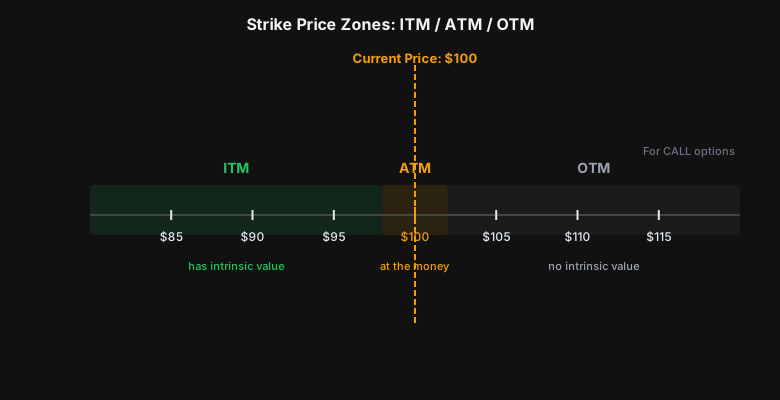
Every strike price falls into one of three zones relative to the current stock price:
In the Money (ITM) — the option already has real value. For a call, ITM means the strike is below the current price. If a stock is at $50 and you hold a $45 call, you're $5 in the money. You could exercise right now and profit.
At the Money (ATM) — the strike is at or near the current stock price. A $50 call when the stock is at $50. No intrinsic value yet, but maximum time value. Delta is close to 0.50.
Out of the Money (OTM) — the option has no intrinsic value. A $55 call when the stock is at $50. The stock needs to climb $5 before the option has any real value. Cheap, but requires a bigger move to profit.
How Strike Price Affects Your Cost
With a stock trading at $50, here's what three different strikes on a 45-day call look like:
- ITM strike $45: costs $6.50 ($5 intrinsic + $1.50 time value)
- ATM strike $50: costs $3.00 (all time value)
- OTM strike $55: costs $1.20 (all time value)
The ITM call is most expensive because it already has $5 of real value baked in. The OTM call is cheapest — but it needs a bigger move to profit.
Breakevens at expiration:
- $45 call: $45 + $6.50 = $51.50 (stock needs to rise just $1.50 from current)
- $50 call: $50 + $3.00 = $53.00 (stock needs to rise $3.00)
- $55 call: $55 + $1.20 = $56.20 (stock needs to rise $6.20)
The OTM option looks cheap, but it demands the most from the underlying stock.
I bought a 2-week OTM call once. AAPL moved up $5. My option barely moved. That's time decay eating your gains — combined with Delta being too low to translate the stock's move into meaningful profit.
Expiration Date: Your Time Deadline
Every options contract has an expiration date. After that date, the contract is gone. Zero value if it expires out of the money.
The expiration date you choose determines three things: how much time value you pay, how long your thesis has to play out, and how fast time decay works against you.
Short expiration = cheaper, but brutal time pressure. Long expiration = more expensive, but time works more slowly against you.
Weekly vs Monthly vs LEAPS
Weekly options expire every Friday. They're cheap — sometimes $0.50 or less. High leverage if you're right, total loss if you're slightly wrong on timing. I rarely use weeklies for directional plays. They're better for selling premium or trading specific catalysts you know will happen this week (earnings, Fed announcement).
Monthly options expire on the third Friday of each month. This is where I spend most of my time. 3-6 weeks of runway is enough for most directional trades. Liquidity is better than weeklies. Time decay is present but not yet brutal.
LEAPS are options with expirations of one year or more — often January of the following year. They behave more like stocks: high Delta, low time decay relative to their lifetime. A LEAPS on AAPL might cost $2,000-$2,500 per contract. Expensive, but useful for multi-year bullish bets or as stock replacements in longer portfolios.
Time Decay Accelerates in the Last 30 Days
This is the most important dynamic beginners miss: time decay (theta) is not linear. It accelerates as expiration approaches.
An ATM option with 90 days left might lose $0.02 of value per day. The same option with 14 days left loses $0.08 per day. With 5 days left, it might lose $0.20+ per day.
The curve is exponential near expiration. If you're holding an OTM option and the stock hasn't moved in your direction, you're watching your premium evaporate faster and faster.
This is what happened on my first trade. Two weeks until expiration, OTM strike, and time decay accelerated exactly when I needed the option to gain value.
The 30-45 Day Rule: Why Most Traders Use It
The 30-45 DTE (days to expiration) range is the sweet spot for buying options.
Here's why:
- Enough time value remaining that a reasonable move in the stock can generate profit
- Theta decay exists but hasn't reached the steep part of the curve yet
- Good liquidity — these contracts trade actively
- If the trade goes wrong, you can often salvage some premium by exiting early
When I buy a directional option now, I almost always start at 30-45 DTE. If I'm wrong on timing but right on direction, I have room to wait. If the stock moves fast in my favor, I can exit early for a gain before time decay becomes a factor.
For selling options (covered calls, cash-secured puts), the logic reverses: you want the 30-45 DTE range because you're collecting that accelerating time decay as income.
A Practical Decision Framework
Before choosing any strike and expiration, I run through these four questions:
1. How long do I expect to wait? If my thesis plays out in a week, I still buy a monthly. I give myself more time than I think I need. Being right on direction and running out of time is the most frustrating loss in options.
2. How large a move do I realistically expect? Calculate the breakeven. For a call, it's strike + premium. If I paid $3.00 for a $50 call, the stock needs to reach $53 at expiration for me to break even. Is that realistic in my timeframe?
3. What's my risk tolerance? OTM options are cheaper but have higher probability of total loss. ITM options cost more but have higher probability of ending with some value. ATM is the middle ground — where most beginners should start.
4. Is there a clear catalyst? If earnings are in 3 days and I expect a big move, a short-dated OTM option might make sense. Without a clear catalyst, favor longer expirations and ITM or ATM strikes.
A simple starting point: if you're bullish on a stock and want to express it with a call, buy an ATM call expiring 30-45 days out. That gives you a 50 Delta start, reasonable breakeven, enough time to be right, and moderate time decay.
That framework cost me $400 to learn. Now it's yours for free.
Selecting a Strike Price and Expiration Date in 2026: A Five-Step Checklist
Update, 16 September 2026. The framework above has not changed; the market around it has. The 10-year Treasury touched 5% this week for the first time since 2007, the Fed is expected to raise rates today for the first time since 2023, and the VIX sits near 17. Three of those facts change how I select strikes and expirations, so here is the checklist I actually run now.
- Rates matter for premium again. With short-term Treasury bills yielding above 4%, the cost of carry is back in the pricing model. Calls cost more and puts cost less than they did at zero rates, all else equal, and the effect grows with time to expiration. A LEAPS call carries a year of that cost inside its premium; a 30-day option barely notices it.
- Use delta as the probability gauge. Delta approximates the chance of finishing in the money: about 0.70 for an ITM strike, 0.50 at the money, 0.30 for a typical OTM strike, 0.16 at one standard deviation. Pick the strike from the probability you want, not from the price you like.
- Match the expiration to the catalyst, then add a cushion. Earnings or a Fed decision inside the window mean elevated implied volatility that collapses the moment the news is out; buying the day before pays for volatility that disappears at 14:01. A directional trade gets 30–45 days; a thesis that needs a quarter gets 60–90 days; a view on a cycle goes to LEAPS.
- Check implied volatility before the strike. On a Fed day the front-week options price a move larger than the 2% the S&P 500 has averaged on decision days; compare the implied move with history before paying for it.
- Write the exit before the entry. A profit target, a stop on the underlying, and a date to close if nothing has happened, typically at 21 days to expiration for a position opened at 45.
| Purpose | Expiration | Strike | Delta |
|---|---|---|---|
| Catalyst this week (earnings, Fed) | 7–14 days | ATM or first OTM | 0.40–0.50 |
| Directional trade | 30–45 days | ATM | about 0.50 |
| Thesis that needs a quarter | 60–90 days | slightly ITM | 0.60–0.70 |
| Stock replacement | LEAPS, 12+ months | deep ITM | 0.80 and above |
| Selling premium | 30–45 days | OTM | 0.16–0.30 |
Read this with the beginner's guide to implied volatility and, for a live example of catalyst timing, today's three Fed scenarios.
— Ruslan Averin