On 14 August 2026 the US Treasury sold $25 billion of 30-year bonds at 5.216%. It was the highest yield at a 30-year auction since 2001. Three days later the secondary market printed 5.31%, the highest daily close in the FRED series since 2007. On 8 September the bond closed at 5.25%.
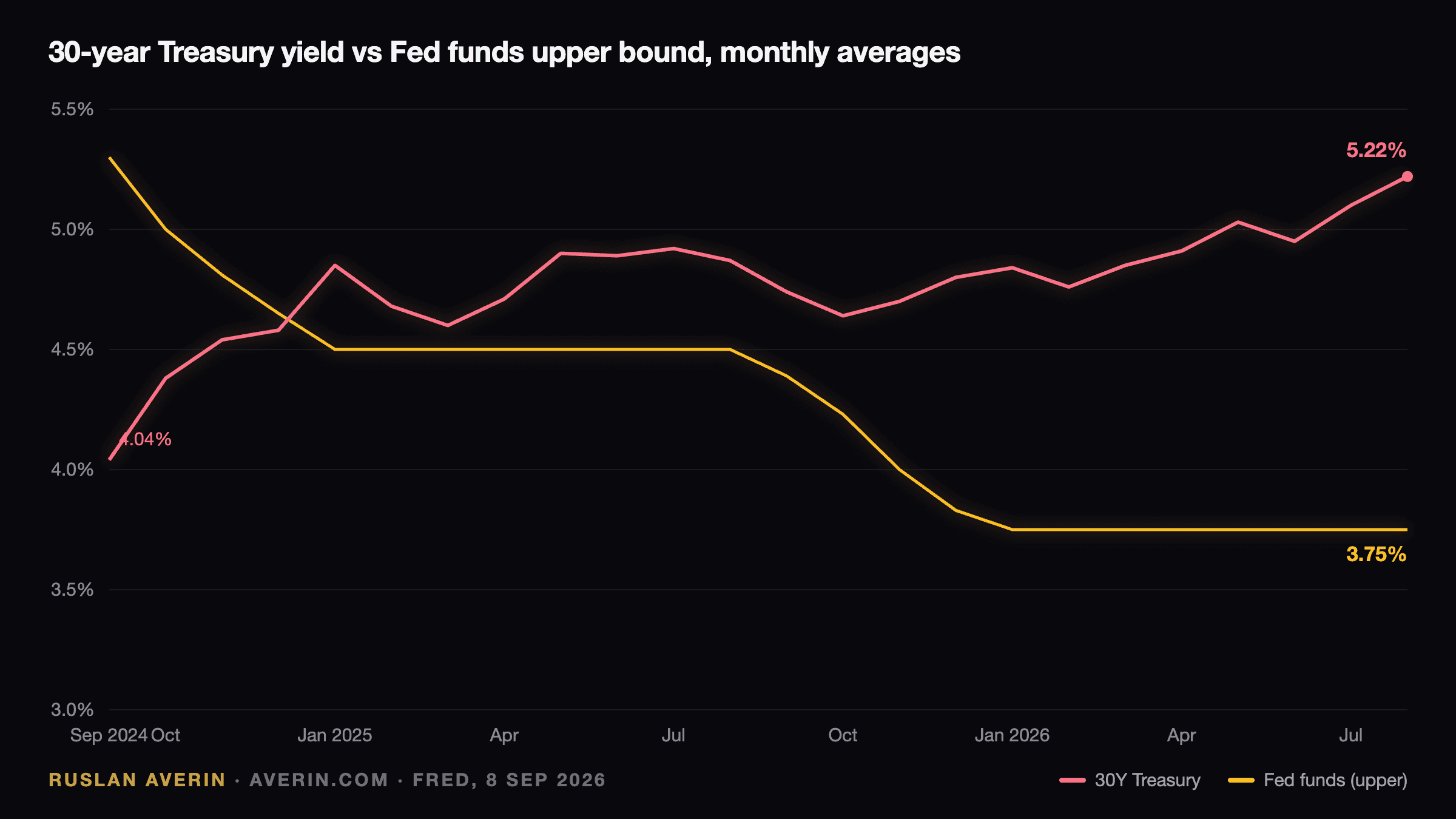
A quarter of a century is a long time. The last time the US government paid this much to borrow for thirty years, the policy rate was 6.5%, the federal debt was $5.7 trillion, and the deficit had just turned into a surplus. Today the policy rate is 3.75%, the debt has crossed $40 trillion, and the 12-month deficit is $1.8 trillion. The 30-year yield is not high because short rates are high. It is high in spite of them.
Who bought the auction
The auction statistics are the best window into who is still willing to lend for thirty years.
| 30-year auction, 14 August 2026 | |
|---|---|
| Size | $25 billion |
| High yield | 5.216% |
| Bid-to-cover | 2.39 |
| Primary dealers' share | 11.5% |
A bid-to-cover of 2.39 is on the low side of the past two years' range. The dealer share of 11.5% is the number to watch: primary dealers are obliged to bid, and the paper they absorb is the paper nobody else wanted. At 11.5% they were not left holding the bag, but the buyer base is narrower than it was. Domestic funds and insurers took the rest.
Compare the 10-year auction on 9 September: 4.834%, bid-to-cover 2.71, with 79.2% going to indirect bidders — the category that includes foreign central banks and overseas funds. Demand for ten-year paper is fine. Demand for thirty-year paper is the problem, because the marginal foreign buyer has stopped showing up at the long end.
Who is selling
Two sellers matter, and one of them is a government.
Japan's Ministry of Finance has been selling Treasuries repeatedly through the summer to defend the yen. When Tokyo needs dollars to buy yen, it sells the most liquid dollar asset it holds, and it holds a great deal of long US paper. Every intervention is a bid removed from the 30-year.
The second seller is the US Treasury itself, and it is selling by necessity. Debt held by the public reached 100% of GDP in August. Net interest is running at roughly $1.25 trillion a year, more than defence. The deficit is $1.8 trillion over twelve months and $168 billion in August alone. That has to be financed, and Treasury has chosen to finance a growing share of it in coupons rather than bills. The one mitigating move — tripling the buyback programme to $6 billion of off-the-run long bonds — is a rounding error against $25 billion auctions every month.
Behind both sits the private-sector flood: corporate issuers, led by hyperscalers borrowing to fund AI capex, have sold more than $1.5 trillion of bonds this year. A pension fund choosing between a Microsoft 30-year and a Treasury 30-year does not have to buy the Treasury.
The arithmetic of a 30-year bond at 5.25%
This is where the coupon stops being the point. A 30-year bond with a 5.25% coupon at par has a modified duration of about 15. That means:
| Yield move | Approximate price change |
|---|---|
| +0.25% | −3.7% |
| +0.50% | −7.1% |
| +1.00% | −13.5% |
| −0.50% | +8.0% |
| −1.00% | +16.9% |
A half-point rise in yield — the distance the 30-year travelled between May and August — costs a holder seven percent of principal, or sixteen months of coupon. The bond pays 5.25% a year and can lose that in a fortnight.
Set that against the 2-year at 4.39% with a duration under two: the same half-point move costs under 1%. The 30-year offers an extra 0.86% of yield for roughly eight times the price risk. In September 2026 that trade is being paid, but not generously.
Where the value is on the long end
If the objective is the highest coupon per unit of duration, the answer is not the 30-year. The 20-year at 5.26% pays a basis point more with a duration of about 12.3 instead of 15. It trades cheap because it has fewer index buyers, which is precisely why a buyer who does not care about the index should own it.
If the objective is a locked real return for a long horizon, the 10-year TIPS at a 2.43% real yield is the cleaner instrument. It carries the same government credit, removes the inflation risk that is the main reason the long end has repriced, and for a buyer who will hold to maturity is very close to what a 30-year at 5.25% is supposed to deliver — without the 15-duration exposure to the next Japanese intervention or the next hawkish Warsh speech.
Is 5.25% a top?
Nobody knows, and the honest range is wide. The case for a top: 5.25% nominal is 1.85% above July CPI and 1.5% above the policy rate, the auction cleared, and a Fed hike on 16 September would flatten the curve by pulling the front end up faster than the back. The case against: the supply is structural, the foreign bid is shrinking, the deficit is not on any path to $1 trillion, and a 3.4% inflation rate with oil elevated is not a rate at which a 30-year bond is obviously cheap.
My own position is that the 30-year is a trading instrument in 2026, not a holding. The yield is attractive enough to buy on a move above 5.3% and sell on a move below 5%. It is not attractive enough to lock away for three decades when the 20-year pays the same coupon and TIPS lock the real return without the inflation bet. The yield-curve overview shows where the 30-year sits against the rest of the curve; the playbook turns this into an allocation.