An investment-grade corporate bond index yielded 5.53% on 8 September 2026. That is a good number in absolute terms — a year ago it was 4.79%. It is a bad number once it is taken apart.
Of the 5.53%, 4.72% is the yield on the Treasury bond of matching maturity. The remaining 0.81% is the option-adjusted spread — the compensation an investor receives for lending to a corporation rather than the US government. Eighty-one basis points a year is what the market charges for the possibility of default, downgrade, illiquidity and every other thing that can go wrong with a company and cannot go wrong with the Treasury.
The corporate bond's yield went up 0.74% in twelve months. The Treasury's went up 0.70%. The spread barely moved. Corporate bonds are not paying more for corporate risk this year; they are paying more because government bonds are.
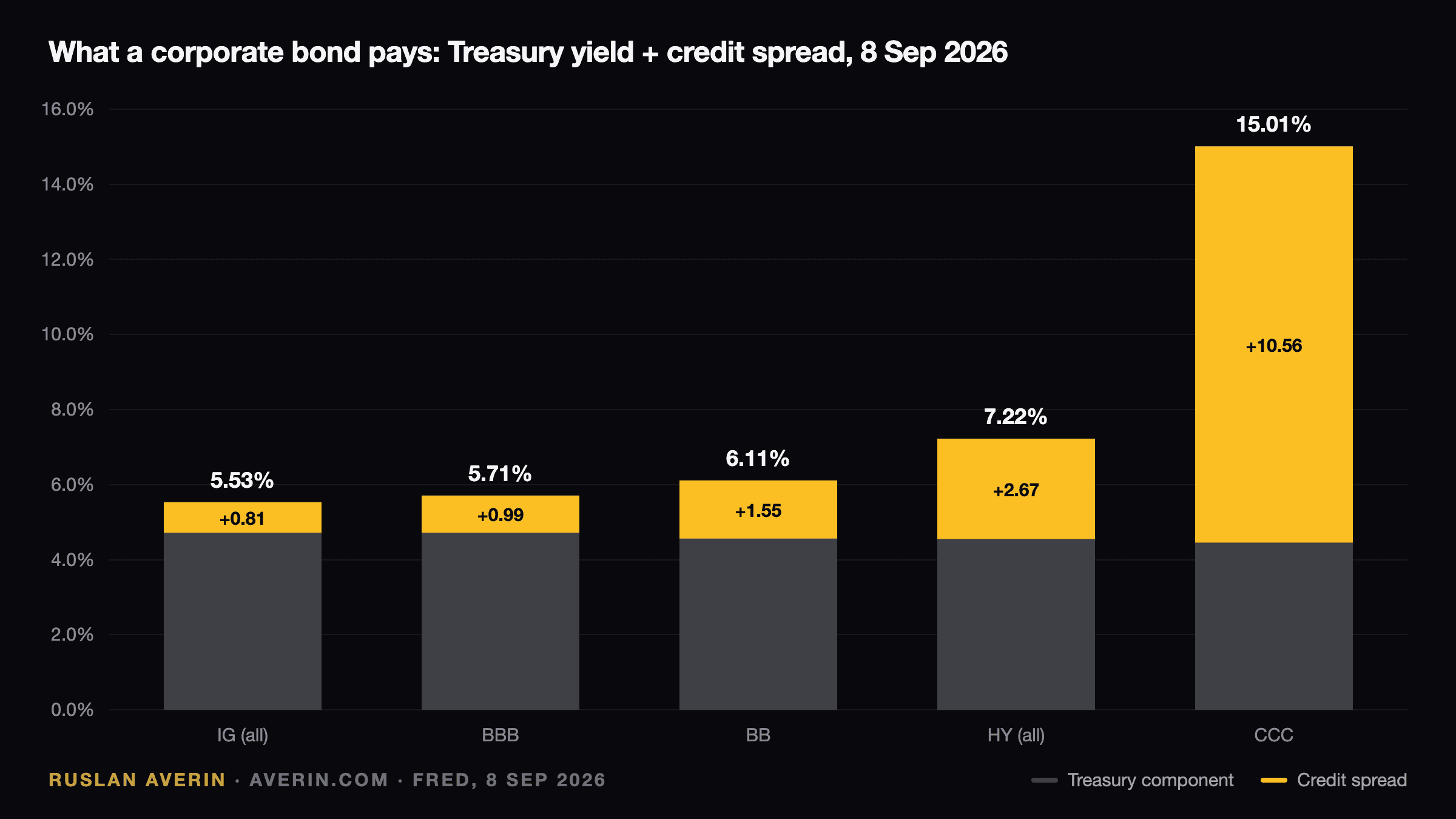
The spread ladder, rung by rung
| Segment | Effective yield | Spread over Treasuries | Treasury component |
|---|---|---|---|
| AAA corporate | 5.40% | 0.43% | 4.97% |
| Investment grade (all) | 5.53% | 0.81% | 4.72% |
| BBB | 5.71% | 0.99% | 4.72% |
| BB | 6.11% | 1.55% | 4.56% |
| High yield (all) | 7.22% | 2.67% | 4.55% |
| B | 7.31% | 2.76% | 4.55% |
| CCC and below | 15.01% | 10.56% | 4.45% |
Source: ICE BofA indices via FRED, 8 September 2026.
Two things stand out. First, the investment-grade spread of 0.81% is within a few basis points of its two-year low (0.75% in June 2026), and the high-yield spread of 2.67% is likewise near the bottom of its range. These are not distressed levels; they are the levels of a market that is not worried. Second, the ladder is not linear. From BB to B the spread widens by 1.21%. From B to CCC it widens by 7.8%. The market is pricing the bottom of the credit stack as a different asset class, and it is right to.
What 0.81% has to cover
The long-run average annual default rate for investment-grade credit is a few tenths of a percent, and recovery on a defaulted senior bond has historically been around 40 cents on the dollar. Expected loss on a diversified IG portfolio is therefore small — call it 0.1–0.2% a year in a normal year. On that arithmetic 0.81% looks like adequate compensation.
The problem is that the spread is not only a default premium. It also has to pay for:
- Downgrade risk. A BBB bond that becomes BB is sold by every fund with an investment-grade mandate, and the holder eats the price gap between 0.99% and 1.55% of spread — roughly 3% on a seven-year bond — without any default occurring.
- Liquidity. Corporate bonds do not trade like Treasuries. In March 2020 the IG spread went from 1% to 4% in three weeks, and the bid disappeared for anything that was not a benchmark issue.
- Supply. Corporate issuance in 2026 is running above $1.5 trillion, driven by AI capital expenditure. The hyperscalers are excellent credits, but the sheer volume of paper is what keeps spreads from tightening further and is what will widen them if the AI capex cycle turns.
Eighty-one basis points covers the first item comfortably and the second and third barely at all. That is a description of a spread priced for a good year, not a bad one.
High yield: 7.22% for a reason
High yield is the more honest market. A 7.22% yield with a 2.67% spread says that the index expects some defaults and is being paid for them. Within it, BB at 6.11% is the sweet spot for an investor who wants more than Treasuries without taking company-specific risk: the historical default rate for BB is low, the spread of 1.55% is nearly double investment grade, and the bonds are mostly larger issuers one notch below the line.
CCC at 15.01% is not a yield. It is a probability. A bond that yields 15% when the risk-free rate is 4.45% is pricing a substantial chance that the coupon will not be paid in full, and the 10.56% spread is the market's estimate of the expected loss plus the premium for being the one to absorb it. Some CCC credits will pay in full and return 15%; the index will not.
What I would own
The decision this month is not IG versus HY. It is Treasuries versus credit, and Treasuries win most of the argument.
- Investment grade at 0.81%: own it only where a specific mandate requires corporate paper. The marginal 0.81% over Treasuries does not pay for a spread-widening event, and there will be one.
- BB at 6.11%: the one segment of credit where the extra 1.55% is reasonable compensation for the incremental risk, provided the position is diversified across issuers.
- B and CCC: trading instruments for specialists. Not an allocation.
- The Treasury alternative: the 10-year at 4.80% and the 20-year at 5.26% offer most of the corporate yield with none of the corporate risk, and TIPS at a 2.43% real yield remove the inflation risk that is the actual reason yields are where they are.
The corporate bond market in September 2026 is paying investors well for government risk and poorly for corporate risk. Take the yield where it is being offered. The curve overview has every Treasury maturity; the playbook turns this into a portfolio.