
Two dates in the next week will decide what a US bond pays for the rest of 2026. On Friday 11 September at 8:30 ET the Bureau of Labor Statistics publishes August CPI. On Wednesday 16 September at 14:00 ET the Federal Reserve announces its rate decision, and the market currently prices roughly a 56% probability of a 25 basis point hike to 3.75–4.00%.
Everything below is built on where yields closed on 8 September and on the arithmetic of what each outcome does to them. It is not a forecast of the outcome.
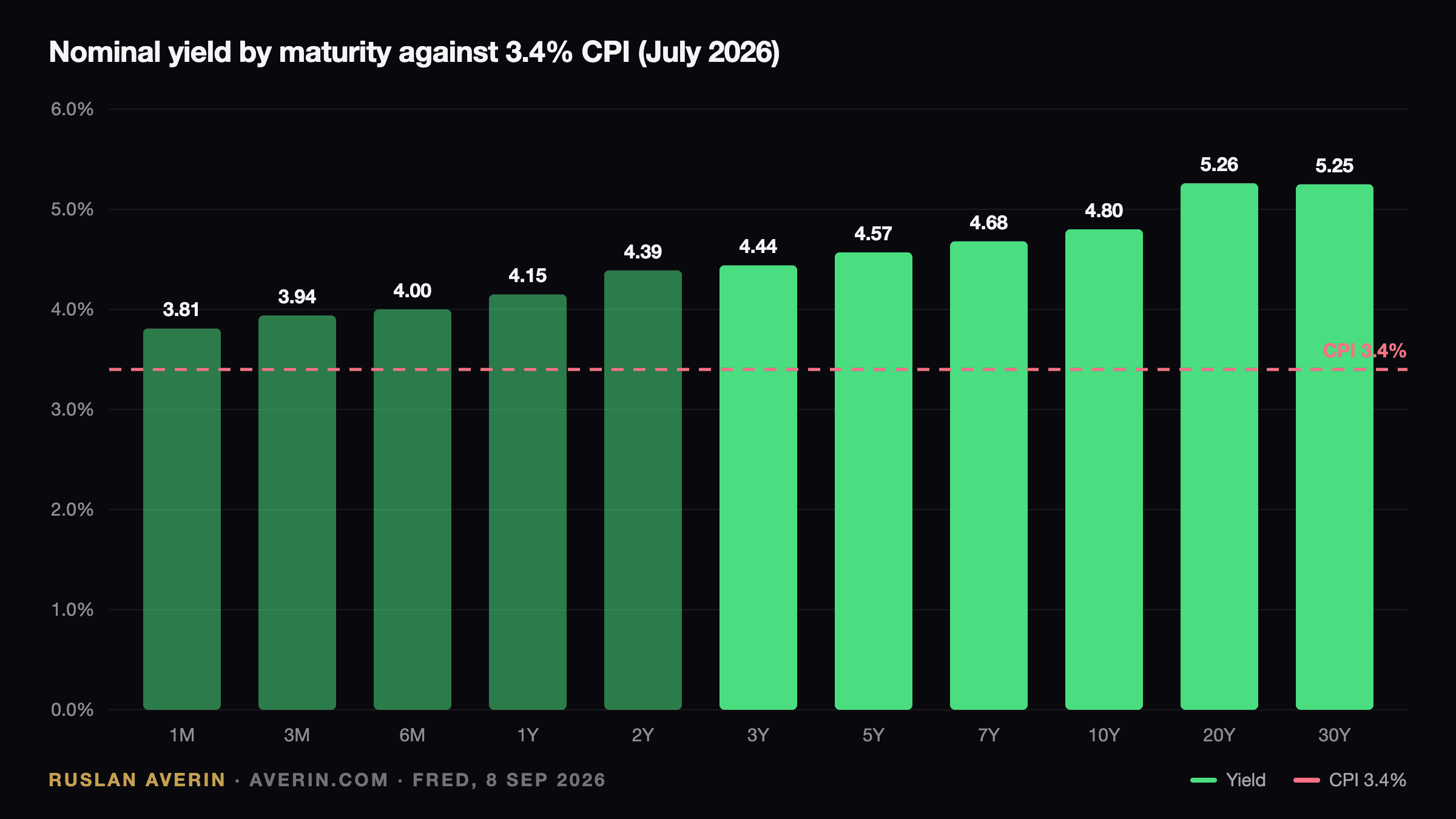
The starting point
| Instrument | Yield, 8 Sep 2026 | Duration (approx.) |
|---|---|---|
| 3-month bill | 3.94% | 0.25 |
| 2-year note | 4.39% | 1.9 |
| 5-year note | 4.57% | 4.4 |
| 10-year note | 4.80% | 7.9 |
| 10-year TIPS (real) | 2.43% | 8.5 |
| 20-year bond | 5.26% | 12.3 |
| 30-year bond | 5.25% | 15.0 |
| IG corporate | 5.53% | 6.8 |
| BB high yield | 6.11% | 3.8 |
July CPI was 3.4%. Every Treasury maturity from one month out yields more than that in nominal terms, and every maturity from one year out yields more than a point above it. That has not been true for most of the past fifteen years.
Scenario one: the Fed hikes
A 25 basis point hike on 16 September lifts the front end almost one-for-one. The three-month bill moves to about 4.2%, the two-year — which already prices most of one hike — perhaps 10–15 basis points higher. The long end is the interesting part. A hike that the market reads as credible — a Fed willing to act on 3.4% inflation — flattens the curve: the 30-year may not rise at all and could fall, because the inflation premium that pushed it to 5.25% shrinks. A hike read as too little does the opposite and steepens the curve further.
Positioning for scenario one: short duration is safe and long duration is a bet on Fed credibility. The two-year at 4.39% loses about 0.3% of price on a hike and earns that back in a month of coupon.
Scenario two: the Fed holds
A hold with hawkish language — the "we are watching September CPI" outcome — is the scenario the long end fears most. It keeps the policy rate 1.5% below the 30-year yield, keeps the inflation question open, and gives the market another six weeks to sell duration into every auction. In that scenario the 10-year retests 4.85% and the 30-year retests 5.31%.
A hold with soft language — a Fed signalling that the July and August payroll numbers of 21,000 and 162,000 worry it more than the CPI — would rally the front end and do very little for the back.
What a hot CPI print does to both
The Friday CPI comes first, and it can change the odds for Wednesday. Consensus is for a headline print close to July's 3.4%. A print at 3.6% or above pushes hike odds toward 75% and adds 10–15 basis points to the two-year on the day. A print at 3.2% or below pulls the odds under 40% and the two-year back toward 4.25%. The 30-year moves less on either, because the long end is trading supply and credibility, not the monthly print.
The ladder that works in both scenarios
For a private investor who is not trading the outcome but wants the yield, the structure that survives both scenarios is a short-to-intermediate ladder with an inflation-protected anchor:
| Bucket | Instrument | Share | Why |
|---|---|---|---|
| 0–1 year | Bills, 3.94–4.15% | 30% | Reprices up on a hike, no principal risk |
| 2–3 years | Notes, 4.39–4.44% | 30% | Locks most of the curve's rise, duration under 3 |
| 5–10 years real | TIPS, 2.17–2.43% real | 25% | Removes the inflation bet that drives the long end |
| 10–20 years | 10Y 4.80% / 20Y 5.26% | 15% | Long coupon, sized so a 0.5% move costs under 1% of the total |
What it excludes: the 30-year (the 20-year pays the same with less duration), investment-grade corporates (the 0.81% spread does not pay for a widening), and anything below BB.
For a non-US investor: the tax line that changes the answer
This is the part that a Ukrainian or European reader should not skip, because it moves the net yield by more than any Fed decision.
Interest on US Treasuries paid to a non-resident is exempt from US withholding tax under the portfolio-interest rules, provided the broker has a valid W-8BEN on file. A Ukrainian resident who buys a Treasury note directly through a broker receives the full 4.39% coupon with nothing withheld in the US. The same applies to most registered corporate bonds.
Distributions from a US-domiciled bond ETF are dividends, not interest. They are subject to 30% withholding, reduced to 15% under a tax treaty — Ukraine's treaty with the US provides 15%. Some US ETFs designate part of their distributions as "qualified interest income" and pass Treasury interest through without withholding, but not every fund does and not every broker applies it. A 4.39% yield becomes 3.73% after a 15% haircut and 3.07% after 30%.
An Irish-domiciled UCITS ETF holding US Treasuries pays no US withholding on the interest at fund level and is the usual route for European investors who want the yield in an ETF wrapper. Accumulating share classes defer the income entirely.
What none of this removes is the home-country tax. A Ukrainian resident's foreign investment income — coupons and capital gains — is taxed at 18% personal income tax plus the 5% military levy, and must be declared. That 23% is the real cost, and it applies equally to a direct Treasury and to an ETF. It is also the reason hryvnia OVDP, which carry no income tax and no levy, remain competitive on a net basis despite the currency risk.
The one-line version
Own the front end for the coupon, own TIPS for the real return, keep the long end small enough that Friday and Wednesday cannot hurt you, and buy Treasuries directly rather than through a US ETF if you live outside the United States. The curve overview has the full set of yields this rests on.
This is analysis, not tax advice. Withholding rates depend on residence, treaty status and broker documentation; confirm them for your own situation.