Amazon reports third-quarter 2026 results on Thursday 29 October after the US close. The conference call starts at 2:00 p.m. Pacific, 5:00 p.m. Eastern (23:00 in Kyiv), according to the company's investor relations calendar. The stock closed on Tuesday 27 October at $253.10, up 1.61% on the day and 9.7% above its 31 December 2025 close of $230.82.
The setup is unusual: Amazon guided below the Street in July, the stock jumped 15% anyway, and the biggest swing factor in reported earnings is a stake in a private company preparing to list.
Amazon's own Q3 guidance and the consensus
Amazon's 30 July release guided third-quarter net sales to $197.0–202.0 billion, growth of 9–12% on a year earlier, including about 80 basis points of currency headwind. Prime Day moved into June this year, and the company says growth excluding Prime Day in both years would be "nearly 400 basis points higher". Operating income was guided to $22.5–26.5 billion, against $17.4 billion in the third quarter of 2025.
That guidance landed below expectations. Analysts polled by LSEG had expected $204.1 billion of third-quarter revenue, CNBC reported on 30 July; StreetAccount's operating income estimate was $24.92 billion, inside the range.
| Line | Guidance or consensus | Source |
|---|---|---|
| Net sales | $197.0–202.0 billion | Amazon, 30 July |
| Revenue consensus | around $202 billion | Pepperstone, 23 October |
| Operating income | $22.5–26.5 billion | Amazon, 30 July |
| EPS consensus | $2.01 (14 analysts) | Zacks, via Nasdaq |
| EPS consensus | $1.96 | Pepperstone, 23 October |
| Q3 2025 EPS | $1.95 | Zacks, via Nasdaq |
So the Street sits at the top of Amazon's own revenue range. Amazon usually guides conservatively, but a print mid-range would be a miss on paper.
What moved the stock into the print
The second-quarter report was a clean beat. Revenue was $200.61 billion against $196.47 billion expected and adjusted EPS $1.97 against $1.82, per LSEG via CNBC. The stock closed at $235.50 on 30 July and at $271.58 the next day, a 15.3% gain, and reached $284.02 at the close on 3 August, according to Yahoo Finance data.
It has given back much of that since. Amazon closed at $262.37 on 21 October, fell 4.57% to $250.38 on 22 October and has hovered around $250 since, per stockanalysis.com. Tuesday's $253.10 is 10.9% below the August high. October was rough for AI-linked stocks generally, as our piece on the Nasdaq's worst week describes, with investors questioning how the infrastructure build is being financed.
AWS: can 37% hold?
AWS revenue grew 37% to $42.2 billion in the second quarter, the fastest in 18 quarters. StreetAccount had expected 31%. Segment operating income was $16.6 billion, a 39.3% margin.
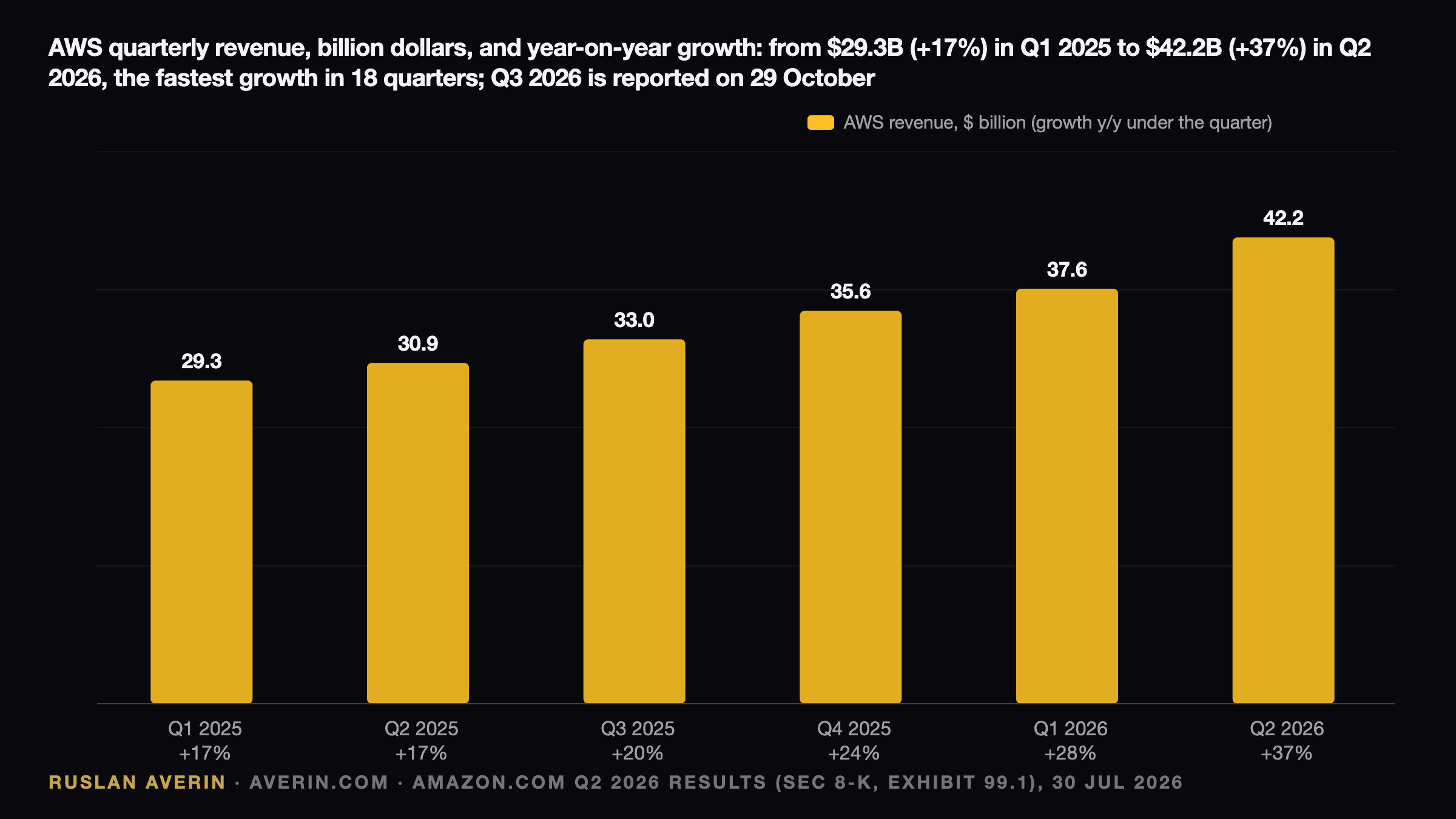
Pepperstone's preview puts the market's expectation at around 35% growth for the third quarter. On last year's $33.0 billion base, that is roughly $44.6 billion. The base is tougher: AWS grew 20% in Q3 2025, after 17% in Q2.
The constraint is supply, not demand. On the July call Andy Jassy said that even with higher spending "we will still not have enough capacity to meet all the demand we have in 2026, and I believe this dynamic will also be true in 2027 too." AWS backlog was $496 billion at 30 June, Jassy said; the 10-Q gives a weighted-average remaining contract life of 6.4 years. It includes an OpenAI expansion of $100 billion over eight years and an Anthropic expansion of more than $100 billion over 10 years.
The margin is the second test. AWS depreciation rose to $8.08 billion in the second quarter from $4.84 billion a year earlier, a 67% increase, faster than revenue. If the margin slips well below 39%, the AWS growth beat will matter less.
Capex: $220 billion, and the cash it consumes
Jassy raised the 2026 capital spending forecast to about $220 billion on the July call, from the $200 billion given in February and repeated in April. He attributed the increase to rising memory prices, CNBC reported.
Cash capital expenditures were $53.1 billion in the second quarter and $96.3 billion in the first half, according to the 10-Q. If the $220 billion is on a comparable basis, the second half needs roughly $124 billion, about $62 billion a quarter. Trailing twelve-month free cash flow was already an outflow of $7.6 billion at 30 June, against an inflow of $18.2 billion a year earlier.
The gap is being filled with debt. Long-term debt was $128.9 billion at 30 June, up from $65.6 billion at the end of 2025, and Amazon sold £4.25 billion of sterling notes on 14 September, according to its 8-K. Part of the build goes to suppliers, as in the $8 billion Generac deal.
The Anthropic stake: why GAAP EPS may look strange
Second-quarter net income was $62.6 billion, or $5.75 a share, including $53.4 billion of pre-tax other income, "primarily from our investments in Anthropic".
Amazon's 10-Q shows that at 30 June it held Anthropic nonvoting preferred stock carried at about $92.5 billion and convertible notes at a fair value of about $97.9 billion, roughly $190.4 billion in total. The preferred stock is revalued only on "observable changes in prices", such as a new funding round, and those adjustments go through other income: $50.5 billion in the second quarter, after the Series H at a $965 billion valuation in May. Gains on the notes go to accumulated other comprehensive income instead, not to net income. That unrealized gain stood at $92.0 billion.
The practical point: I found no priced Anthropic round between July and September in the reporting I reviewed. If there was none, the third-quarter mark could be far smaller than the second quarter's. The IPO itself, reported for November at about $2 trillion (see our Anthropic IPO analysis), would fall in the fourth quarter. At Tuesday's close the stake is about 7% of Amazon's roughly $2.7 trillion market value, using the 10.77 billion weighted-average basic shares from the Q2 release.
The five lines that decide the reaction
In analyst Ruslan Averin's view, the revenue line matters less than usual this quarter, because the Prime Day shift distorts it. I would watch these five numbers:
- AWS growth. Around 35% is the bar. 37% or more says capacity is arriving faster than feared; 32% or below would revive the question of whether the spending is paying off.
- AWS operating margin. Above 38% means depreciation is being absorbed; well below that means the capex bill is reaching the income statement.
- Advertising. Ads grew 26% to $19.81 billion in Q2, ahead of StreetAccount's $19.43 billion. The same pace on last year's $17.70 billion would give about $22.3 billion.
- Capex for the rest of 2026 and a first 2027 signal. A move above $220 billion without matching AWS acceleration is the bear case.
- Q4 guidance. The holiday-quarter operating income range against consensus, and any comment on Amazon Leo, which had nearly 400 satellites in orbit in July and was due to start initial service this year.
Scenario logic
Options were pricing a move of about 7.4% in either direction, Pepperstone said on 23 October. On Tuesday's close, that is roughly $18.70 a share.
- Upside case: AWS at or above 37% with a stable margin, operating income near the top of $22.5–26.5 billion, capex held at about $220 billion. The August high of $284.02 becomes the reference.
- Base case: AWS at 34–36%, revenue near $202 billion, capex nudged up. A move inside the implied range, driven by the call.
- Downside case: AWS slowing toward the low 30s while capex rises again. That combination is the one the market punished in October.
GAAP EPS may be the noisiest number of the night; I would read operating income and AWS first.
Related: Amazon's Q2 2026 results, the Anthropic IPO at $2 trillion and Amazon's stake and Meta's Q3 2026 earnings and capex.