Eli Lilly reports third-quarter 2026 results before the US market opens on Thursday 29 October, with the conference call at 10:00 ET (16:00 Kyiv), the company confirmed on 15 October. The FMP consensus of 10 analysts is $22.58 billion of revenue, 28% above the $17.60 billion of Q3 2025. The stock closed on Tuesday 27 October at $1,281.91, up 10.8% since the end of September and about 3% below its 52-week high of $1,321.21, according to StockAnalysis.
The quarter is the first full one for Foundayo, the once-daily orforglipron pill, and for the Medicare GLP-1 Bridge. But revenue is still a tirzepatide story: Mounjaro and Zepbound brought in $14.9 billion of the $22.97 billion Lilly booked in Q2.
What the Street expects
| Line | Consensus | Q3 2025 actual |
|---|---|---|
| Revenue, FMP (10 analysts) | $22.58B (range $21.35–23.76B) | $17.60B |
| Revenue, Hudson Labs | $22.36B | — |
| Revenue, Earnings Whispers | $22.11B | — |
| Non-GAAP EPS, FMP (11 analysts) | $5.68 | $7.02 |
| Non-GAAP EPS, Earnings Whispers | $7.11 (whisper $8.71) | — |
The revenue estimates sit close together. The EPS estimates do not, and the reason is a deal, not the drugs. Lilly completed its acquisition of AtaiBeckley on 11 September, paying about $2.8 billion upfront plus a contingent value right worth up to $1.0 billion. Lilly does not strip acquired in-process R&D out of its non-GAAP EPS. Its 2026 guidance also leaves out any such charge taken after 30 June. Q2 already absorbed $3.03 a share of these charges. A charge of similar size in Q3 would explain why some estimates fell by about $3 in a month. An EPS "miss" against an older estimate may be a deal charge, so I would read revenue and gross margin first.
Four quarters, four revenue beats above $1.3 billion
Lilly has beaten the revenue consensus by a wide margin every quarter for a year. Q2 2026 revenue was $22.97 billion against $20.82 billion in the FMP consensus. Q1 was $19.80 billion against $17.82 billion.
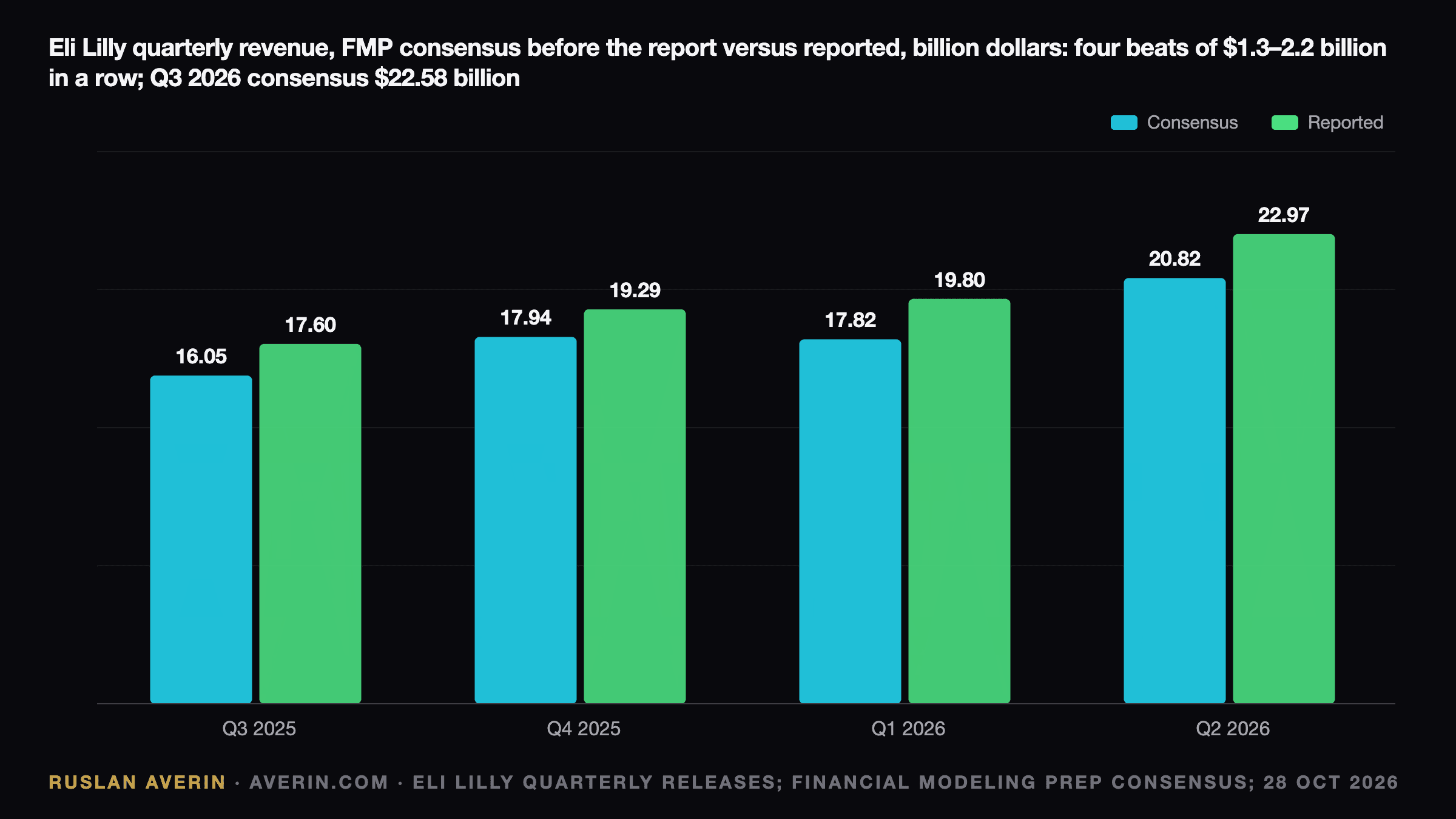
That record works both ways. A beat of $1.5–2 billion is now the expected outcome, not a surprise. A revenue print near $22.6 billion would technically match the estimate but would read as a slowdown against Q2.
Mounjaro and Zepbound: the engine
In Q2, Mounjaro sales rose 91% to $9.94 billion. US sales were $4.8 billion, up 45%; outside the US they were $5.2 billion, up 172%. Zepbound rose 46% to $4.93 billion, almost all of it in the US.
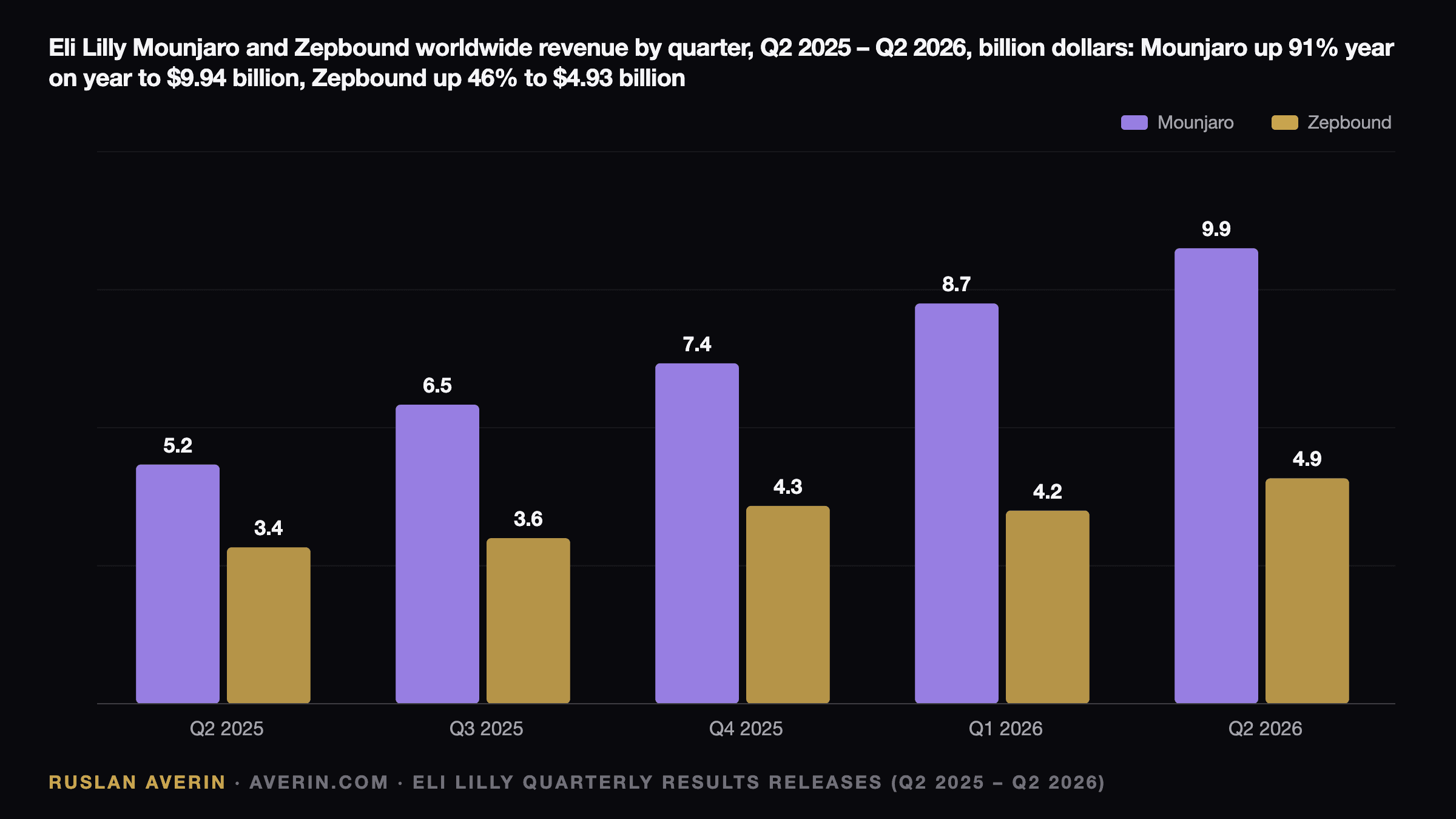
The detail that matters is price. Group volume rose 60% in Q2, but realized prices fell 13%, the same price drop as in Q1. In the US, prices fell 3% as reported, or about 9% excluding rebate and discount adjustments. Outside the US, prices fell 36%, mainly because Mounjaro joined China's national reimbursement list. That cut prices but added volume.
The numbers I would check on Thursday:
- Mounjaro outside the US. Q2's $5.2 billion was more than the US figure. A further step up would confirm the China volume is still building.
- Zepbound in the US. Q1 was $4.1 billion and Q2 $4.9 billion. Cash-pay price cuts and the Medicare Bridge add patients at lower prices.
- The price line. Another quarter of minus 13% is already in the model. A drop in the high teens would hurt more than a small volume miss.
- Gross margin. The Q2 non-GAAP gross margin was 86.3%. Lilly credited product mix and lower production costs.
Foundayo: the first full quarter
Foundayo booked $98 million in Q2, its first quarter as a reported product. The FDA approved it for chronic weight management (see our Foundayo approval and Q2 preview). Two things changed after that. From 1 July, the Medicare GLP-1 Bridge lets eligible Part D patients get Foundayo or Zepbound for weight management for $50 a month. The programme runs until 31 December 2027 and requires prior authorization. Reuters reported on 16 October that EU regulators had backed Foundayo, making it the second oral weight-loss drug to get that support, after Novo Nordisk's.
Lilly gave no prescription or launch-country figures in the Q2 release. Since then, management has described fast growth in prescribers at investor conferences, but I could not confirm those figures in a primary source, so I leave them out. On Thursday, three items will show whether the pill is a real revenue line or still a pilot:
- the Foundayo revenue figure itself;
- any US share of new oral GLP-1 starts that Lilly states in the deck;
- how much of the volume comes through low-price channels, meaning the $50 Medicare tier and self-pay, rather than commercial insurance.
A pill with many patients but low net prices helps the franchise. It does not yet move a $22 billion quarter.
Guidance: a raise is already priced in
At Q2, Lilly raised its 2026 revenue range to $85–87 billion from $82–85 billion. It set non-GAAP EPS at $35.50–36.50: the business added $2.78 at the midpoint, but the $3.03 Q2 charge more than cancelled it out. The performance margin guide rose to 49.0–50.5% from 47.0–48.5%.
Here is the arithmetic. First-half revenue was $42.77 billion, so the range implies $42.2–44.2 billion for the second half. The FMP consensus has $22.58 billion for Q3 and $23.58 billion for Q4, about $46.2 billion together. That puts the full year near $88.9 billion, nearly $2 billion above the top of the range. A raise of only $1 billion, to $86–88 billion, could disappoint. A new range starting near $88 billion is what the consensus implies.
There is another deal in the queue. Lilly agreed to buy Merida Biosciences for up to $2.875 billion, with closing expected in the fourth quarter. Any acquired R&D charge from it would hit Q4 EPS and sit outside the guidance again.
Novo Nordisk, pricing and the calendar
Novo Nordisk reports on 4 November. Its US-listed shares closed at $38.67 on 27 October. Novo fell 7.65% on its own investor day in September (see Novo's 2030 targets). On 26 October a US judge refused Novo's request to block Lilly's weight-loss drug ads, Reuters reported. The rivalry now runs through advertising and cash-pay prices as much as through trial data; Lilly has already cut Zepbound's cash-pay prices, its Q2 release says.
Lilly's filings refer to a voluntary agreement with the US government on drug pricing and access. That is why the price line falls even as volumes grow.
Scenarios
In analyst Ruslan Averin's view, the reaction depends on three numbers in this order: total revenue against about $23 billion (Q2's level), the new full-year revenue range against roughly $88–89 billion, and the Foundayo figure.
- Above Q2 and a raise to $88 billion or more. Revenue at $23.5 billion or higher, Mounjaro outside the US still rising and price erosion no worse than minus 13%. That fits a stock 3% below its high going into the print.
- Matches the estimate but not Q2. Revenue of $22–23 billion and a small raise. After a 10.8% run in October, the move would likely be lower, even with an EPS figure that looks like a beat against older estimates.
- Pricing breaks. Realized prices down more than 15%, or a lower gross margin as Foundayo and Medicare volume grow. That would challenge the volume-over-price story that has carried the stock for a year.
For another large-cap healthcare setup this season, see our Johnson & Johnson Q3 preview. Lilly goes in at about $1.14 trillion of market value and a forward P/E of 33, per StockAnalysis. At that valuation, a clean quarter is already priced in.
Related: Eli Lilly Foundayo pill approval and Q2 preview · Novo Nordisk capital markets day and 2030 targets · Johnson & Johnson Q3 2026 earnings preview