
Generac makes the diesel generators that sit behind a data centre in case the grid fails. On Tuesday evening it filed an 8-K saying Amazon had agreed to buy $2.4 billion of them in 2027 and 2028, with a warrant that keeps paying out until Amazon has spent $8 billion. The stock rose more than 40% after hours, opened Wednesday at $229.50 and closed at $207.23, up 18.34%, on eight million shares against a normal day's one million. That was the same session the Nasdaq snapped its post-Fed losing streak, with AMD up 6.4% and Nvidia up 2.5%, and it is the cleanest single-stock statement yet of a thesis I have been circling for months: the constraint on AI is no longer the chip, it is the electricity.
I do not own Generac. I own the argument, and this is the place to set it out with the contract in hand.
What the filing actually says
The documents are a Global Purchase Agreement dated 24 June 2026, a Long Term Supply Addendum signed this week, and a warrant issued to Amazon.com NV Investment Holdings. The commercial terms are redacted. What is not redacted is enough.
| Term | Value |
|---|---|
| Initial deliveries | $2.4 billion in 2027 and 2028 |
| Warrant ceiling | vests fully when cumulative payments reach $8 billion |
| Warrant shares | 1,693,745, or 2.87% of shares outstanding |
| Exercise price | $200.9266 |
| Vested at signing | 307,954 shares, 0.52% |
| Notional value | about $340 million |
| Term | seven years, to 16 September 2033 |
| Ownership cap | 4.999% of common stock |
| Change of control | full vesting immediately before closing |
| Product | industrial backup generators, "large megawatt" class |
| Supply term, pricing, exclusivity | redacted |
Two readings of the $8 billion are possible and only one is right. It is the threshold at which the last tranche of the warrant vests, not a purchase commitment; 24/7 Wall St was correct to write that "only $2.4B is contracted". But it is also the number Amazon chose to put in a legal document as the point at which it wants to own 2.87% of its supplier, and companies do not negotiate warrant ceilings around volumes they do not expect to reach. Aaron Jagdfeld, Generac's chairman and chief executive, described it to Wisconsin press as establishing "a long-term partner for the supply of industrial backup generators to Amazon" and as "a significant milestone", adding the phrase that matters for the balance sheet: "our ongoing investments in vertically integrated large megawatt generator manufacturing capacity". Amazon declined to comment.
The warrant is Amazon's standard instrument. It took a warrant on 25 million Qualcomm shares at $161.26 on 8 September, vesting against $60 billion of purchases; it took one on 55 million Plug Power shares in 2017 against $600 million of purchases; CNBC lists Astera Labs, ATSG and SpartanNash among others. The logic is the same each time: Amazon gets a discount on its own demand, paid in the supplier's equity, and the supplier gets a customer with a reason to keep ordering. The intrinsic value of Generac's warrant at Wednesday's close was about $10.7 million. The value to Amazon is the pricing leverage a shareholder-customer has in 2029.
What it does to Generac's numbers
Scale first. Generac's 2025 revenue was $4.21 billion, down 2%, with residential at $2.27 billion, down 7%, and commercial and industrial at $1.46 billion, up 5% "primarily due to higher revenue from products sold to data center customers". Adjusted EPS was $6.34. In the second quarter of 2026 the picture had already turned: sales up 11% to $1.17 billion, C&I up 29% to $556 million, residential down 2%, gross margin 44.5% against 39.3%, adjusted EPS $2.91 against a $2.00 consensus, and a data-centre backlog of "approximately $1.6 billion" that "does not include any committed volumes from the second hyperscale customer". Amazon is that second customer; the first committed about $700 million for 2027. Data-centre revenue for 2026 is "nearly $450 million".
So $2.4 billion over two years is 57% of a year's sales and more than five times this year's data-centre revenue; $8 billion is 1.9 times the whole company's annual revenue. Stifel's Stephen Gengaro says the deal "expands backlog by ~$4 billion"; Jefferies' Tanner James argues that consensus for 2028 data-centre revenue is "more than $1.5 billion below reasonable expectations" and that the warrant structure "likely protects margins"; Wells Fargo's Praneeth Satish reckons Generac could supply "almost 50% of Amazon's diesel generator needs" and top $3 billion of data-centre revenue by 2028. Nine targets were raised on Wednesday, Canaccord's George Gianarikas to $375 from $275. Roth's Chip Moore called it "transformational" and kept a Hold at $250, which is the honest position for a stock at 40–48 times trailing earnings and 20 times forward.
The caveats are in the same releases. The second-quarter margin included about $71 million of tariff refunds, six points of gross margin and roughly a point and a half of the full-year EBITDA guidance of 20–21%. Residential is still 54% of sales and it is a housing product: home standby generators sell with houses, and houses are not selling at a 6.95% mortgage rate. Needham flags an August executive order on foreign-produced bulk-power equipment as an engine-sourcing question. And capacity is a promise, not a fact: Enercon in East Peoria, a plant in Belvidere, expansions in Beaver Dam and Oshkosh, and a new Sussex plant due to start production this year. The stock had fallen 40% from its June high of $296.44 to $175 before Tuesday, partly because a March investor day came without a hyperscaler deal; it now has one, and it is still 30% below June.
Why generators, and why now
The generator is the unglamorous end of the AI build-out, and it is where the bottleneck has moved. The IEA's baseline has data-centre electricity rising from about 415 TWh in 2024, 1.5% of global demand, to about 945 TWh in 2030, with US demand up roughly 240 TWh. The grid cannot connect that on the schedule the hyperscalers want: JLL's 2026 outlook puts the average US connection wait at four years and a 100 MW site in Northern Virginia at about seven, against 18–24 months to build the shell; the ERCOT large-load queue was about 410 GW in April, three-quarters of it data centres. SemiAnalysis's June note is the one to read: US data-centre build-out of 21 GW in 2026 rising to 84 GW by 2030 against about 15 GW a year of net-new firm grid capacity, grid headroom "turns negative by 2027", and behind-the-meter generation powering "well over half of new US datacenters in 2028+". A data centre that cannot get a grid connection in time runs on its own turbines and engines, and every one that can still needs backup rated for the full load.
Amazon's side of the ledger explains the urgency. Capex guidance for 2026 was raised to $220 billion in July; AWS grew 37% in the second quarter; the announcements this month alone include a $10 billion site in Wharton County, Texas, a $3 billion site in Sidney, Ohio, and a Saudi region due by December. Data Center Map counts 287 operating and 200 planned AWS data centres in 22 countries. Add the $38 billion OpenAI cloud deal and the $11 billion Anthropic campus, and Amazon needs more standby megawatts than any one supplier makes today, which is why it is taking equity in the one it chose.
The rest of the power trade
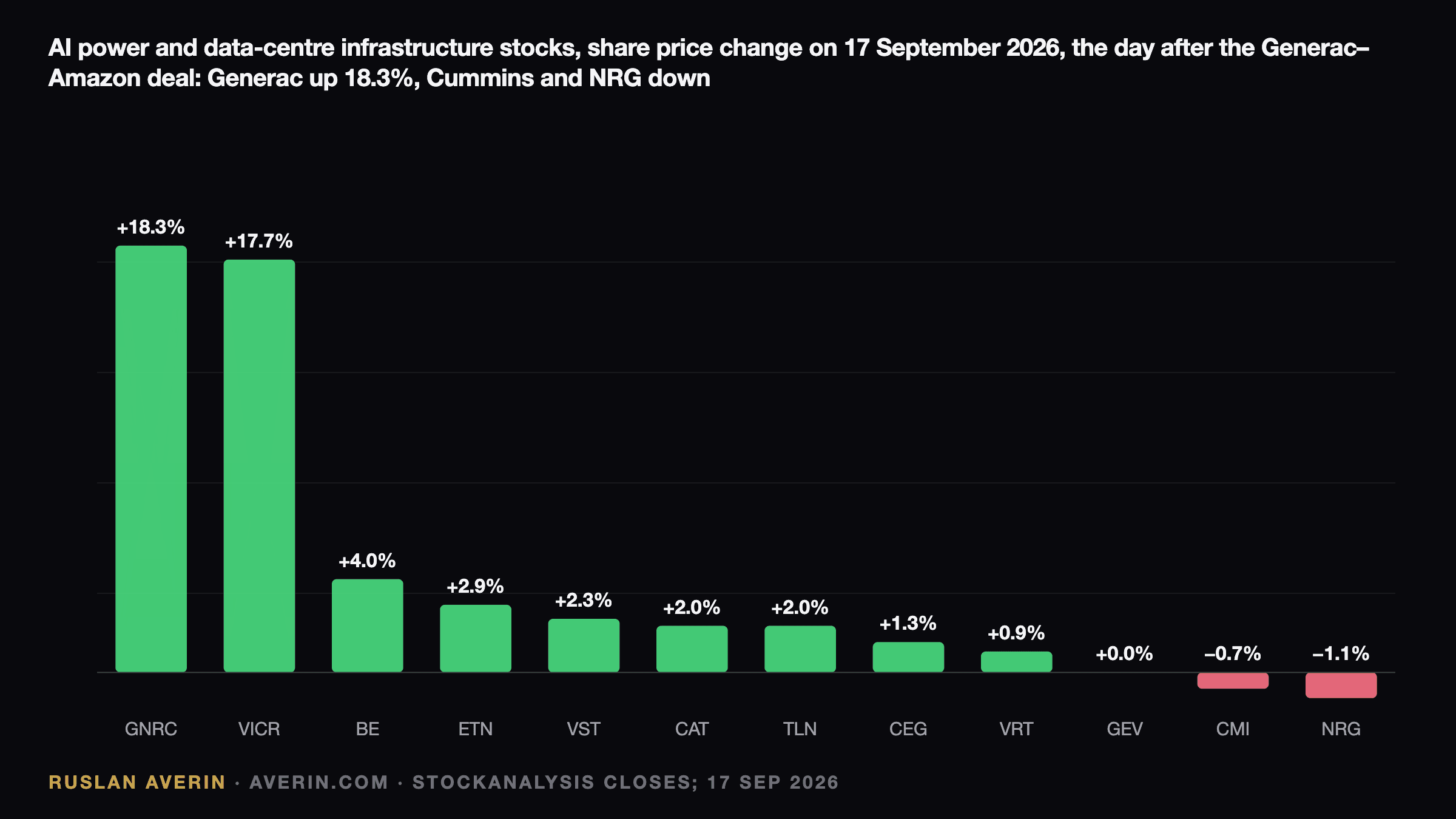
Wednesday's reaction was selective, which is a healthy sign. Vicor, which makes power modules for AI racks, rose 17.7%. Bloom Energy, fuel cells with a $25 billion Brookfield agreement behind it, rose 4.0%. Eaton, whose electrical backlog more than doubled in the second quarter, rose 2.9%. Vistra 2.3%, Caterpillar 2.0% on a record $63 billion backlog and a raised 2026 target tied to data-centre demand, Talen 2.0%, Constellation 1.3%, Vertiv 0.9% after raising 2026 guidance to 24% sales growth on 8 September. GE Vernova, sold out of gas turbines through 2030 with a 116 GW backlog, was flat after a 4.8% gain the day before. Cummins, Generac's most direct competitor in engines, fell 0.7% and "sat out the rally", and NRG fell 1.1%. The industrials ETF was up 0.1%; this was a repricing of one company's backlog, not of the sector.
| Company | 17 Sept move | What it sells to data centres | Latest data-centre marker |
|---|---|---|---|
| Generac (GNRC) | +18.3% | backup generators | $2.4B Amazon deliveries, $8B warrant ceiling |
| Vicor (VICR) | +17.7% | rack power modules | AI power rally |
| Bloom Energy (BE) | +4.0% | fuel cells, on-site power | $25B Brookfield deal, Nebius sites |
| Eaton (ETN) | +2.9% | switchgear, distribution | orders +33%, backlog doubled |
| Vistra (VST) | +2.3% | generation, nuclear | backs $10B KKR AI infrastructure |
| Caterpillar (CAT) | +2.0% | generators, turbines | record $63B backlog |
| Talen (TLN) | +2.0% | nuclear power to AWS | Susquehanna campus, ~2.5 GW |
| Constellation (CEG) | +1.3% | nuclear PPAs | 920 MW of new deals |
| Vertiv (VRT) | +0.9% | cooling, power management | 2026 sales growth guided to 24% |
| GE Vernova (GEV) | 0.0% | gas turbines | 116 GW backlog, sold out to 2030 |
| Cummins (CMI) | −0.7% | engines, gensets, storage | BESS at a large US data centre |
| NRG (NRG) | −1.1% | generation | $3.2B, 1.2 GW hyperscaler deal |
What I make of it
The week's argument about whether AI should slow down, which I covered on Tuesday, ended with Jensen Huang telling the president "We're not going to let that happen, sir" and Zuckerberg writing that labs have "a strong natural incentive" to keep building. The Generac filing is what that looks like in a purchase order: Amazon is buying two years of diesel generators for buildings that do not yet have grid connections, and paying in stock. In analyst Ruslan Averin's view the contract confirms the thesis behind the AI capex cycle piece and changes the ranking inside it. The chip makers are priced for the build-out; the power suppliers were priced, until Tuesday, for a residential generator company with a housing problem. Generac at $207 is neither cheap nor a bargain on the numbers it has reported; it is a call option on the $5.6 billion between the contracted $2.4 billion and the warrant's $8 billion, and the strike is whether the Sussex plant ships on time. The names I would rather own on the same thesis are the ones with backlogs already booked and no single-customer risk: Eaton, Vertiv and GE Vernova, and, for the physical constraint underneath all of them, copper. The Fed's hike on Wednesday raised the cost of financing every one of these plants by a quarter point, as I wrote yesterday; it did not change who needs the megawatts.
Related: the AI slowdown debate and chip stocks, the hyperscaler capex cycle, the Fed's decision and the dot plot and three central banks hiking in 72 hours.