Amazon reported third-quarter 2026 results on Thursday 29 October after the US close. The headline is a split decision: record operating profit and the fastest AWS growth in nearly five years, but a miss on revenue and earnings per share against the LSEG consensus, and a free cash flow outflow of $42.4 billion over twelve months.
The stock had already closed on Thursday 29 October at $243.79, down 4.25% on the day, in a session when Alphabet fell 13% on its own cash flow worries, according to CNBC. After the release Amazon slid more than 6% in extended trading, CNBC reported at 5:09 p.m. ET. In pre-market trading on Friday it was quoted at $226.00 at 8:32 a.m. ET, 7.30% below the close, according to stockanalysis.com.
The numbers against consensus
| Line | Q3 2026 actual | Consensus or guide | Source |
|---|---|---|---|
| Net sales | $201.94 billion | $202.31 billion | LSEG via CNBC |
| Diluted EPS | $1.89 | $1.96 | LSEG via CNBC |
| Operating income | $28.1 billion | $22.5–26.5 billion guide | Amazon |
| AWS revenue | $45.98 billion | $45.29 billion | StreetAccount via CNBC |
| AWS operating income | $17.77 billion | $16.97 billion | StreetAccount via CNBC |
| Advertising | $19.64 billion | $20.82 billion | StreetAccount via CNBC |
| Purchases of property and equipment | $77.3 billion | $58.7 billion | FactSet via CNBC |
Net sales rose 12% from $180.2 billion, at the top of Amazon's $197.0–202.0 billion guide. Operating income beat the top of the guide by $1.6 billion, and the 13.9% operating margin is the highest in the company's history, the release says.
The EPS miss sits below the operating line. A year ago net income included $9.5 billion of pre-tax gains on the Anthropic investment. This quarter "other income (expense), net" was a loss of $703 million, and interest expense rose to $1.69 billion from $538 million as borrowing grew. Net income fell to $20.7 billion from $21.2 billion.
AWS: 39% growth, and why the stock still fell
AWS sales rose 39% to $46.0 billion, after 37% in the second quarter. CNBC notes it is the fastest rate since the fourth quarter of 2021, and AWS is now almost 23% of Amazon's revenue. Segment operating income rose 55% to $17.8 billion; the margin was 38.7%, down from 39.4% in the second quarter.
The disappointment was against the buy side: StreetAccount's published consensus was 38%. Deutsche Bank wrote on Friday that the reaction reflects "AWS growth coming in shy of the Buyside expectation (39% vs. 43%)", and UBS put likely investor expectations at 42–43%, CNBC reported.
Andy Jassy answered with a longer horizon. "We believe that AWS can grow north of 40% in each of 2027 and in 2028, and be a trillion-dollar revenue business in the next five to 10 years," he said on the call, as quoted by CNBC.
Contracted revenue not yet recognised was about $578 billion at 30 September, the 10-Q shows, up from $496 billion at 30 June, with a weighted-average remaining life of 6.1 years.
Capex held at $220 billion, cash flow deep in the red
Amazon kept its 2026 cash capital expenditure forecast at about $220 billion. Jassy said on the call that the company expects to "spend meaningfully more in 2027", according to CNBC. For comparison, Microsoft trimmed its forecast to $170 billion this week and Alphabet held $195–205 billion.
Purchases of property and equipment were $77.3 billion in the quarter, or $75.9 billion net of proceeds and incentives, against $35.1 billion a year earlier. On the same net basis, the nine-month total is $172.2 billion. If the $220 billion is measured that way, about $48 billion remains for the fourth quarter, far below the third-quarter pace.
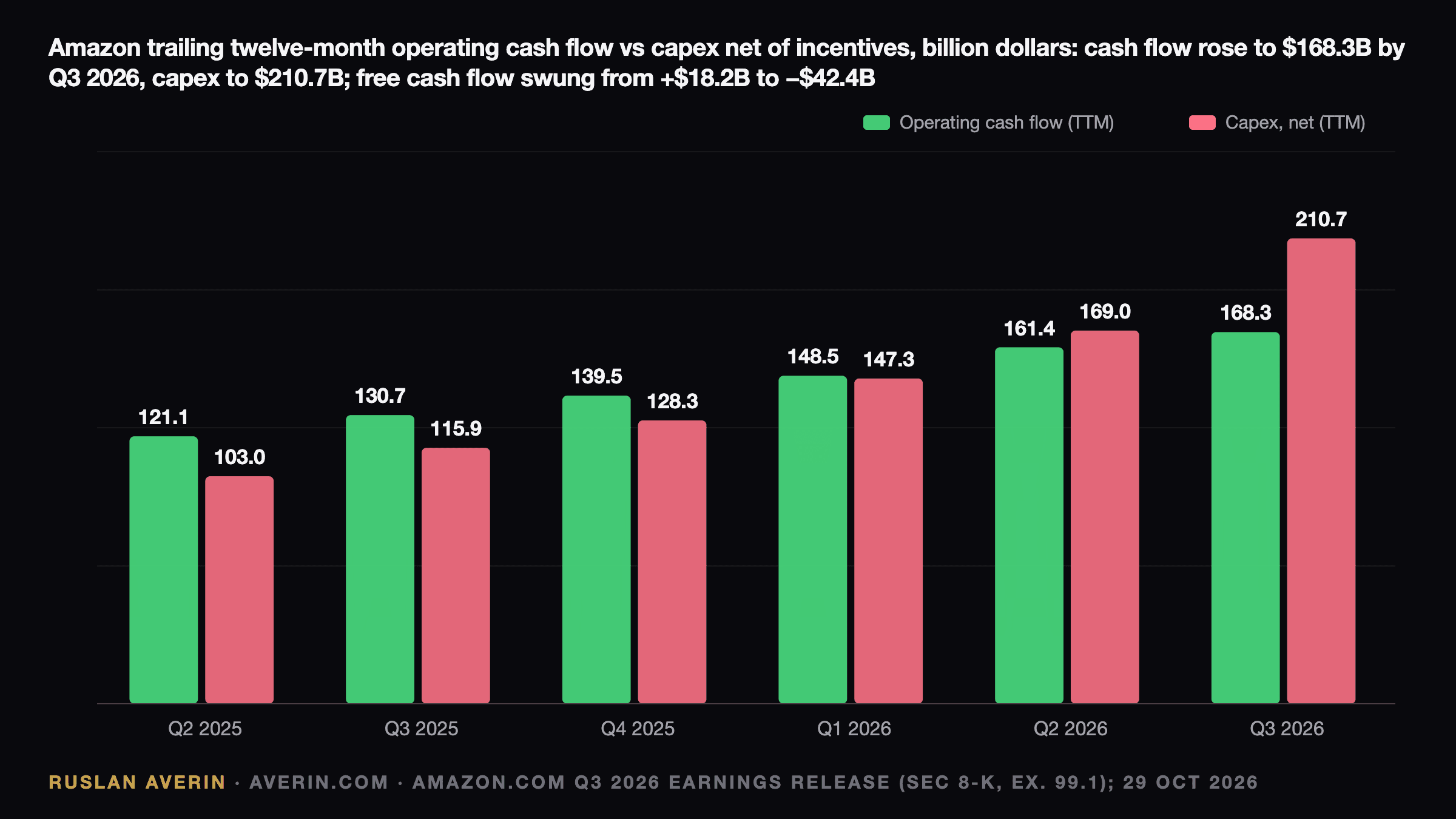
Trailing operating cash flow grew 29% to $168.3 billion, but trailing net capex reached $210.7 billion. Free cash flow therefore swung to an outflow of $42.4 billion from an inflow of $14.8 billion a year earlier. Long-term debt was $173.1 billion at 30 September, against $128.9 billion at 30 June and $65.6 billion at the end of 2025.
Retail and advertising: the Prime Day shift bites
Prime Day moved into the second quarter for most large countries this year, and Amazon says third-quarter growth would have been about 400 basis points higher without the shift. Online stores grew 2% to $68.47 billion, below StreetAccount's $69.68 billion.
North America sales rose 6% to $112.9 billion, yet operating income nearly doubled to $8.7 billion from $4.8 billion. International sales grew 5% to $43.1 billion, or 8% excluding currency, with operating income of $1.6 billion.
Advertising was the weak line: up 11% to $19.64 billion, or 12% excluding currency, against 22% a year earlier. Amazon blames Prime Day and "a couple other timing factors" and expects ad growth in the high teens in the fourth quarter.
Q4 guidance
Amazon guided fourth-quarter net sales to $240.0–247.0 billion, growth of 12–16%, including about 60 basis points of currency headwind. The $243.5 billion midpoint is below the $244.5 billion LSEG consensus cited by CNBC. Operating income is guided to $28.5–33.5 billion, against $25.0 billion a year earlier. CFO Brian Olsavsky said costs for Amazon Leo are weighing on the profit forecast ahead of launch, GeekWire reported; the release says initial Leo service remains on track for later this year.
The Anthropic stake: nothing in net income, $48 billion in equity
The 10-Q explains the missing gain. The Anthropic nonvoting preferred stock, which is marked through net income only on observable price changes, was carried at about $92.5 billion at 30 September, the same as at 30 June. The convertible notes, which run through other comprehensive income, rose to a fair value of about $146.2 billion from $97.9 billion. The related unrealised gain grew to $140.3 billion from $92.0 billion.
Together the two positions are worth about $238.7 billion, roughly 9% of Amazon's market value at Thursday's close, using the 10.81 billion shares outstanding. Anthropic has since filed its IPO prospectus, CNBC reported; a listing would give the stake an observable market price, as discussed in our Anthropic IPO analysis.
Scorecard against our preview
Our Q3 preview set five tests. Honestly, a mixed result.
- AWS growth. We put the bar at about 35%. It came in at 39%, but the real bar was 42–43%.
- AWS margin. We wanted it above 38%. At 38.7%, it passed.
- Advertising. We projected about $22.3 billion at the second-quarter pace. It was $19.64 billion. We missed that Prime Day timing would hit ads as hard as retail.
- Capex. We flagged a move above $220 billion as the bear case. The figure held, but the quarter's $77.3 billion and the 2027 comment did the damage instead.
- Q4 guidance. Profit guidance strong, revenue midpoint slightly light.
We were right that GAAP EPS would be the noisiest number and that the Anthropic mark would shrink. We were wrong on direction: our upside case — AWS at 37% or more, a stable margin, operating income near the top of the range, capex at $220 billion — was delivered, and the stock still fell. The 7.3% pre-market drop is close to the 7.4% move options implied, just in the other direction.
What I would watch next
In analyst Ruslan Averin's view, this report moves the debate from demand to funding. Demand looks secure: a $578 billion backlog and a 40%-plus growth target for two more years. The open question is cash: a $42.4 billion outflow, $173.1 billion of long-term debt, and a 2027 budget that will be "meaningfully more".
I would watch three things before the fourth-quarter report: whether Q4 capex really falls toward the $48 billion the arithmetic implies, whether AWS margin holds near 39% as new capacity is depreciated, and the Anthropic listing, which could swing GAAP earnings sharply.
Related: Amazon's Q3 2026 earnings preview, Amazon's Q2 2026 results and Meta's Q3 2026 earnings and capex.