Three central banks decided within 24 hours, and only one of them moved. The National Bank of Ukraine raised its rate by 0.5 percentage points on Thursday 29 October, to 16.5% from 16%, effective Friday 30 October. The Federal Reserve held on Wednesday 28 October. The European Central Bank held on Thursday.
The decisions, from the primary documents:
- NBU: 16.5%, up from 16%. The 2026 inflation forecast was raised to 12.5%, and the National Bank expects to keep rates at the new level until the second quarter of 2027.
- Fed: kept the target range for the federal funds rate at 3.75–4.00%, by a 10–2 vote. Governor Lisa Cook and Cleveland Fed President Beth Hammack voted for a quarter-point hike.
- ECB: deposit facility rate 2.50%, main refinancing rate 2.65%, marginal lending facility 2.90%, all unchanged, decided unanimously.
- Hryvnia: the official rate for 30 October is UAH 45.5293 per dollar and UAH 50.6796 per euro.
The NBU: a second hike in six weeks
The press release names two reasons: "a significant increase in price pressures and a deterioration in inflation expectations". Inflation reached 10.0% in September, core 8.8%, and the NBU says the trend continued in October by its own estimates. It points to fuel prices driven by the war in the Middle East and to Russian attacks on warehouses and logistics. The attacks alone, it estimates, add about 0.7 percentage points to annual inflation.
The new macro forecast is weaker on every line:
- Inflation: 12.5% at the end of 2026, 7.3% in 2027, back to the 5% target in 2028.
- GDP: down 0.5% year on year in the third quarter; the 2026 forecast was cut to a 0.4% decline. Growth of 0.4% is expected in 2027 and 2.2% in 2028.
- Reserves: above $62 billion in 2026–2027, assuming about $50 billion of direct budget support and more than $32 billion under the defence component of the Ukraine Support Loan this year.
The NBU also says the hike will "help contain pressures on the FX market, which have intensified due to a decline in exports and worsening expectations". The full Inflation Report follows on 5 November, and the summary of the committee discussion, with the vote split, on 9 November. The press release announces no change to reserve requirements.
Scorecard. Our NBU preview put a hold at 16% as the base case and a 0.5 percentage point increase as the main alternative. The alternative happened. The preview was right that the forecast would be lifted well above 10% and that the National Bank would signal a longer stay at a high level; it underestimated how much weight the board would give to expectations.
The Fed: hold, two hawkish dissents, no guidance
The statement is short. "Economic activity is expanding at a strong pace," it says, and "inflation remains elevated." It adds that "the accumulation of more information" will help the committee decide on the appropriate stance, and closes: "The Committee will deliver price stability."
At the press conference Chair Kevin Warsh said "inflation is too high" and that energy prices "have moved higher again in recent weeks". Asked why not hike now, he said quashing inflation "is not about some fixed individual date on a calendar". Asked about December, he said: "I don't believe in forward guidance absent exigent circumstances, absent a crisis." He also announced that from 2027 one of the eight annual meetings will be devoted to strategy, with no rate vote.
Bonds read the meeting as less hawkish than feared. The US 2-year Treasury yield fell from 4.70% on 27 October to 4.61% on 29 October, and the 10-year from 4.99% to 4.98%, after 5.05% on the day of the decision, according to the Treasury's par yield curve.
The ECB: a hike debated, a hold agreed
Christine Lagarde said the Governing Council "debated whether a hike was appropriate" but "unanimously decided that we were well positioned enough at this stage to hold". The statement mentions indirect and second-round effects of the energy shock, says financing conditions have tightened and repeats that the ECB is "not pre-committing to a particular rate path". Euro area inflation was 3.8% in September, energy inflation 18.9%, unemployment 6.4% in August.
The same day Lagarde told the Governing Council she will step down on 7 February 2027, after the February meeting. The European Council will appoint her successor.
Scorecard. Our Fed and ECB preview expected a double hold, citing about 10% hike odds for the Fed and 5.3% for the ECB, and at least two Fed dissents for a hike. All three came true. The preview's view that a hawkish Fed hold would lift the dollar did not show up: the ECB reference rate moved from $1.1150 per euro on 27 October to $1.1130 on 29 October.
What it means for the hryvnia and the dollar
The official dollar rate eased to UAH 45.5293 for 30 October from 45.6008 on 28 October, the highest of the year. It is still 8.0% above the 2 January level of 42.1701. The euro costs UAH 50.6796, 2.3% more than on 2 January, because the euro has weakened against the dollar.
The NBU sets the dollar rate through interventions; the euro follows EUR/USD. The two official rates imply $1.113 per euro, in line with the ECB reference rate. With both the Fed and the ECB on hold, the external driver for the euro in hryvnia is energy and the French bond market rather than a rate move.
In analyst Ruslan Averin's view, the hike changes the cost of holding dollars more than the exchange rate itself. A dollar deposit pays 1.17% for 12 months on the UIRD index; a hryvnia deposit pays 14.29%. The NBU will keep financing the gap with reserves, and its own forecast assumes reserves stay above $62 billion. Longer views are in the dollar exchange rate forecast for Ukraine and the dollar rate and NBU interventions in mid-October.
What it means for deposits and OVDP
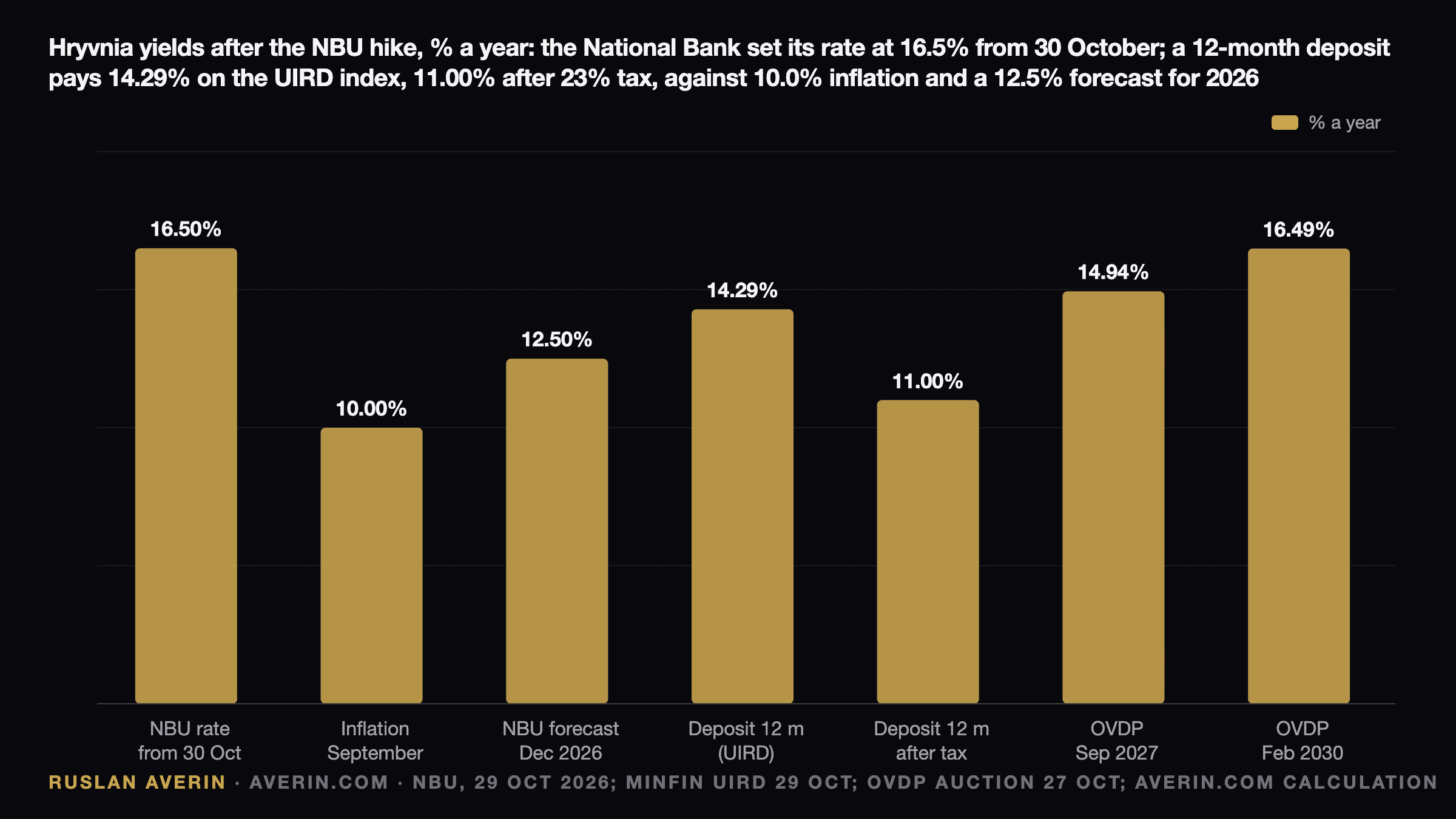
Banks had started repricing before the decision. The UIRD index for 29 October stood at 14.02% for three months, 14.56% for six, 14.96% for nine and 14.29% for twelve, up from 13.88%, 14.49%, 14.75% and 14.09% on 16 October, according to Minfin. In its 21 October review Minfin reported that PrivatBank raised six- and nine-month rates by 3.5 percentage points to 13.5%, while KominBank pays 17% for a year and monobank 16%.
The NBU said that after the September hike large banks "have also begun to adjust their interest rates". Our analysts expect the second step to work the same way: gradually, smaller banks first, over several weeks. Dmytro Zamotaiev of Globus Bank told Minfin before the meeting that average rates could stay mostly at 15–15.5%, with changes gradual and selective even after a hike.
The arithmetic for savers is less comfortable than the headline. After 23% tax, 14.29% leaves 11.00%, one percentage point above September inflation but below the NBU's 12.5% forecast for December. Bank offers by term are tracked in deposit rates in Ukrainian banks.
OVDP interest is tax-free. At the 27 October auction, two days before the decision, the Ministry of Finance sold UAH 2.0 billion of bonds maturing in September 2027 at a weighted average 14.94%, with demand of UAH 8.98 billion. Paper maturing in February 2030 went at 16.49%, but only UAH 593.7 million of the UAH 1 billion offered was sold. The next auctions will show how far the ministry has to follow the 16.5% level.
What to watch
- 5 November: the NBU Inflation Report with the full rate path.
- 9 November: the committee summary and the vote split.
- Weekly: NBU intervention data and Tuesday OVDP auctions.
- 9 December: the next Fed decision.
- 17 December: the next ECB and NBU decisions, on the same day.
Related: the NBU decision of 17 September, Ukraine inflation in September 2026 and what Kevin Warsh at the Fed means for rates.