Exxon Mobil (NYSE:XOM) and Chevron (NYSE:CVX) published third-quarter 2026 results on Friday 30 October, before the US open. Both beat the consensus compiled by LSEG, and for the same reason: crude was cheaper than in the second quarter, but refining margins hit records as roughly a tenth of the world's refining capacity stayed offline.
Exxon closed on Thursday 29 October at $183.29 and Chevron at $231.46, according to stockanalysis.com. In pre-market trading Exxon was quoted at $186.34 at 8:30 a.m. New York time, up 1.66%, and Chevron at $234.32 at 8:32 a.m., up 1.24%, according to the same source. Those are indications, not closes.
The scorecard against consensus
| Line | Exxon Mobil | Chevron |
|---|---|---|
| Adjusted EPS | $4.23 | $5.28 |
| LSEG consensus EPS | $4.08 | $4.89 |
| GAAP EPS | $3.72 | $5.06 |
| GAAP net income | $15.4 billion | $9.9 billion |
| Revenue and other income | $113.2 billion | $67.8 billion |
| LSEG revenue consensus | $103.1 billion | $61.6 billion |
| Cash flow from operations | $25.7 billion | $16.0 billion |
Company figures are from the two earnings releases; the consensus figures are LSEG's, as reported by CNBC and Reuters. Exxon's adjusted earnings of $17.5 billion also topped the $16.6 billion LSEG estimate, Reuters reported.
Exxon beat by about 3.7% on adjusted EPS, Chevron by about 8%. A year ago Exxon earned $7.5 billion, or $1.76 a share, and Chevron $3.5 billion, or $1.82, so headline profit roughly doubled at Exxon and nearly tripled at Chevron.
Why GAAP and adjusted differ this quarter
Both companies booked large negative timing effects, the mark-to-market on derivatives that hedge physical cargoes still at sea. Exxon's were $2.54 billion, partly offset by $449 million of net identified items, including a $675 million gain on asset sales. Chevron's timing effects were $1.58 billion, plus a $160 million legal reserve and a $110 million impairment.
These effects reverse when the cargoes are delivered. That is why both companies, and the consensus, focus on the adjusted figure.
Exxon: refining did the work
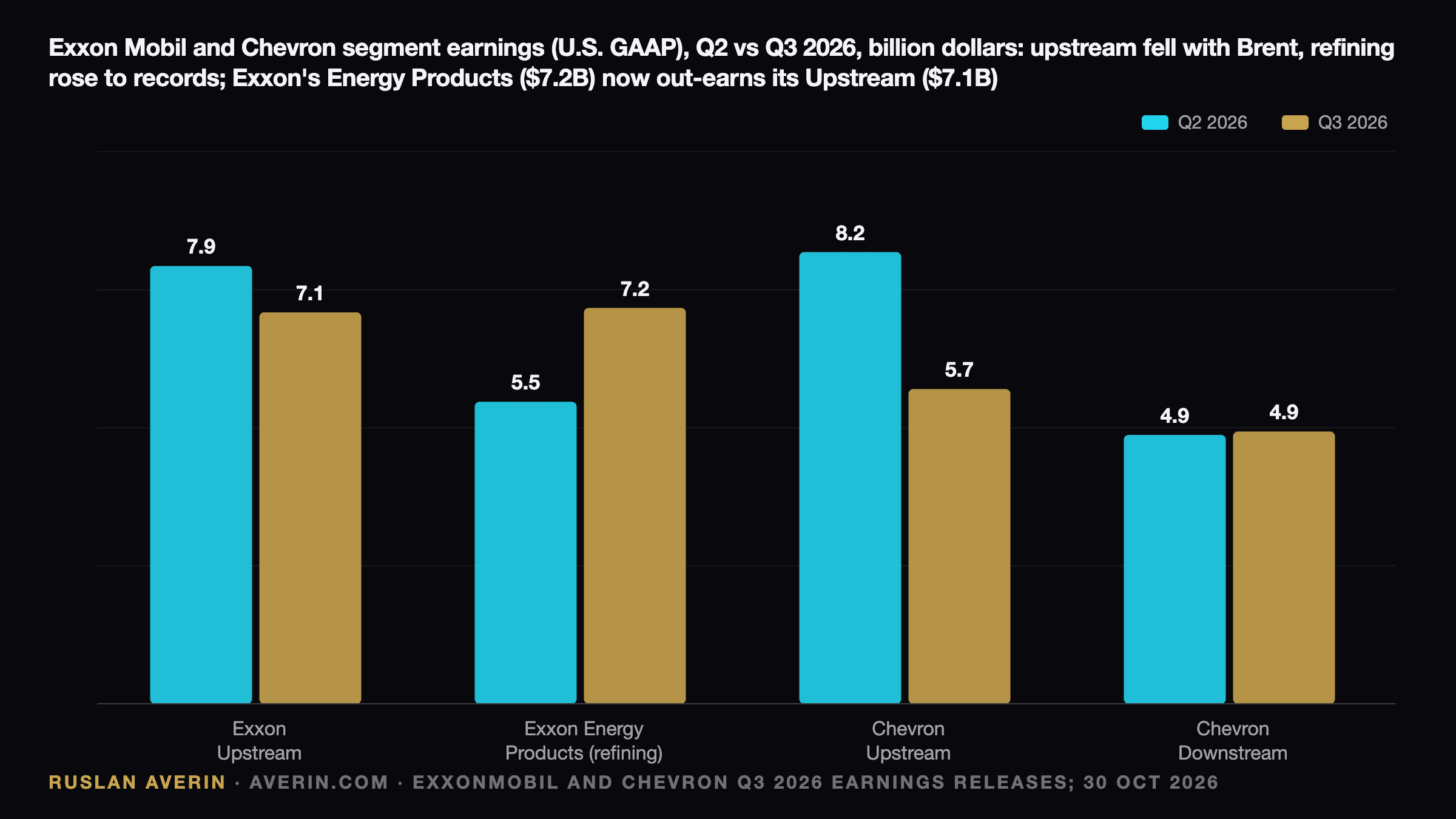
Exxon's Energy Products segment, its refining arm, earned $9.05 billion on an adjusted basis against $4.10 billion in the second quarter. Its indicative refining margin, a Platts-based marker, averaged $50.3 a barrel against $29.0 in Q2. The company's U.S. Gulf Coast refineries ran at 100% crude unit utilisation.
Exxon's explanation is specific. Refining capacity in Russia and the Middle East remained curtailed, with "roughly 10 percent of global capacity offline", the prepared remarks say. That cut crude demand and held crude prices in range, while squeezing gasoline and diesel supply. CNBC tied the diesel surge to Ukrainian and Iranian strikes on refineries in Russia and the Middle East.
Upstream went the other way. Adjusted upstream earnings fell to $7.31 billion from $9.19 billion, on lower prices and what Exxon calls an accelerated Guyana entitlement impact. Production was 4,496 thousand barrels of oil equivalent a day (koe/d), against 4,514 in Q2. Over nine months it averaged 4,534 koe/d, down from 4,651 a year earlier.
Two lines explain the volume picture:
- Permian: "just above 1.8 million" barrels of oil equivalent a day, in line with 2026 guidance.
- Middle East: about 550 koe/d produced in Q3, including 250 in Qatar and 300 in the UAE. Disruptions there cut nine-month earnings by about $2.9 billion. For Q4 Exxon assumes about 350 koe/d remain offline.
Guyana passed one billion barrels of cumulative production, and the fifth FPSO is due to start up late in the fourth quarter.
Exxon's cash: $9.4 billion returned and $20 billion for 2027
Cash flow from operations was $25.7 billion and free cash flow $19.1 billion. Cash capex was $7.0 billion, $20.0 billion for nine months, and Exxon says the full year will land within its planned range. Net debt fell by more than $9 billion in the quarter to $22.1 billion, a net-debt-to-capital ratio of 7.5%.
Shareholder distributions were $9.4 billion: $4.3 billion of dividends and $5.1 billion of buybacks, or $28.0 billion so far this year. The fourth-quarter dividend rises 4% to $1.07 a share, the 44th straight year of increases. That is $4.28 a year, a 2.3% yield on Thursday's close. Exxon also set 2027 buybacks at $20 billion, the same as 2026, Reuters noted, "assuming reasonable market conditions".
Chevron: record U.S. refining, softer international upstream
Chevron's adjusted earnings were $10.4 billion, or $5.28 a share, against $1.85 a year earlier. Downstream earned $4.93 billion against $1.14 billion a year ago. U.S. refineries processed a record 1.09 million barrels a day at nearly 98% utilisation.
Net production was 3,980 thousand barrels of oil equivalent a day (koe/d), down from 4,086 a year earlier. U.S. output, at 2,043 koe/d, was flat and topped 2 million for the fifth quarter running. International production fell by 109 koe/d, because higher prices cut entitlement volumes and the Middle East conflict disrupted output.
The Hess acquisition shows up in the comparison more than in a new number: the year-ago quarter carried Hess severance and transaction costs that are now gone. Chevron's headline that U.S. production is up 27% from two years ago largely reflects that deal. The release does not break out Guyana volumes. Chevron also said its Venezuelan joint ventures plan to invest $7 billion over five years.
Cash flow from operations was $16.0 billion, or $16.6 billion before working capital. Capex was $4.0 billion and free cash flow $12.0 billion. Chevron paid $3.48 billion of dividends and bought back $2.50 billion of stock. That brings nine-month buybacks to $8.19 billion. It also cut total debt by $3.5 billion. The board declared a quarterly dividend of $1.78, or $7.12 a year, a 3.1% yield on Thursday's close.
Oil above $100: the quarter versus October
Brent averaged $97.01 a barrel in Q3 on Exxon's marker table, against $104.52 in Q2. Chevron's Platts figure is the same $97, against $104. The averages hide the path: EIA monthly Brent spot was $83.76 in July and $114.16 in September.
October has been higher. Brent front-month settled at $108.82 on 21 October, around the Shaybah drone strike. The case for the fourth quarter, then, rests on upstream recovering with price while refining margins hold. For the inflation side of that, see what Brent at $100 means for rates.
What Shell and TotalEnergies showed on Thursday
Our Shell and TotalEnergies preview put Shell's implied adjusted earnings at about $10.2 billion. Shell reported $10.81 billion, or $1.93 a share, and lifted the buyback to $5.0 billion for the coming quarter from $4.2 billion. TotalEnergies' adjusted net income was $9.10 billion, well above the roughly $7.6 billion implied by Benzinga's consensus. Its refining and chemicals result doubled to $3.6 billion. On both sides of the Atlantic refining carried the quarter. In Europe the cash also faces new windfall-tax proposals.
What I would watch next
In analyst Ruslan Averin's view, this was a refining quarter dressed as an oil quarter. Exxon's Energy Products profit is now larger than its upstream profit on a GAAP basis, $7.2 billion against $7.1 billion. I would watch three things into the fourth quarter:
- Refining margins as Russian and Middle East capacity returns. Exxon's $50.3 marker is the number most exposed to repairs.
- Middle East volumes. Exxon's assumption of about 350 koe/d still offline is the swing factor for upstream.
- Timing effects. Exxon's $2.54 billion and Chevron's $1.58 billion should reverse if prices stabilise, lifting GAAP profit in Q4.
The buybacks look safe on these cash flows: Exxon's $19.1 billion of quarterly free cash flow covers its $9.4 billion of distributions twice over.
Related: Shell and TotalEnergies Q3 2026 preview, Brent at $111 after the Shaybah strike and the EU windfall tax on energy.