
Bali and Phuket are sold to foreign buyers with the same number: a gross rental yield of 9–12% a year, sometimes more. One published figure for Bali villas is "up to 18 percent gross". The number is not invented, but it describes a villa that is full, managed for free, never repaired and never taxed. What a foreign investor actually keeps depends on three things the brochure leaves out: what kind of ownership the law allows, what the island's authorities are enforcing this year, and what the costs between gross and net add up to.
What a foreigner can own
Neither island sells land to foreigners. In Indonesia freehold (Hak Milik) is reserved for citizens under the Agrarian Law of 1960. A foreign buyer has three routes. The common one is a leasehold (Hak Sewa): a private contract with the landowner, typically for 25–30 years, with extensions to be negotiated, sometimes with the owner's heirs. A foreigner with a residence permit can hold a right of use (Hak Pakai), subject to minimum prices set by region; investor guides cite about IDR 5 billion for a house. The third is a foreign-owned company, a PT PMA, holding a right to build (HGB), which requires an investment plan above IDR 10 billion per project and brings corporate tax of 22%. Nominee structures, in which an Indonesian citizen holds land on a foreigner's behalf, are not a fourth route: they are unenforceable and illegal.
Thailand offers something closer to real ownership, but only in a condominium. Foreigners may own condo units freehold as long as foreign ownership in the building stays within 49% of the total floor area. Land cannot be foreign-owned, and the maximum registrable lease is 30 years. Two reforms have been discussed since 2024 and 2025: raising the condo quota to 75% in resort areas including Phuket, and extending leases to 99 years. Neither had been enacted as of February 2026.
| Bali | Phuket | |
|---|---|---|
| Freehold for foreigners | No | Condo units only, within the 49% quota |
| Typical structure | Leasehold 25–30 years | Condo freehold or 30-year land lease |
| Company route | PT PMA, over IDR 10 billion per project | Thai company with nominees: under prosecution |
| Purchase costs | 5% transfer tax, notary 1–2.5% | 2% transfer fee |
| Tax on rent, non-residents | 20% of gross, 10% under some treaties | 7.24–25.20% effective, progressive |
| Short-term rental rule | Business registration required, enforced from May 2026 | Hotel licence for stays under 30 days |
2026 is an enforcement year on both islands
In Bali, Governor Wayan Koster issued a directive on 8 May pressing booking platforms, Airbnb, Agoda, Booking.com and Traveloka among them, to stop listing properties without a business registration number and paid taxes. According to The Jakarta Post, of about 470,000 accommodation listings across nine platforms only about 31,000 held valid registration. Enforcement starts in Denpasar and Badung, which includes Canggu and Uluwatu. A villa bought on the assumption of informal short-term letting now needs a licence, or its income disappears from the platforms.
In Thailand, the government is prosecuting nominee companies nationwide: more than 850 companies had been charged by early 2026, and on Koh Samui and Koh Phangan alone 11,426 firms were reviewed. In July officials raided five unlicensed hotels in Phuket and arrested five managers; about 30% of properties on the island are estimated to operate without a licence. Letting a condo or villa for less than 30 days without a hotel licence is punishable by up to a year in prison or a fine of THB 20,000, plus THB 10,000 a day while it continues. Foreign buyers account for about three in five Phuket villa purchases, and brokers report them delaying deals and moving towards condominiums, where the ownership framework is clearer.
Demand is real, and so is supply
Neither island lacks tourists. Bali received a record 6.95 million foreign visitors in 2025, up 10%, according to Horwath HTL and C9 Hotelworks; Phuket received 8.8 million, and its airport handled 17.4 million passengers, 39% above its stated capacity. But supply is growing faster than occupancy. Bali hotel occupancy fell 2.5 points to 73.2% in 2025, with 45 hotels and 5,641 rooms in the pipeline, and short-term rental listings in Canggu grew by more than 40% in a year while occupancy declined. In Phuket, hotel occupancy fell 6% while average rates rose 5%, Chinese arrivals fell 44% and Russia remained the largest market; 41 hotel projects with more than 8,000 rooms are in the pipeline, concentrated in Bang Tao and Cherngtalay.
Prices reflect the premium for a resort address. In Phuket the median condominium price was about THB 144,000 per square metre across 40,600 units in May 2025, and landed villas about THB 70,000. In Bali, listed examples range from a one-bedroom apartment in Nusa Dua pre-selling from $90,000 to designer villas in Uluwatu at $3 million.
From 10% gross to what is left
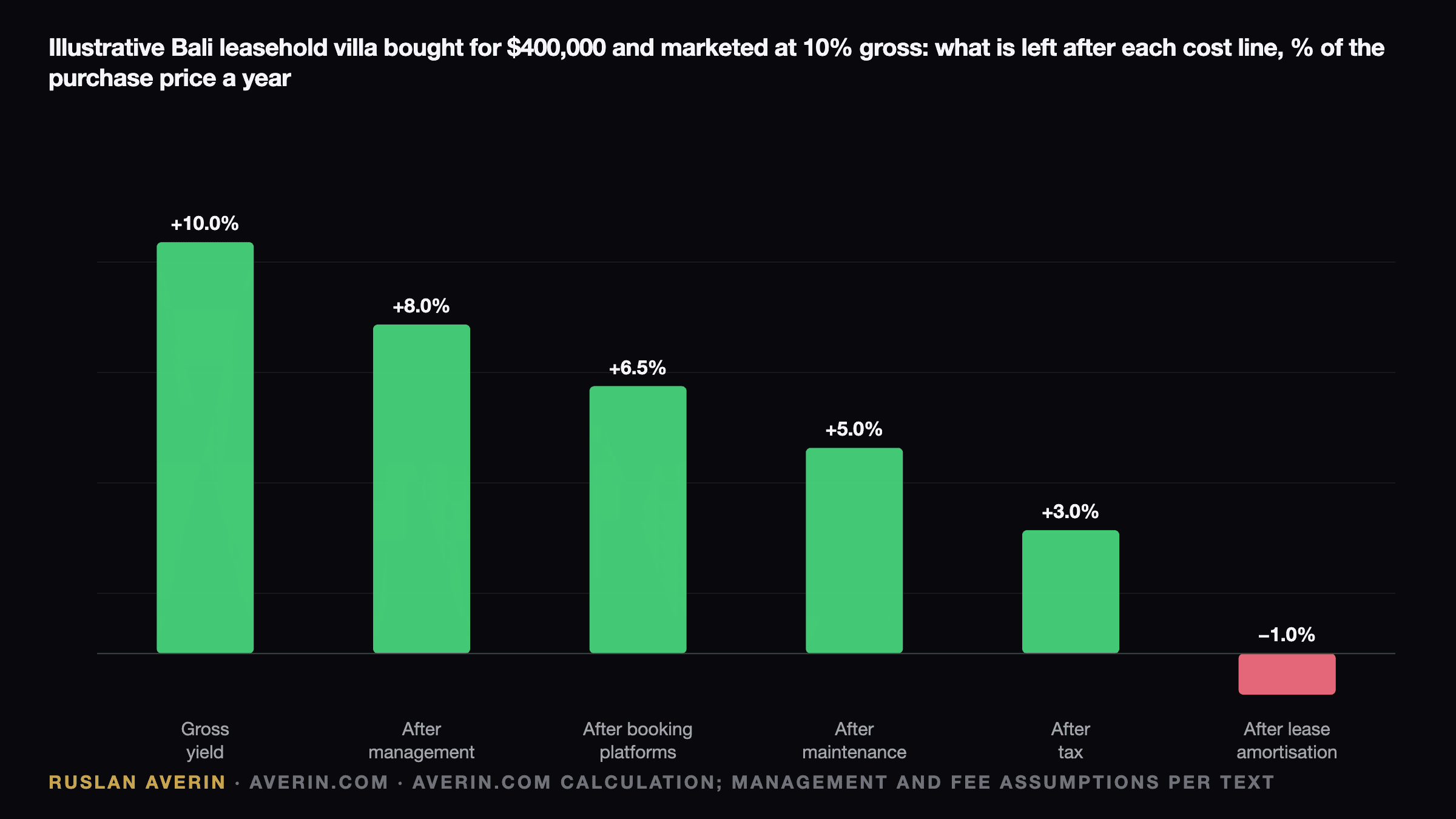
No independent consultancy publishes a net yield for Bali or Phuket villas; Horwath HTL and C9 Hotelworks report occupancy and room rates, not investment returns. The bridge has to be built from the cost lines. The chart above does it for an illustrative Bali leasehold villa bought for $400,000 and marketed at 10% gross, $40,000 a year. Management takes 15–20% of gross revenue, according to advisers quoted by realestate.com.au; at 20% that is $8,000. Booking platforms take about 15%: Airbnb is moving all hosts to a 15.5% host-only fee. A maintenance and furniture reserve of 1.5% of the price a year, an analysts' assumption for a pool villa in a tropical climate, is $6,000. The 20% final tax on gross rent for a non-resident is $8,000. What is left in cash is $12,000, or 3.0%.
Then comes the line that the brochure never shows. A 25-year leasehold is worth nothing at the end of the term, so $16,000 of the price is consumed every year. Counting that, the illustrative villa returns about −1.0% a year before any change in its market value.
| Illustrative, per year | Bali leasehold villa, $400,000 | Phuket freehold condo, $300,000 |
|---|---|---|
| Gross rent | $40,000 (10.0%) | $24,000 (8.0%) |
| Management, 20% of gross | −$8,000 | −$4,800 |
| Booking platforms, 15% of gross | −$6,000 | −$3,600 |
| Maintenance reserve | −$6,000 (1.5% of price) | −$3,000 (1.0% of price) |
| Tax on rent | −$8,000 (20% of gross) | −$3,600 (about 15% of gross) |
| Net cash | $12,000 (3.0%) | $9,000 (3.0%) |
| Lease amortisation | −$16,000 (25 years) | none, freehold |
| Economic return before price change | −$4,000 (−1.0%) | $9,000 (3.0%) |
The same arithmetic for a Phuket condo marketed at 8% gross ends at about 3.0% in cash, and because the unit is freehold nothing is amortised. The Phuket figure assumes the condo sits in a building with a hotel licence or is let for 30 days and longer; otherwise the rental line itself is at risk.
The currency adds a final layer. Between 2 January and 25 September 2026 the dollar rose from IDR 16,716 to IDR 17,914, or 7.2%, and from THB 31.39 to THB 33.345, or 6.2%, according to ECB reference rates. Rent collected in rupiah or baht bought fewer dollars this year, and a resale price in local currency is worth less to a buyer who will convert it back.
What investors weigh
In the view of analyst Ruslan Averin, the choice between the islands is a choice between two kinds of ownership rather than two beaches. A Phuket condo within the foreign quota is real property: it can be sold, inherited and financed, and its return is roughly what the rent pays after costs. A Bali leasehold is a prepaid rental of land, closer to a long bond that pays out its principal as it goes; investors who buy one should compare it with a 25-year annuity, not with a flat in Kyiv or Dubai. The PT PMA route turns a Bali villa into real property but at the scale of a small business, with IDR 10 billion of investment and a corporate tax return.
Residence is often the real motive, and both countries price it separately. Indonesia's second-home visa requires proof of funds of IDR 2 billion; Thailand Privilege membership starts at THB 650,000 for five years and reaches THB 1.5 million for ten. Buyers whose aim is a place to live part of the year are paying for that, and should not expect the rent to cover it.
Investors comparing these yields with other markets have useful benchmarks: Dubai after the Iran war, four ways to invest in Kyiv in 2026 and the case for bonds over property at today's yields. At a 3% cash return, a 10-year US Treasury at 5.2% is the number any tropical villa has to beat.
Related: Dubai real estate and the Iran war, Kyiv investment options compared, apartment versus bonds: the verdict and the 60/40 portfolio at 5% yields.