
Bitcoin traded at $78,537 on 14 September 2026, up 2% on the day while the Nasdaq fell on an AI sell-off and gold lost 2%. In the next 48 hours it faces two binary events: at 2:15 pm New York time on Tuesday the Senate votes on cloture for the Clarity Act, and at 2:00 pm on Wednesday the Federal Reserve most likely raises rates for the first time since July 2023. Bernstein's line on Monday was that a positive surprise "is definitely not priced in" and that bill failure plus a hawkish Fed could mean "a major drawdown".
I have written here since August that this is a bear market with a range, not a trend, and nothing in the positioning below changes that. What changes is that both ends of the range get tested this week.
Where Bitcoin stands
$78,537 is 37.7% below the all-time high of $126,080 of 6 October 2025, up 24.7% over thirty days and down 0.8% over seven. The weekly close on Sunday was $76,842, below the $78,300 that Rekt Capital said was needed to hold the 50-week average; the market has spent Monday buying it back. The range for the week was $76,046 to $80,560. Ether is $2,506, half its August 2025 high; Bitcoin dominance is 58.6%.
Leverage has already been flushed. Futures open interest fell 13.5% in the week to 11 September, from 321,000 to 278,000 BTC, about 20% below mid-August; on 12 September, after the CPI print, about $1.05 billion of Bitcoin positions were liquidated in 24 hours. Funding on Monday was flat to slightly positive at 0.005–0.007% per eight hours, and the 24-hour liquidation tape was quiet at $52 million for Bitcoin. Whatever happens this week will not be a leverage cascade; the leverage is gone.
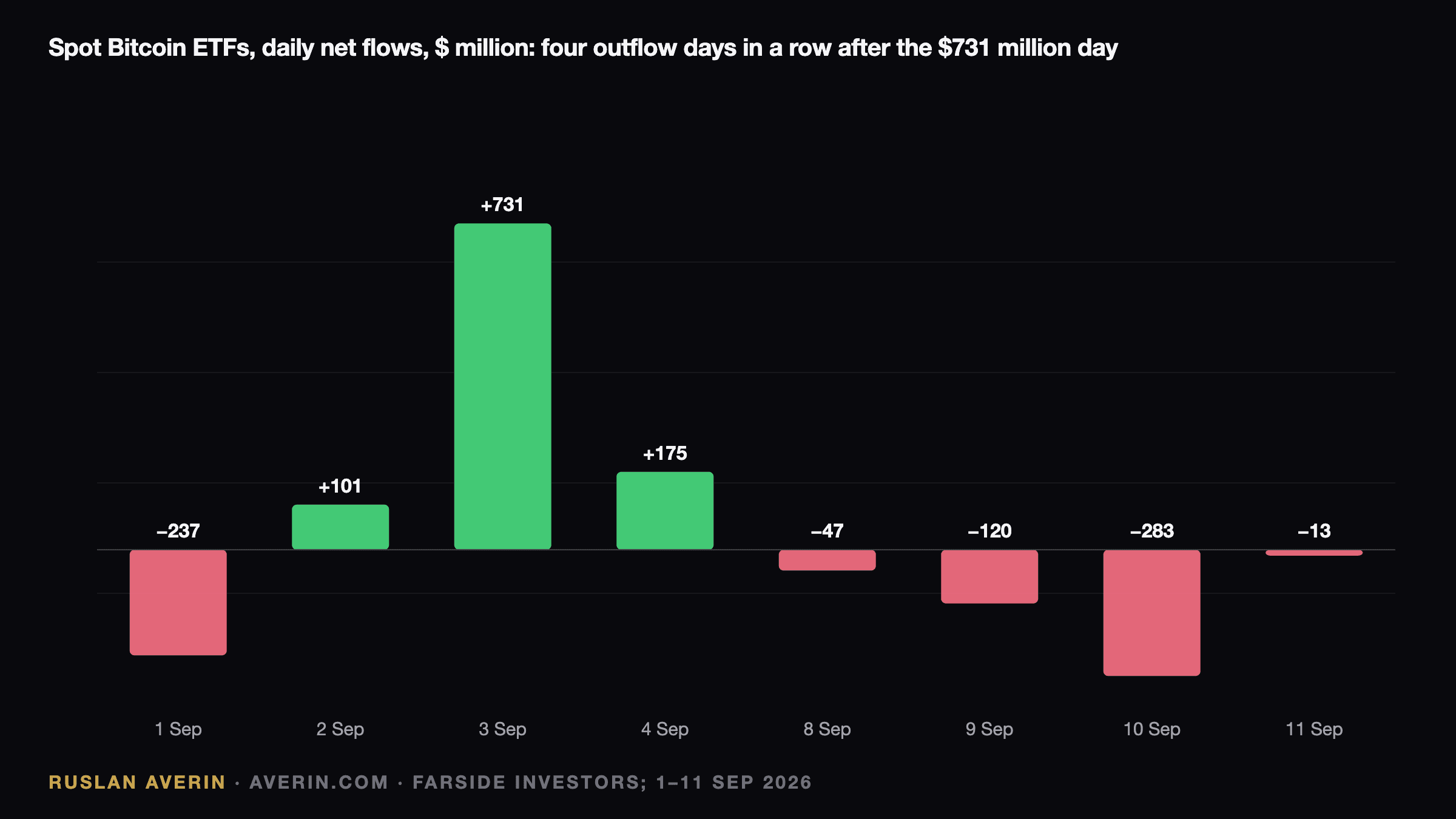
The ETF tape
| Date | Net flow, spot Bitcoin ETFs, $ million |
|---|---|
| 1 September | −236.5 |
| 2 September | +101.1 |
| 3 September | +730.8 |
| 4 September | +174.6 |
| 8 September | −46.6 |
| 9 September | −120.2 |
| 10 September | −282.7 |
| 11 September | −13.2 |
Four straight outflow days for $462.7 million ended a three-week inflow streak of about $3.8 billion. Month to date the funds are still $307 million positive because of the 3 September day. IBIT holds $60.6 billion. Ecoinometrics' reading is the right one: four days is too short to call a reversal, "but an extended streak would make it increasingly difficult for Bitcoin to hold above $75,000", the August breakout level. Monday's flow is published on Tuesday morning, hours before the vote.
Strategy, the largest corporate holder with 845,050 BTC at an average $75,412, bought nothing for a second week and spent $139 million buying back its STRC preferred instead. Its last purchase, 4,603 BTC at about $80,300 announced on 8 September, is already under water; the stock trades at 1.1 times net asset value, 71% below its 2025 peak. The marginal corporate bid has paused at exactly the price where the ETFs turned.
Tuesday: the vote that is not a vote
The Clarity Act, the market-structure bill that passed the House 294–134 in July 2025, reached the Senate floor after a 630-page substitute with 126 changes was released late on Sunday. It puts spot markets in digital commodities under the CFTC, keeps tokenised securities with the SEC, treats assets with under 20% insider control as commodities, which covers Bitcoin and Ether, bans deposit-like yield on idle stablecoins while allowing activity-linked rewards, and, in the version Trump accepted on Sunday night, bars the President, Vice-President, members of Congress, judges and their spouses from holding a significant interest in digital assets outside a blind trust.
Tuesday's vote is cloture on the motion to proceed. It needs 60. Republicans have 53; Rand Paul and Josh Hawley are expected to vote no; so roughly nine Democrats are needed, and as of Sunday none had committed. Gillibrand, Warner, Gallego, Blunt Rochester, Kim and Alsobrooks negotiated the text; Warren calls it "a bill written by the crypto industry for the crypto industry"; seventeen state attorneys general led by New York's Letitia James oppose it. Polymarket's per-senator markets price Gallego at 51%, Gillibrand at 47%, Kim at 47%, Warner at 22%.
| Market | Odds on 14 September | A week earlier |
|---|---|---|
| Polymarket, signed into law in 2026 | 25–35% by hour | 12–16% |
| Kalshi, law before October 2027 | 53% | 26% |
| Polymarket, more than 60 senators vote yes | 52% | — |
| TD Cowen | 25% | — |
| Galaxy Research | 30% | 50% in the summer |
Even a successful cloture only opens debate. Amendments, a final vote, reconciliation with the House text and a signature all follow, with the Senate leaving on 5 October and the election on 3 November. Failure this week, in The Block's framing, delays the bill to 2030. In July 2025 Bitcoin front-ran the House vote to a record $123,000 and then fell 1.6% in the three days after passage; the pattern is headline-driven, and the headline this time is a procedural one.
Wednesday: the first hike in three years
Futures price an 87% probability of 25 basis points to 3.75–4.00%, with a new dot plot and Chair Warsh's press conference. The reasons are oil above $105, payrolls of +162,000 against +53,000 expected, and August CPI at 3.4%; core is 2.4%, which is why some, James Thorne among them, call it a hike "to calm Wall Street" rather than a change in the inflation outlook. Diane Swonk expects three hikes by early 2027.
The historical table is less frightening than the headlines. On 7 of the 11 hike days from March 2022 to July 2023 Bitcoin closed higher; the first hike, in March 2022, was a +4.7% day. The next day was negative in 7 of 11 cases, and the two catastrophic weeks of that cycle, −23% in May 2022 and −22% in November 2022, were Terra and FTX, not the Fed. The Fed sets the drift; crypto supplies the crashes.
Options agree that the event itself is small. Deribit's DVOL at 37.8 implies a one-day move of about 2%, or $1,550. The 18 September weekly expiry has max pain at $78,000 with a put-call ratio of 0.86; the 25 September quarterly, with 186,000 BTC of open interest, has max pain at $72,000 and twice as many calls as puts. The market is positioned for a grind lower into quarter-end with a call overhang above $85,000, not for a crash on Wednesday.
Levels and what I am doing
| Direction | Level | Why |
|---|---|---|
| Above | $78,761 | 50-week average, lost at Sunday's close |
| Above | $85,000, then $87,600 | resistance, 50% retracement |
| Below | $75,000 | August breakout, ETF line in the sand |
| Below | $73,050–73,400 | 200-day and 50-day averages |
| Below | $72,270 / $72,000 | 21-week average / quarterly max pain |
The position from August, small and spot, stays. I would add below $73,000 if the ETF flows are still only mildly negative, because that is the price at which the quarterly options and the moving averages agree, and I would sell nothing above $85,000 until cloture has actually passed. The asymmetric event is Tuesday, not Wednesday: a hike at 87% is priced, and cloture at roughly 50% is not.
In analyst Ruslan Averin's view the line from CryptoQuant is worth keeping in mind through the week: flat-to-negative funding of this kind has historically marked the final stages of Bitcoin bear markets, not their beginnings. That is not a reason to buy on Monday. It is a reason not to sell on Wednesday.
Related: Bitcoin at $65,000 in August, Coinbase and the Clarity Act, the Fed's first hike since 2023 and the AI sell-off Bitcoin sat out.