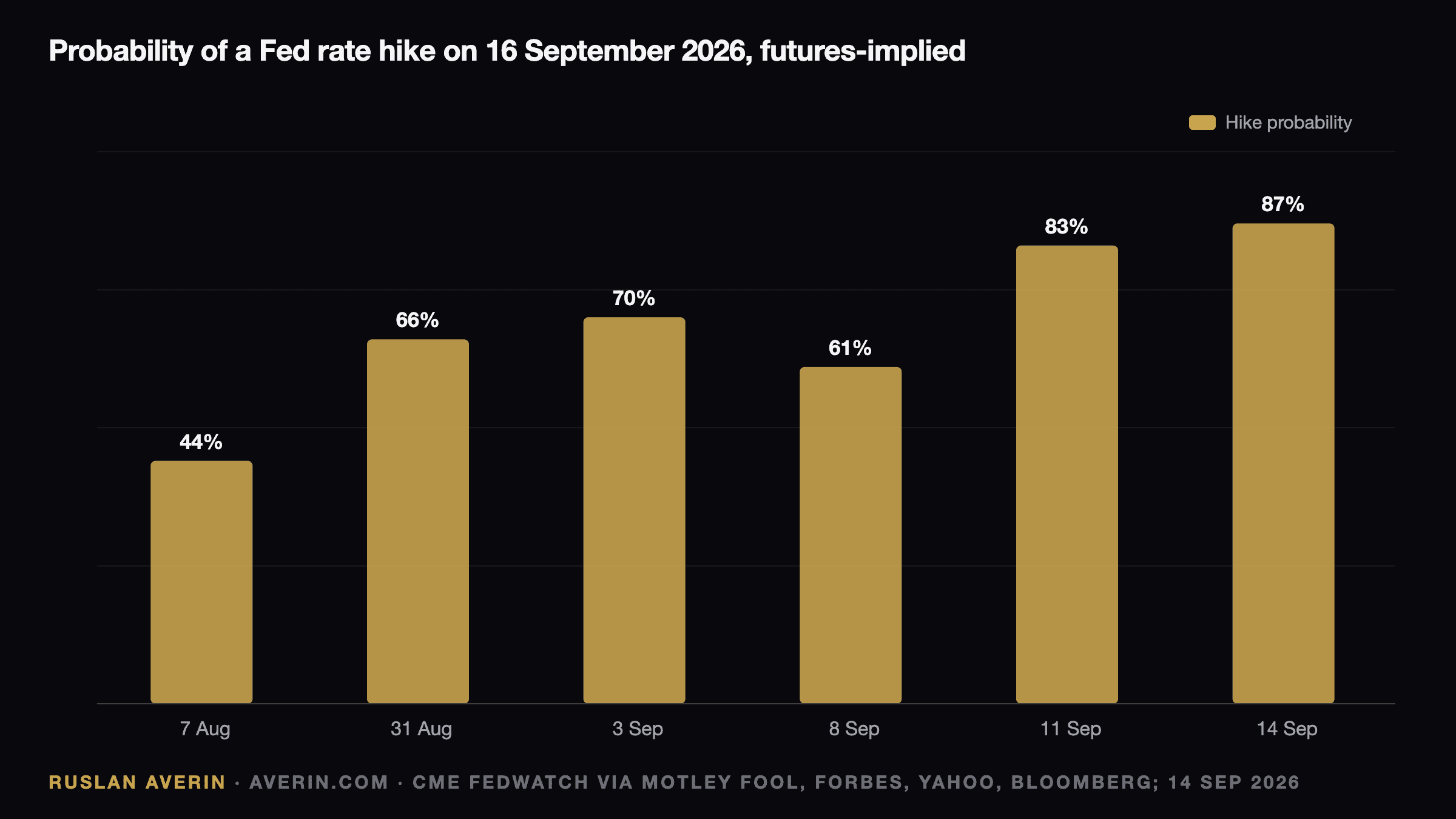
On Wednesday 16 September 2026 at 2:00 pm New York time the Federal Reserve will most likely do something it has not done for three years and two months: raise the federal funds rate, now 3.50–3.75%. Futures price the move at about 87%. A week ago it was closer to 60%, and on 7 August, after a weak July jobs report, it was 44%. Three data points flipped the odds in six weeks, and the bond market has already delivered the hike before the Fed has.
I hold long-dated Treasuries and have written here about the curve since the 30-year crossed 5% in June, so this is not an abstract exercise. Below is what is priced, why, and what the rest of the week looks like from a portfolio.
What the Fed is expected to do
The target range has sat at 3.50–3.75% since the cut of 11 December 2025. Before that the Fed cut six times from the 5.25–5.50% peak: 50 points in September 2024, then 25 in November and December 2024, and 25 each in September, October and December 2025. The last increase was on 26 July 2023.
The expected move on Wednesday is 25 basis points to 3.75–4.00%. In the Reuters poll published on 14 September, 86 of 101 economists expect exactly that. One week earlier the same poll had 70% of respondents expecting a hold. That is a very fast repricing for a central bank, and it happened because three releases landed the same way.
| Date | Release | Number | Consensus |
|---|---|---|---|
| 28 Aug | Warsh at Jackson Hole | PCE 3.7% over 12 months, 4.1% over 6 annualised | "committed to a discipline, not to a decision" |
| 4 Sep | August payrolls | +162,000, unemployment 4.1% | +53,000 |
| 11 Sep | August CPI | headline +0.4% m/m, 3.4% y/y; core +0.3%, 2.4% y/y | core +0.2% m/m |
| 14 Sep | Reuters poll | 85% expect +25 bp on 16 Sep | 30% a week earlier |
Gasoline did a third of the August CPI increase on its own: +3.9% for the month and +27.4% year on year, with energy overall +16.3%. That is the oil shock from the Strait of Hormuz and, since last week, the shutdown of the Saudi East-West pipeline, with Brent above $106.
Why a supply shock still gets a hike
The July statement called the inflation overshoot partly a supply shock "including energy". Supply shocks are the textbook case for looking through. Yet the July vote was 9–3, with Hammack, Kashkari and Logan all wanting a hike, the first three-way dissent in the same direction since 2016.
Warsh's argument in August settles the question of why the Fed acts anyway. "Inflation is running above our 2 percent target. So the Fed's predominant focus right now should be on prices." And: "While this summer's readings were better than expected, they do not tell me that underlying trends have meaningfully improved." Core CPI at 2.4% is a five-year low, but the six-month annualised PCE at 4.1% is the number the chair chose to cite. When a chair picks the higher number in a speech, the committee usually follows.
Scott Anderson of BMO put it plainly on 14 September: the Fed's inflation-fighting credentials are on the line, and hawkish rhetoric has to be backed by action. A unanimous vote on Wednesday would be read as exactly that.
What the bond market has already done
The hike has been delivered by the curve in advance. Treasury par yields on 14 August were 4.17% for two years, 4.51% for ten and 5.25% for thirty. By the 11 September close they were 4.35%, 4.96% and 5.38%. On 14 September the 10-year touched 5.00% intraday for the first time since October 2023, and the two-year traded at 4.65%.
That is a 45 basis point move in the 10-year in one month against 18 in the two-year. The long end moved more than the front end, which is the opposite of a normal hiking cycle, where the two-year leads. It says the market is pricing not one hike but a longer path: futures now show roughly four increases by July 2027, and 53% of economists in the Reuters poll expect at least one more by end-March.
For anyone holding duration this is the uncomfortable part. A 30-year at 5.38% pays a coupon that was unavailable for most of the last two decades, but a further 25 basis points on the long end costs about 3.7% of price. The 30-year has been the least sensitive of the three maturities this month, +13 points, precisely because it was already carrying the inflation premium.
Mortgages, gold, equities
Mortgages follow the 10-year with a lag. Freddie Mac's 30-year average was 6.76% for the week of 10 September, up from 6.71% the week before and 6.35% a year earlier. That print did not yet include the post-CPI jump in yields, so the 17 September number will be higher. At 6.76% a $400,000 loan costs $2,597 a month; at 7.00% it costs $2,661.
Gold has had three straight weekly declines and traded below $4,300 on 14 September, the lowest in over a month, down about 3% over four weeks but still up 16% year on year. The mechanism is simple: a hiking Fed lifts real yields and the dollar, and gold pays neither. As long as the market prices four hikes, gold has a headwind regardless of what the Middle East does.
Equities were down under 1% at midday: S&P 500 −0.7%, Nasdaq −0.8%, Dow −0.4%, with the VIX up 10% to 17.5. Two other things were happening at once, an AI sell-off in chips and oil above $100, so the rates contribution is hard to isolate. What is clear is that a risk-free 5% on the 10-year is something this equity cycle has not had to compete with before.
Three scenarios for Wednesday
| Outcome | Probability (market) | Bonds | Gold | Dollar |
|---|---|---|---|---|
| +25 bp, dots show two more in 2026 | most likely | front end sells, long end steady | lower | higher |
| +25 bp, dots show one and done | possible | curve rallies, 10-year back under 4.90% | relief bounce | flat |
| Hold with hawkish language | about 13% | long end sells on credibility, curve steepens | initially up, then down | mixed |
The scenario I would watch for is the third. A hold now, after the chair's August speech and with 87% priced, would be read as the Fed blinking to a supply shock, and the long end would pay for it. That is the outcome in which 30-year yields go through 5.50%, not the hike itself.
What I am doing
Nothing before 2:00 pm on Wednesday. The position in long Treasuries stays, because a 5.38% coupon compounds regardless of the next 25 points, and I would add on a move through 5.50% rather than sell into it. The cash portion that was going to short-dated bills waits for the dot plot: if the median shows two more hikes this year, six-month bills at 4.3% and rising are a better place than a two-year locked at 4.65%.
In analyst Ruslan Averin's view the trade of the week is not the decision but the press conference. Warsh has said the Fed is "committed to a discipline". The market will test on Wednesday what that discipline costs in 2027.
Related: the Treasury curve in September 2026, the 30-year above 5%, diesel at a record and the refinery war and Bitcoin before two catalysts in 48 hours.