BlackRock reports third-quarter 2026 results before the New York Stock Exchange opens on Wednesday 14 October, with the conference call at 7:30 a.m. New York time, the company confirmed in a Business Wire release on 30 September. Morgan Stanley reports the following day. BlackRock shares closed on Monday 12 October at $1,083.92, up 1.3% from the 2025 year-end close of $1,070.34 and 8.4% below the closing high of $1,182.84 set on 13 August.
The world's largest asset manager has beaten the EPS consensus in each of the last four quarters. The question on Wednesday is less whether it beats again and more whether the flow engine that produced $868 billion of net inflows over the twelve months to June kept running through a quarter in which bonds fell and the Fed raised rates.
Update, 15 October 2026: the results
BlackRock beat on every line the preview flagged. Adjusted EPS was $15.93 against the $14.31 Yahoo Finance consensus, an 11% beat, and 38% above $11.55 a year earlier. GAAP EPS was $10.57, held down by a noncash change in the fair value of contingent consideration from past acquisitions. Revenue was $7.75 billion against the $7.52 billion consensus, up 19% year on year.
| Metric | Consensus | Actual |
|---|---|---|
| Adjusted EPS | $14.31 | $15.93 |
| Revenue | $7.52 billion | $7.75 billion |
| Organic base fee growth | about 8% (preview bar) | 11% |
| Total net flows | about $200 billion (preview bar) | $205.5 billion |
| Performance fees | about $500 million (preview bar) | $630 million |
Total net inflows were $205.5 billion, level with $204.6 billion a year earlier: $134.5 billion went into ETFs and $30.7 billion into cash, while institutional index lost $27.4 billion. Private markets took in $15.3 billion, and BlackRock says it raised $68 billion in private markets over twelve months. Technology services revenue was $588 million, up 14%, but contract value growth slowed to 12% from 15%. AUM ended at $15.49 trillion, the low end of my estimate. The adjusted operating margin rose to 47.8% from 45.9% in the second quarter, and buybacks stayed at $550 million.
Laurence Fink said client trust "is translating into higher earnings power" and that BlackRock is "entering our seasonally strongest fourth quarter with accelerating momentum".
The shares closed on 14 October at $1,073.79, up 0.7% from $1,066.12 on 13 October, after trading as high as $1,106.00 during the session.
What it changes. The asymmetric case I described did not happen: performance fees beat, but organic growth accelerated to 11% instead of slipping. I read the muted close as a valuation ceiling rather than doubt about the quarter. Part of the EPS beat also came from nonoperating gains, including about $80 million on the Securitize stake, which will not repeat every quarter.
What the consensus expects
The Yahoo Finance consensus is adjusted EPS of $14.31 from 15 analysts, in a range of $13.66 to $16.78, on revenue of $7.52 billion from eight analysts. The Zacks consensus, cited on Nasdaq's earnings page, is lower at $14.01 from six analysts. A year earlier BlackRock earned $11.55 a share as adjusted on revenue of $6.51 billion, so $14.31 implies EPS growth of about 24% and $7.52 billion implies revenue growth of 15.5%.
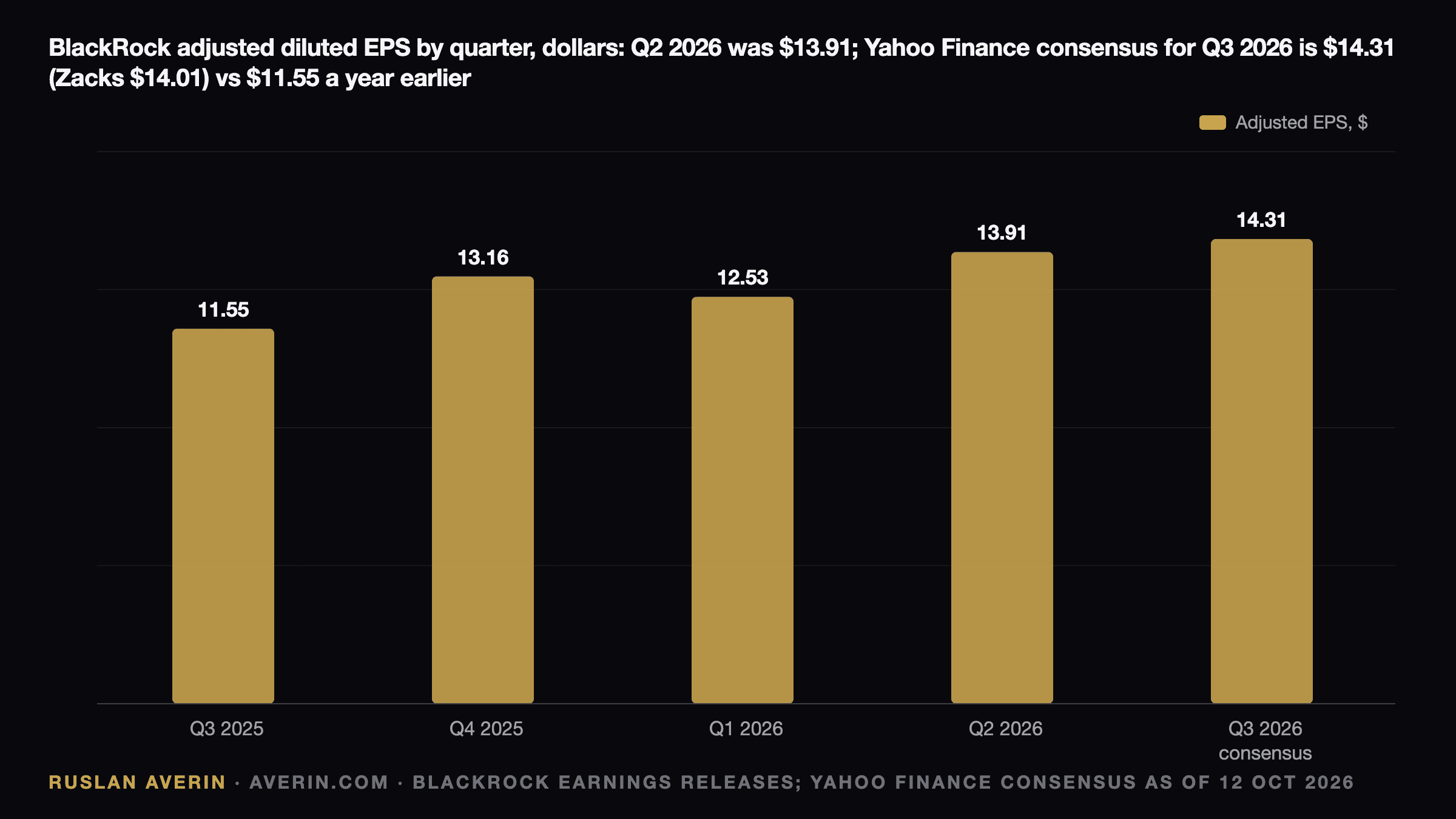
The beats have grown, not shrunk. Against the Yahoo Finance estimates, the surprise was 2.3% in the third quarter of 2025, 7.9% in the fourth, 9.4% in the first quarter of 2026 and 9.6% in the second, when BlackRock reported $13.91 against $12.69. The sequential step from $13.91 to $14.31 is only about 3%, which looks modest given where the quarter started.
AUM: a high starting point, mixed markets
BlackRock ended June with a record $15.34 trillion of assets under management, after net inflows of $192 billion and market appreciation of $1.28 trillion in the second quarter. The mix matters for the third quarter: $8.89 trillion was in equities, $3.39 trillion in fixed income, $1.35 trillion in multi-asset and $1.07 trillion in cash.
Markets in the quarter pulled in different directions. The S&P 500 rose 2.0% between the closes of 30 June and 30 September, and the iShares MSCI ACWI ETF rose 1.2%. The iShares Core US Aggregate Bond ETF (AGG) returned about minus 3.5% including distributions, as the 10-year Treasury yield climbed above 5% after the Fed's September hike. On my rough arithmetic, equity gains and bond losses roughly offset each other, so period-end AUM depends mainly on flows: with net inflows similar to recent quarters, it would land around $15.5–15.6 trillion. That is my estimate, not a company figure.
The more important number for revenue is average AUM, because base fees are earned on it. Second-quarter average AUM was $14.85 trillion. The third quarter started at $15.34 trillion, so average AUM should be several percent higher sequentially even if markets added little.
Net flows: iShares and private markets
The flow bar is high. In the third quarter of 2025 BlackRock took in $205 billion, including a then-record $153 billion into ETFs and $34 billion into cash, which produced 10% annualised organic base fee growth. Since then quarterly net inflows have been $342 billion in the fourth quarter, $130 billion in the first quarter of 2026 and $192 billion in the second.
ETFs carry the platform: iShares took in $178 billion in the second quarter, AUM passed $6 trillion, and first-half ETF inflows reached $310 billion. The weak spot was institutional index, with net outflows of $41 billion, and digital-asset ETFs, with outflows of $3 billion. I would watch whether bond ETF inflows held up in a quarter of falling bond prices, because fixed income ETFs took in $66 billion in the second quarter.
Private markets are smaller in AUM but larger in fees. They held $329 billion at the end of June, only 2% of AUM but 11% of base fees and securities lending revenue. Net inflows were $15.4 billion in the second quarter, offset by $6.2 billion of realisations. BlackRock's stated goal is $400 billion of private markets fundraising by 2030. The third quarter laps the 1 July 2025 closing of HPS, which added $165 billion of client AUM, so private credit growth is now organic rather than acquired. Any fundraising figure for HPS's flagship funds, and the pace of GIP infrastructure fundraising, will be read as the test of the $400 billion goal.
Organic growth, fee rate and Aladdin
Organic base fee growth was 8% annualised in the second quarter and 10% over the last twelve months; Laurence Fink called the quarterly figure "well in excess of our target". A print near 8% again would keep the premium multiple intact. A drop to the mid-single digits would revive the old argument that BlackRock grows assets faster than revenue.
That argument is about the fee rate. By my calculation, base fees and securities lending revenue of $5.73 billion on average AUM of $14.85 trillion annualise to about 15.4 basis points in the second quarter, against about 15.6 basis points a year earlier. Flows into low-fee ETFs and cash pull the rate down; private markets and active ETFs push it up. Holding near 15.4 basis points would mean the private markets mix is offsetting index pricing.
Technology services and subscription revenue, mostly Aladdin plus Preqin data, was $566 million in the second quarter, up 13% year on year, and annual contract value grew 15%. The year-ago base is $515 million, so 13% growth points to roughly $580 million. Preqin's contribution is now in both periods, which is why the growth rate slowed from 22% in the first quarter.
Revenue arithmetic: performance fees are the swing
If average AUM rises about 4% sequentially, base fees would be close to $5.95 billion. Add roughly $580 million of technology revenue, about $400 million of distribution fees and some $85 million of advisory and other revenue, and the total is about $7.0 billion. Reaching the $7.52 billion consensus therefore needs around $500 million of performance fees, against $305 million in the second quarter and $516 million a year earlier. Performance fees from HPS and liquid alternatives are the line most likely to decide whether revenue beats or misses.
Margin is the other check. The adjusted operating margin was 45.9% in the second quarter, the highest in almost five years. BlackRock also raised planned buybacks to $550 million a quarter and to $2 billion for 2026, alongside a quarterly dividend of $5.73.
How the stock got here, and the scenarios
BlackRock rose 6.6% on the day of its second-quarter report, 15 July, closing at $1,093.40. It peaked on 13 August and then slid with financials as yields rose: by 30 September it closed at $1,058.29, still up 10.1% for the quarter from $961.56 on 30 June. At $1,083.92 the stock trades at about 19.3 times the Yahoo Finance consensus of $56.11 for full-year 2026 EPS.
In analyst Ruslan Averin's view, four lines decide the reaction:
- Organic base fee growth. Around 8% or above confirms that flows are not just cheap ETF money.
- Total net flows against about $200 billion. The year-ago $205 billion is the visible comparison.
- Performance fees near $500 million. The revenue consensus quietly depends on them.
- Private markets fundraising. HPS and GIP commentary is the test of the $400 billion goal for 2030.
If flows and organic growth match recent quarters, I would expect a muted move, because the stock has recovered from its September dip and the consensus already assumes 24% EPS growth. The asymmetric case is a quarter where the EPS beat comes from performance fees while organic growth slips below 5%: the headline would look strong, but the multiple rests on recurring fees.
Related: BlackRock's record $15.3 trillion in Q2, VOO vs VTI in 2026 and why stocks and bonds fell together in September.