
ASML reports third-quarter 2026 results before the open on Wednesday 14 October, ahead of Euronext Amsterdam trading, with the investor call at 15:00 CET (9:00 a.m. in New York). It is the first big read on chip equipment this season, and the third quarter in a row without a bookings number, so investors will judge ASML almost entirely on its guidance.
The shares go into the print strong but off the highs. On Nasdaq (NASDAQ:ASML) they closed on Monday 12 October at $1,750.24, down 1.7% on the day and up 63.6% from the end-2025 close of $1,069.86. In Amsterdam (ASML.AS) they closed the same day at €1,575.80, up 71.0% from €921.40 at the end of 2025. The gap between the two figures is the euro, which has weakened against the dollar this year. Both lines sit below their record closes of 30 June: $1,989.44 and €1,721.40.
Update, 15 October 2026: the results
ASML reported on Wednesday 14 October: total net sales of €11.66 billion, a gross margin of 57.5% and net income of €4.96 billion, or €12.95 per share. Sales were in line with consensus, the margin beat the 55–57% guidance, and EPS includes a €509.7 million gain on the Mistral AI stake (about €1.33 a share before tax).
| Metric | Consensus | Actual |
|---|---|---|
| Net sales | €11.6–11.8B (TradingKey); €11.71B (Visible Alpha) | €11.66B |
| EPS | €10.87 (Visible Alpha); $12.47 (Zacks) | €12.95 |
| Gross margin | 55–57% (company guidance) | 57.5% |
| Q4 sales guidance | ~€14.4B (implied by the full-year range) | €14.2–15.2B |
| China, share of system sales | well below 20% (preview base case) | 23% |
The four lines from the preview:
- Q4. The €14.7 billion midpoint beats the implied €14.4 billion, but the year was only narrowed to €44–45 billion.
- Margin. About 57% guided for Q4, but the Q3 beat came from €3.3 billion of service and upgrades, about €400 million above plan. EUV system sales were €4.1 billion: 17 tools, including one High-NA.
- 2027. Still no bookings figure. Christophe Fouquet: "we now expect that our supply as currently planned for both 2027 and 2028 will not fully meet the demand of our customers", and "some customers are expressing an interest in placing orders with us for 2029 and even 2030." Non-current liabilities, which hold customer down payments and which the CFO called "an interesting gauge" of order intake, rose from €6.2 billion to €12.0 billion.
- China. 23% of system sales, up from 14% in Q2; still about 20% of 2026 sales.
Shares. In Amsterdam ASML closed on 14 October at €1,528.20, up 1.2% from €1,509.60. On Nasdaq it closed at $1,650.00, down 3.9% from $1,717.76, as chip-equipment stocks sold off after Amsterdam had closed. On Thursday Amsterdam caught up: about €1,440 at 10:30 CET, down 5.8% (intraday).
What it changes. I read this as the strongest order language possible without a number, met by the reaction the preview flagged: a strong quarter, no raise above €45 billion, a stock up about 54% this year in dollars. For 2027 the question is now capacity and price, not demand; the 2027 margin guide comes in January.
What ASML guided in July
On 15 July ASML guided third-quarter total net sales of €11.0–12.0 billion and a gross margin of 55–57%, with Installed Base Management (service and upgrades) sales of about €2.9 billion, R&D costs of about €1.2 billion and SG&A of about €0.4 billion. It raised full-year 2026 guidance to €43–45 billion of sales at a 54–56% gross margin.
That was the third raise of the year. In January the range was €34–39 billion, in April €36–40 billion, in July €43–45 billion. The year-ago base is low: in the third quarter of 2025 ASML had €7.5 billion of sales, a 51.6% gross margin and EPS of €5.49. The guidance midpoint of €11.5 billion means growth of about 53% year on year.
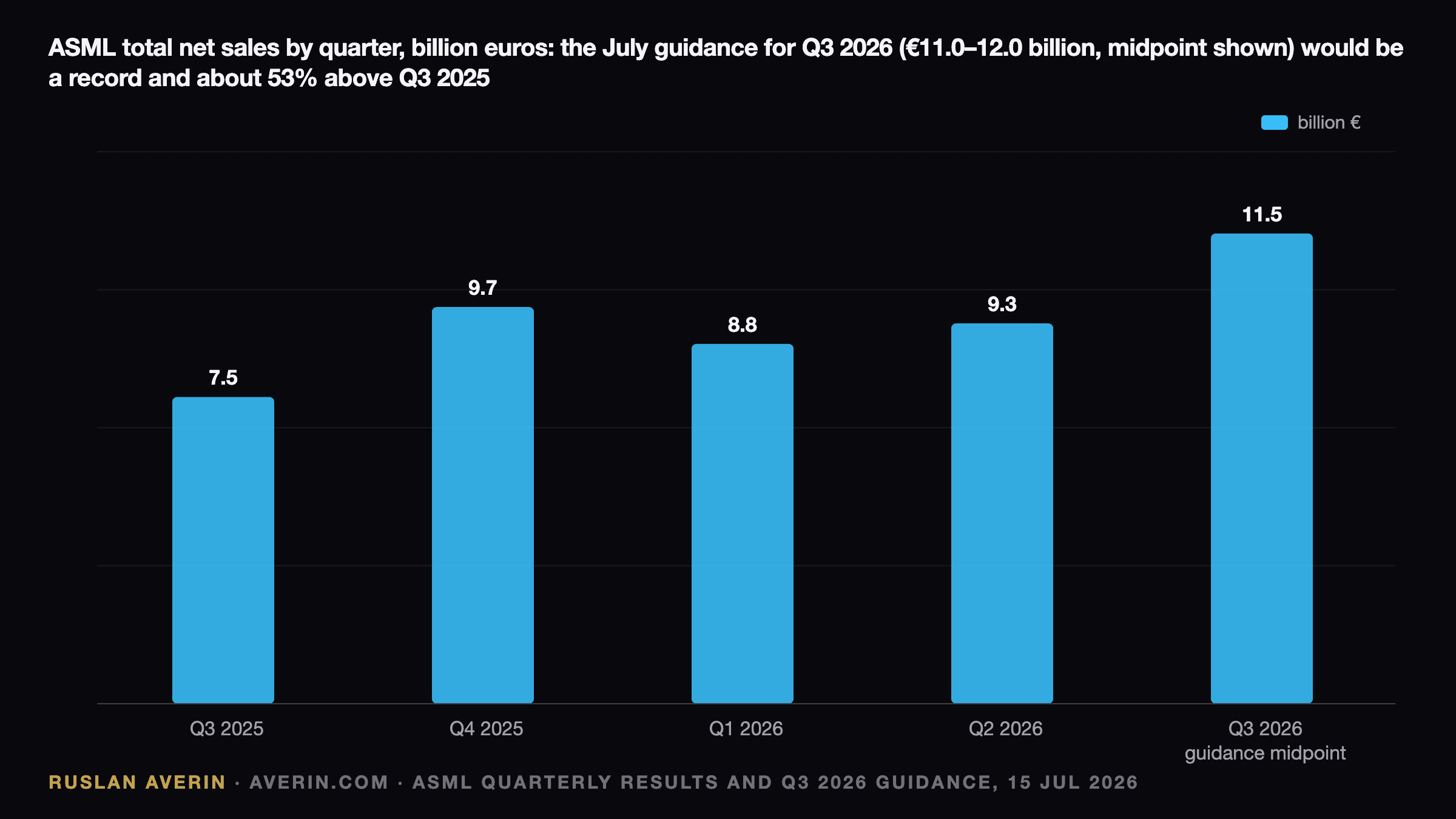
The full-year range also says something about the fourth quarter. First-half sales were €18.1 billion (€8.8 billion plus €9.3 billion). At the €44 billion midpoint, the second half needs €25.9 billion, and with the third quarter at €11.5 billion the implied fourth quarter is about €14.4 billion, a record by a wide margin.
What the consensus expects
The Zacks consensus, in dollars, is sales of $13.18 billion and EPS of $12.47 per share (one Nasdaq share equals one ordinary share). A TradingKey preview puts consensus revenue at €11.6–11.8 billion, in the upper half of the guided range. Zacks also notes that 2026 and 2027 earnings estimates have slipped over the past 60 days, so the bar is high on sales but not rising.
ASML has a recent habit of landing above its own range. In the second quarter sales of €9.3 billion beat guidance of €8.4–9.0 billion, and the 54.0% gross margin beat guidance of 51–52%. The CFO said service and upgrade sales came in about €300 million above plan. A third quarter at or above €12.0 billion with a margin of 57% would repeat that pattern; a print near €11.0 billion would land well below the consensus.
Orders: the number ASML no longer gives
From 2026 ASML stopped publishing quarterly net bookings, arguing that orders are lumpy and that its guidance is the better indicator. The last figures were strong: fourth-quarter 2025 net bookings were a record €13.2 billion, of which €7.4 billion was EUV, and the backlog at the end of 2025 was €38.8 billion. A year ago, in the third quarter of 2025, bookings were €5.4 billion with €3.6 billion of EUV.
Since then management has described order intake only in words: "very strong" in April, "extremely strong in the first half of the year" in July. So the order read on Wednesday comes from three proxies.
The first is 2027 capacity. ASML plans to ship about 65 low-NA EUV systems in 2026 and to add 30% to that capacity in 2027, roughly 85 tools. In July the CFO said the order book for 2027 was close to being fully covered. I would look for the word "covered" to turn into "fully booked".
The second is 2028. ASML is "investigating" another 30% increase in EUV and DUV immersion capacity for 2028. The CFO said there were no orders yet for that scenario. Any firm commitment would be the closest thing to a bookings surprise this quarter.
The third is High-NA. ASML sold 16 EUV systems in each of the first two quarters, and second-quarter EUV system sales of €3.8 billion included one High-NA tool. Intel Foundry has qualified High-NA on select 18A product layers, and on 8 September ASML and TSMC announced a joint initiative on large-format photomasks for High-NA EUV. What TSMC now says about adopting High-NA, through ASML, matters more than any single shipment.
Memory, Korea and the AI capex cycle
The demand is coming from memory as much as from logic. In the second quarter memory was 49% of €6.6 billion of net system sales and logic 51%. By ship-to location, South Korea took 43% and Taiwan 30%. For the full year ASML expects memory-related system sales to grow by more than 75%, advanced logic by more than 25%, EUV system sales by more than 45% and installed-base sales by more than 30%.
The customers' numbers support it. TSMC reported second-quarter revenue of $40.20 billion, up 33.7% in dollars, guided the third quarter to $44.6–45.8 billion, and reported September revenue of NT$511.86 billion, up 54.6% year on year. South Korea's 43% share points to Samsung and SK hynix adding DRAM capacity, including high-bandwidth memory for AI accelerators.
China and export controls
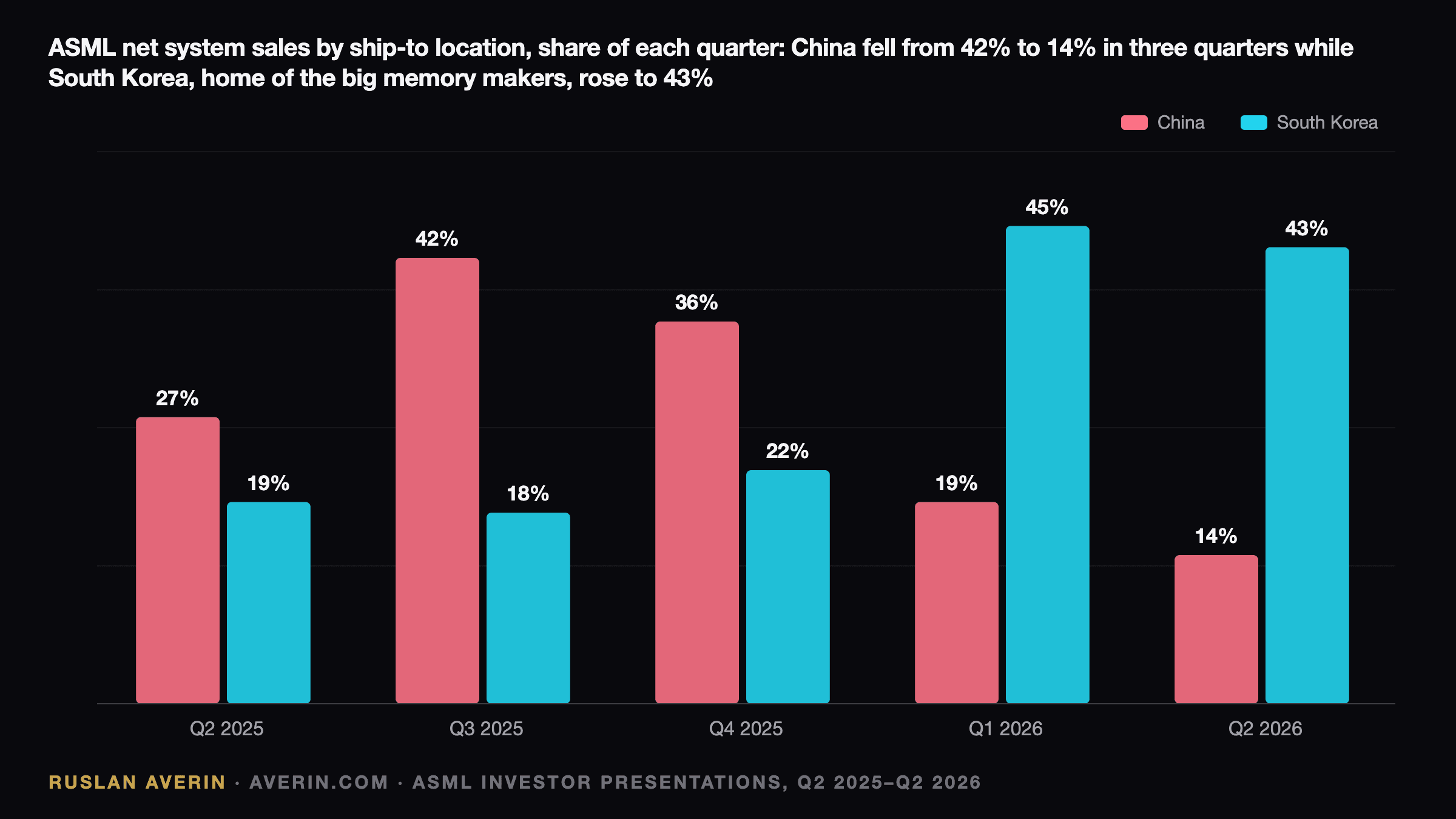
China is the line that has moved most. Its share of ASML net system sales fell from 42% in the third quarter of 2025 to 36% in the fourth, 19% in the first quarter of 2026 and 14% in the second. In October 2025 ASML warned that China sales would decline significantly in 2026; in July the CFO said China would be about 20% of total 2026 net sales, a figure that includes service.
Policy is the open risk. In April ASML said the bandwidth of its 2026 guidance accommodated "potential outcomes of ongoing discussions around export controls". On 26 September the Center for Technology & Statecraft counted 343 immersion DUV systems in Chinese-owned fabs, about 270 of them ASML's NXT:1980i, and called for tighter export rules. A restriction on servicing that installed base would hit the high-margin service line, not just new tool sales.
How the stock got here
On Nasdaq ASML rose 2.2% on the day of its second-quarter report, closing at $1,815.27 on 15 July, then fell to $1,550.69 on 29 July. It closed at $1,591.48 on 15 September and rallied 17.3% to $1,867.31 on 2 October, before losing 6.3% over the next six sessions to Monday's close. In Amsterdam the shares fell 4.9% from €1,656.20 on 5 October to €1,575.80.
The lines that decide the reaction
In analyst Ruslan Averin's view four lines decide Wednesday's move:
- Fourth-quarter guidance against the implied €14.4 billion. A raise of the full-year range above €45 billion confirms the backlog is converting.
- Gross margin. A third quarter at 57% and a fourth-quarter guide at the same level would show that EUV volume, not service one-offs, is lifting margins.
- 2027 language. "Fully covered" EUV capacity and any order for the 2028 expansion. Without a bookings figure, this is the order signal.
- China. A share well below 20% of system sales with no new export-control charge is now the base case; anything worse would cut 2027 estimates.
If the quarter lands in the upper half of guidance, the year is held at €43–45 billion and 2027 is described only qualitatively, I would expect a muted or negative reaction: the stock is up 64% this year in dollars and the consensus already sits near €11.7 billion. The upside case needs a raise and a firm 2027 statement. The downside case is the familiar one for equipment makers: a strong quarter paired with talk of 2027 as a peak year.
Related: the August chip selloff while memory prices set records, the September AI-slowdown scare and chip stocks and TSMC's June sales and AI demand.