Morgan Stanley reports third-quarter 2026 results at about 7:30 a.m. New York time on Wednesday 14 October, before the US open, with the conference call at 9:30 a.m. The shares closed on Monday 12 October at $190.02. That is 7.0% above the end-2025 close of $177.53, but 16.9% below the 2026 closing high of $228.55, set on 15 July, the day of the record second-quarter report.
In July the question was the size of the beat. Now the stock has been marked down for a weaker trading quarter, and the question is whether estimates fell far enough.
Update, 15 October 2026: the results
Morgan Stanley reported third-quarter EPS of $3.03 on net revenues of $20.34 billion, with ROTCE of 22.6%. EPS landed between the two consensus figures the preview quoted: 20 cents above the Zacks $2.83 and 9 cents below the Hudson Labs $3.12. The LSEG consensus cited by CNBC was $2.91.
| Metric | Consensus | Actual |
|---|---|---|
| EPS | $2.83 (Zacks) / $3.12 (Hudson Labs) | $3.03 |
| Net revenues | $19.63B / $20.66B | $20.34B |
| Equities | $4.51B (Zacks) | $5.80B, up 41% |
| Investment banking | $2.16B (Zacks) | $2.16B, up 2% |
| Fixed income | $2.17B year ago (preview line) | $2.01B, down 7% |
| Wealth Management margin | 30% goal | 30.4% |
| Net new assets | $81B year ago | $232B |
Equities beat the Zacks figure by $1.29 billion, well past the "near $5 billion" upside case. Investment banking matched the estimate: advisory rose to $887 million from $684 million, while equity underwriting fell to $525 million from $652 million on fewer IPOs and blocks. Wealth Management posted record revenue of $9.07 billion. Net new assets were a record $232 billion, with just over half from IPO-related flows. The firm bought back $1.54 billion of stock at an average of $212.74, the same pace as the second quarter, and CET1 was 14.9%. Fixed income fell short of the $2.17 billion marker on weaker securitized products and commodities.
Ted Pick said in the release: "Institutional Securities benefited from global strength, led by our Equity franchise, and Wealth Management reported record revenues and added $232 billion in net new assets and $80 billion in fee-based flows."
The shares closed on 14 October at $181.51, down 2.75% from $186.64 on 13 October. The S&P 500 fell 1.11% and the KBW Bank Index 1.49%. The stock is 20.6% below its July high of $228.55.
What it changes. I read this as a beat the market declined to pay for. In my upside case equities overdelivered, but EPS stayed below $3.12 and the buyback did not speed up. The downside case did not play out either: the margin held above 30% and banking did not fall below a year ago. At about 3.4 times tangible book of $53.96, I would now watch whether IPO-driven asset flows turn into higher underwriting fees in the fourth quarter.
What the consensus expects
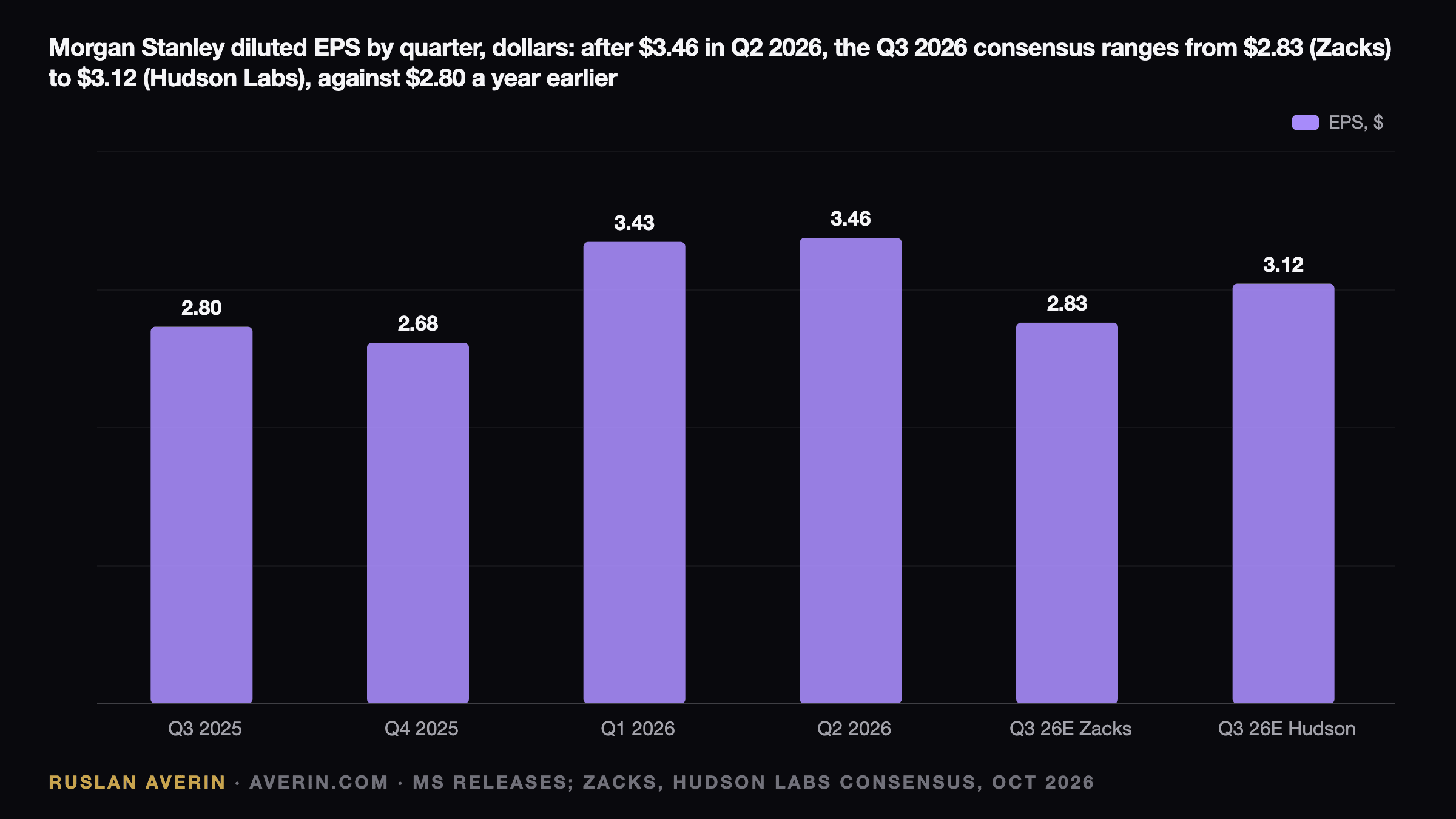
The estimates are unusually far apart. The Zacks consensus is EPS of $2.83 on revenue of $19.63 billion, up 1.1% and 7.7% from a year earlier. Zacks counts five EPS estimates, and all five were revised down over the past four weeks. A consensus compiled by Hudson Labs at the end of September is higher: EPS of $3.12 on revenue of $20.66 billion. The 29-cent gap means a "beat" or "miss" headline depends partly on which number is used.
The year-ago base is $2.80 a share on net revenues of $18.2 billion, with return on tangible common equity (ROTCE) of 23.5%. The sequential base is much higher: $3.46 on $21.3 billion in the second quarter and $3.43 on $20.6 billion in the first. Even the Hudson Labs figure implies a drop of about 10% from the second quarter. The Zacks figure implies 18%.
Institutional Securities: equities and FICC after a record
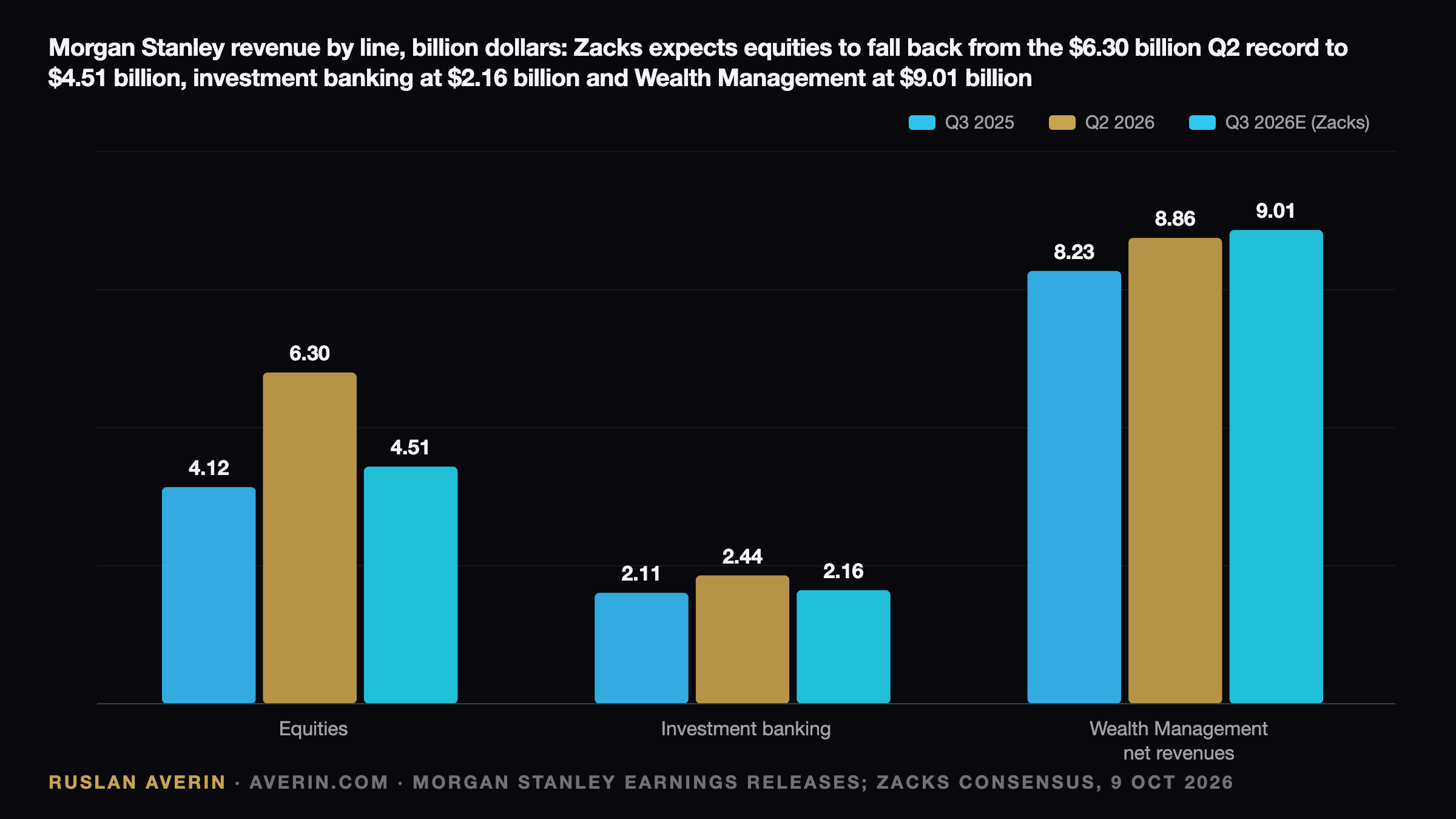
Second-quarter Institutional Securities revenue was a record $11.0 billion. Equities alone brought in $6.3 billion, up 69% year on year, with notable strength in Asia. Fixed income (FICC) made $2.46 billion, up 13%, and investment banking $2.44 billion, up 58%.
Management has already warned against extrapolating. At an investor conference on 15 September co-president Dan Simkowitz said the third quarter was not matching the second in markets, according to a MarketBeat summary of his remarks. The Zacks consensus reflects that: equities revenue of $4.51 billion, up 9.6% from $4.12 billion a year ago but about 28% below the second quarter. Total Institutional Securities revenue is expected at $9.21 billion, against $8.52 billion a year ago.
Fixed income made $2.17 billion a year ago. The Fed raised its target range to 3.75–4.00% on 16 September and the 10-year Treasury yield went above 5%, which gives rates and credit desks more client activity but also more mark-to-market risk. In the second quarter, losses on corporate loans, net of hedges, already pushed the "Other" line in Institutional Securities to minus $152 million. I would watch whether FICC holds above $2.17 billion.
Investment banking: the pipeline versus the print
Zacks expects investment banking revenue of $2.16 billion, only 2.6% above the $2.11 billion of a year ago and below the $2.44 billion of the second quarter. Simkowitz described pipelines as "very robust" and said the firm holds more than 100 private-equity sell-side mandates, a record.
The sell side has turned more cautious since. On 2 October Oppenheimer analysts Chris Kotowski and John Coffey cut their third-quarter EPS forecasts for Goldman Sachs and Morgan Stanley and said they expect both to fall short of consensus. Across the banks they cover they lowered investment banking revenue projections by 9.5% and raised trading by 6%.
The comparison with JPMorgan is useful. On 15 September Doug Petno said JPMorgan expected its own investment banking fees and markets revenue to rise by a mid-to-high-teens percentage year on year in the third quarter. If Morgan Stanley's banking line grows in the low single digits, as Zacks pencils in, the call will need to explain whether that is timing, with deals slipping into the fourth quarter, or lost share. JPMorgan reports this morning, so its numbers will be the first read on the quarter.
Wealth Management: net new assets and the 30% margin
Wealth Management is the steady part of the firm. In the second quarter it delivered record revenue of $8.86 billion, a pre-tax margin of 30.5% and record net new assets of $148 billion. Just over half of those assets came from IPOs of certain clients in the Workplace channel, so the second-quarter figure was flattered by one-off listings. A year ago net new assets were $81 billion and the margin was 30.3%.
Zacks expects segment revenue of $9.01 billion, up 9.4% year on year, asset management revenue of $5.40 billion and net interest income of $2.30 billion, up 15.4%. That line grew in the second quarter on higher sweep deposits and lending.
The firm-wide goal for the segment is a 30% pre-tax margin. I would treat net new assets near the $81 billion of a year ago as a normal quarter, and a figure well above $100 billion without a large IPO as evidence that the Workplace funnel is converting employees into advisory clients.
ROTCE, capital and the $20 billion buyback
Morgan Stanley's firm-wide goals, restated in its January strategic update, are ROTCE of 20%, a 30% Wealth Management margin, an efficiency ratio of 70% and client assets above $10 trillion. The last goal was reached in the second quarter. In the first half of 2026 ROTCE was 26.8% and the efficiency ratio 65%. Zacks' consensus return on equity of 16.8%, against 20.7% in the second quarter, translates on my arithmetic into ROTCE of roughly 21–22%: lower, but still above the goal.
Capital is ample. The CET1 ratio was 14.8% at the end of June. The firm bought back $1.5 billion of stock in the second quarter at an average of $197.64 and $1.75 billion in the first. In July the board reauthorized a multi-year buyback of up to $20 billion starting in the third quarter and raised the quarterly dividend to $1.15. With the shares below that average price, the repurchase pace is a signal of how management values the stock. At $190.02 the stock trades at about 3.6 times tangible book value of $53.18 a share.
What moved the stock into the print
Since 15 September, the day before the Fed hike, Morgan Stanley has fallen 7.9%, against 6.8% for the KBW Bank Index and 8.5% for Goldman Sachs, while the S&P 500 rose 2.9%. Since the start of the year the stock is up 7.0%, against 14.0% for the S&P 500.
There were also stock-specific headlines. On 24 September Semafor reported that UBS leadership had revived discussions about leaving Swiss oversight, possibly through a foreign merger; Morgan Stanley's name appeared in an editor's analysis, and the Swiss paper Blick later listed it among possible partners. Neither bank commented. Morgan Stanley fell 1.04% to $196.32 that day while several large peers rose. Any talk of large acquisitions competes with the buyback for capital.
The scenarios
In analyst Ruslan Averin's view, four lines decide the reaction:
- Equities revenue against $4.51 billion.
- Investment banking against $2.16 billion, and what Ted Pick says about the private-equity and IPO pipeline for the fourth quarter.
- Wealth Management margin of at least 30% and net new assets compared with the $81 billion of a year ago.
- Buyback pace under the $20 billion program and any comment on acquisitions.
If EPS lands between the two consensus figures, $2.83 to $3.12, with the margin at 30% or above, I would expect a contained move: the stock has already given back 16.9% from its July high. The upside case is EPS above $3.12 with equities near $5 billion and a faster buyback, which would let the market treat the quarter as a pause. The downside case is investment banking below a year ago together with a margin under 30%, which would confirm the caution on capital-markets names at a valuation that still leaves room to fall.
Related: the Bank of America Q3 2026 preview, the JPMorgan Q3 2026 preview and Morgan Stanley's record second quarter.