US diesel reached $6.23 a gallon on 14 September 2026, a record, and on the same morning the President of the United States was asking Ukraine to stop hitting Russian refineries. The two facts are connected, and the connection is the most important thing in energy markets this week. Crude oil is cheaper than it was in June 2022, when the previous diesel record was set. The product is not.
I have followed the refinery campaign since the spring because it is a rare case where a war decision shows up directly in a Western price index. Here is the arithmetic behind the headline, in dollars, roubles, hryvnia and votes.
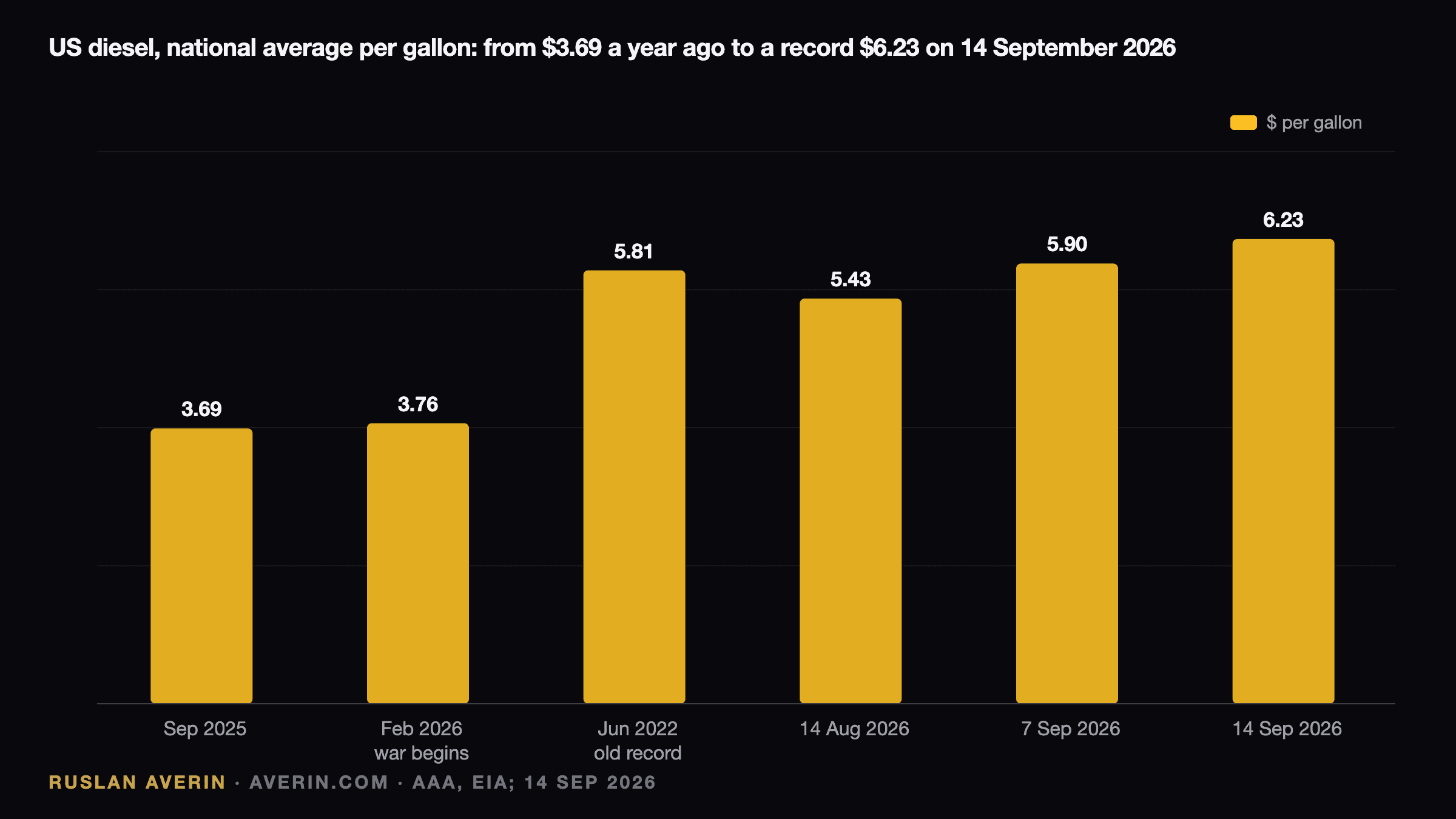
The price, in one table
| Date | US diesel, AAA average | Note |
|---|---|---|
| September 2025 | $3.69 | one year ago |
| Late February 2026 | $3.76 | start of the Iran war |
| June 2022 | $5.81 | previous all-time record |
| 14 August 2026 | $5.43 | one month ago |
| 4 September 2026 | $5.85 | 2022 record broken |
| 11 September 2026 | $6.05 | first close above $6 |
| 14 September 2026 | $6.23 | record; Pennsylvania $6.35, California $7.98 |
Diesel is up about 60% since the war began and 69% year on year. Gasoline is $4.32, up 36% year on year, which is painful but not a record. The difference between the two is the whole story: gasoline is a crude problem, diesel is a refining problem.
The diesel crack spread, the refiner's margin between crude and product, hit $108 a barrel on 3 September, more than double the 2022 peak territory. Brent on 14 September traded at $108 after a 3.5% jump, WTI at $103. Crude is $28 a barrel below the 2022 record, and diesel is 42 cents above it.
Where the diesel went
Three supply lines feed the shortage, and two of them are the same war.
The Gulf. After the Strait of Hormuz attacks and the Bab al-Mandab closures, Gulf diesel exports in August were just over a quarter of their February level, roughly 390,000 barrels a day short. On 10 and 11 September drones from Iraq hit pump stations on the Saudi East-West pipeline, the 1,200 km line from Abqaiq to Yanbu that carried four to five million barrels a day around Hormuz. It is shut. Together the Gulf and Russia were about 45% of seaborne diesel trade before the war.
Russia. Ukraine's drones have hit all eleven of the largest Russian refineries in 2026: Omsk, Kirishi, Ryazan, Kstovo, Yaroslavl, Volgograd, Perm, Moscow, Novokuibyshevsk, Syzran and Bashneft. Kstovo stopped again on 26 August, Kirishi on 30 August. Reuters put the capacity halted or cut at nearly a quarter in May; the IEA says more than 20%; Ukraine's General Staff claims 42.7%. Russia banned diesel exports by non-producers from 8 July and has extended the ban to 30 September; 55 of 83 regions have had shortages or rationing.
The refiners. Andy Lipow's line on 11 September explains why nothing relieves the price quickly: refiners have already maximised diesel output and "simply can't get any more diesel out of the system". The EU average is €2.03 a litre, up 35% year on year, with Germany at €2.33 and the Netherlands at €2.44, and Europe enters autumn with diesel inventories well below normal.
What Trump said and why now
On Saturday 13 September at his golf club in Doonbeg, Ireland, Trump told reporters: "Mr. Zelenskyy has to do one thing. He has to stop knocking out diesel fuel in Russia." And: "There are plenty of other targets. Don't hit diesel fuel, because that's hurting, that's hurting the world." He added that he had raised it with Putin earlier in the week.
The domestic number behind the request is the Brown University cost tracker: the diesel spike has cost Americans more than $46 billion since the war began, over $350 per household, on top of $55 billion on gasoline. August PPI was +5.4% year on year with the diesel component +24.1%. UPS raised its ground fuel surcharge to 28.5% this week. The midterm election is on 3 November, and Trump said on 11 September that "right after the election, oil prices are going to be tumbling downward".
Kyiv's answer was that refineries are legitimate military targets and that Russian oil "funds and directly fuels" the invasion. Foreign Minister Sybiha called the shortage "Putin's terror knocking directly on the doors of the EU and NATO". For Ukraine the strikes are the one lever that reaches the Russian budget without waiting for sanctions, and the price at American pumps is the cost of that lever becoming visible.
The Ukrainian side of the same pump
The shortage does not stop at the Polish border. On 14 September the average price of A-95 in Ukraine was UAH 85.01 a litre, up 1.05 in three days, and diesel was UAH 95.94, up 1.31. Fuel is 38.7% more expensive than a year ago and drove August inflation to 8.1%. The National Bank raised its policy rate to 15.5% on 30 July citing exactly this fuel shock, and has sold more than $1 billion a week for nine weeks to hold the hryvnia at 44.6, a story covered separately on this site.
Who makes money on it
The refiners did, until this morning. Marathon Petroleum and Valero roughly doubled this year and Phillips 66 gained about 60% against 11% for the S&P 500; the three earned $12.6 billion together in the second quarter. On 14 September they fell, Valero −1.9%, Marathon −1.1%, Phillips 66 −1.0%, while crude rose 3.5%. The market read Trump's request as the first sign that the product squeeze could ease, and a rising crude price with a flat product price is a narrower crack. Product tankers went the other way: Scorpio +0.3%, Frontline +1.4%, because as long as diesel has to travel from South Korea to Rotterdam, someone is paid to carry it.
In analyst Ruslan Averin's view the refiners have had their year and the tankers are the remaining trade, but the larger point is for bond holders: a diesel price that adds a third of a monthly CPI print is why the Federal Reserve is about to raise rates on Wednesday.
Related: the Fed's first hike since 2023, Brent at $105 as a recession signal, Hormuz and the oil price and nine weeks of NBU dollar sales.