The last time European finance ministers met with diesel at a record, they left with a windfall tax. That was October 2022. On Friday they are at Dublin Castle with diesel at €2.471 a litre in Germany, the highest ever, €2.158 on the EU average, Brent at $102 after $108.75 on Monday, and a letter from six governments, Germany, Spain, Portugal, Italy, Poland and Austria, asking for "an EU-wide mechanism" to tax the profits that the Saudi pipeline attack has handed the oil companies. The Commission's answer, delivered by Valdis Dombrovskis at the door, was that the tax "is in the hands of member states". Germany's Lars Klingbeil called that "very reserved". This is going to October, and I think it is going to happen in at least four countries whatever Brussels says.
I own European energy through Shell and Equinor and I have been through this once. The pipeline, the restart and the price are covered separately; this is about the tax, the precedent and what it does to the equities.
Who wants what in Dublin
The meeting is an informal ECOFIN, two days, chaired by Ireland's finance minister Simon Harris, with Lagarde, Georgieva, Cormann and the finance ministers of Ukraine, Canada, the UK and Switzerland in the room. The published agenda is energy, AI and competitiveness, banking-sector competitiveness and financial innovation. The energy item is where the positions are.
| Country | Position on a windfall tax | Domestic measure |
|---|---|---|
| Spain | leads the push; Carlos Cuerpo wants "fair sharing of the economic burden"; proceeds for a climate-adaptation fund | diesel excise cut 20c/l, petrol 5c/l, expire 30 September; 2022 levy of 1.2% on turnover struck down January 2025 |
| Germany | finance minister Klingbeil for, chancellor Merz against | VAT on fuel 19% to 7% proposed by CDU/CSU, 21–25 cents from 1 October, about €3 billion; SPD wants a margin cap |
| Poland | for; already legislating | 60% tax on fuel margins above the 2025 average plus 20%, March–December 2026, about 4 billion zloty, mostly from Orlen |
| Italy | for; among the six signatories | car tax abolished on small and medium cars; asks Commission to treat energy as a defence emergency |
| Portugal, Austria | for; signatories | Austrian diesel at a record €2.268 |
| Ireland (presidency) | "kept under review"; Taoiseach rejected it | excise restoration of 27c petrol, 32c diesel phased from 1 November; Budget on 6 October |
| France | government defends TotalEnergies against a profits tax | TotalEnergies' voluntary €1.99/l cap, five months, €250–300 million |
| Commission | "in the hands of member states"; no EU-wide plan | "There is no supply problem in the EU at the present time" |
Klingbeil's line from Dublin is the one that will be quoted at the October meeting: "People in our countries can currently see how oil companies are exploiting the situation, overcharging people, and significantly increasing their profits." His counterpart at home is his own chancellor. Merz, on Monday, after reversing himself on relief in a single day: "I see no sufficient factual basis and no legal basis for taxing so-called excess profits." Two state elections on Sunday, Mecklenburg-Vorpommern, where the CDU could fall out of the parliament, and Berlin, are why the German government has three proposals and no decision, or, in Handelsblatt's phrase, has "got itself stuck".
The 2022 precedent, honestly measured
The instrument exists and it has a track record. Council Regulation 2022/1854, adopted on 6 October 2022 under Article 122 of the treaty, the emergency clause that lets the Council act without Parliament, imposed a "solidarity contribution" of at least 33% on the profits of companies with 75% or more of their turnover in oil, gas, coal or refining, on the part of profits exceeding the 2018–2021 average by more than 20%, for fiscal 2022 and/or 2023. Alongside it came a €180/MWh cap on the revenues of power producers. Fifteen member states applied the contribution as written and eight adopted "equivalent" national measures; Cyprus never did.
What it raised is the number the Dublin communiqué will not print. The Commission estimated €25 billion from oil and gas. The Tax Foundation's review put actual collections in 2022 at about €6.85 billion, roughly 27% of the projection. Italy, which wrote its own version, took about €3.8 billion against an estimated €1.8 billion under the EU formula; Czechia ran a 60% rate through 2025; Spain's 1.2% turnover levy lasted two years before its parliament killed it. Patrick Pouyanné said in September 2022 that the EU tax would cost TotalEnergies "more than 1 billion euros"; the company's second-quarter profit this year was $5.4 billion. A Spanish newspaper on Friday claimed "Brussels collected about 28 billion euros"; that figure does not match any official series I can find and I would not repeat it.
The legal fight is also not over. ExxonMobil's Dutch and German subsidiaries sued the Council in December 2022 over the Article 122 basis, and in June 2026 the Court of Justice's Grand Chamber heard three further challenges, from Varo Energy, Vermilion Energy Ireland and Acea, on "competence, legal basis and institutional procedure". A new levy built on the same article would carry the same risk, which is one reason the Commission is reserved and the member states are being told to do it themselves.
The price, and why the tax is back now
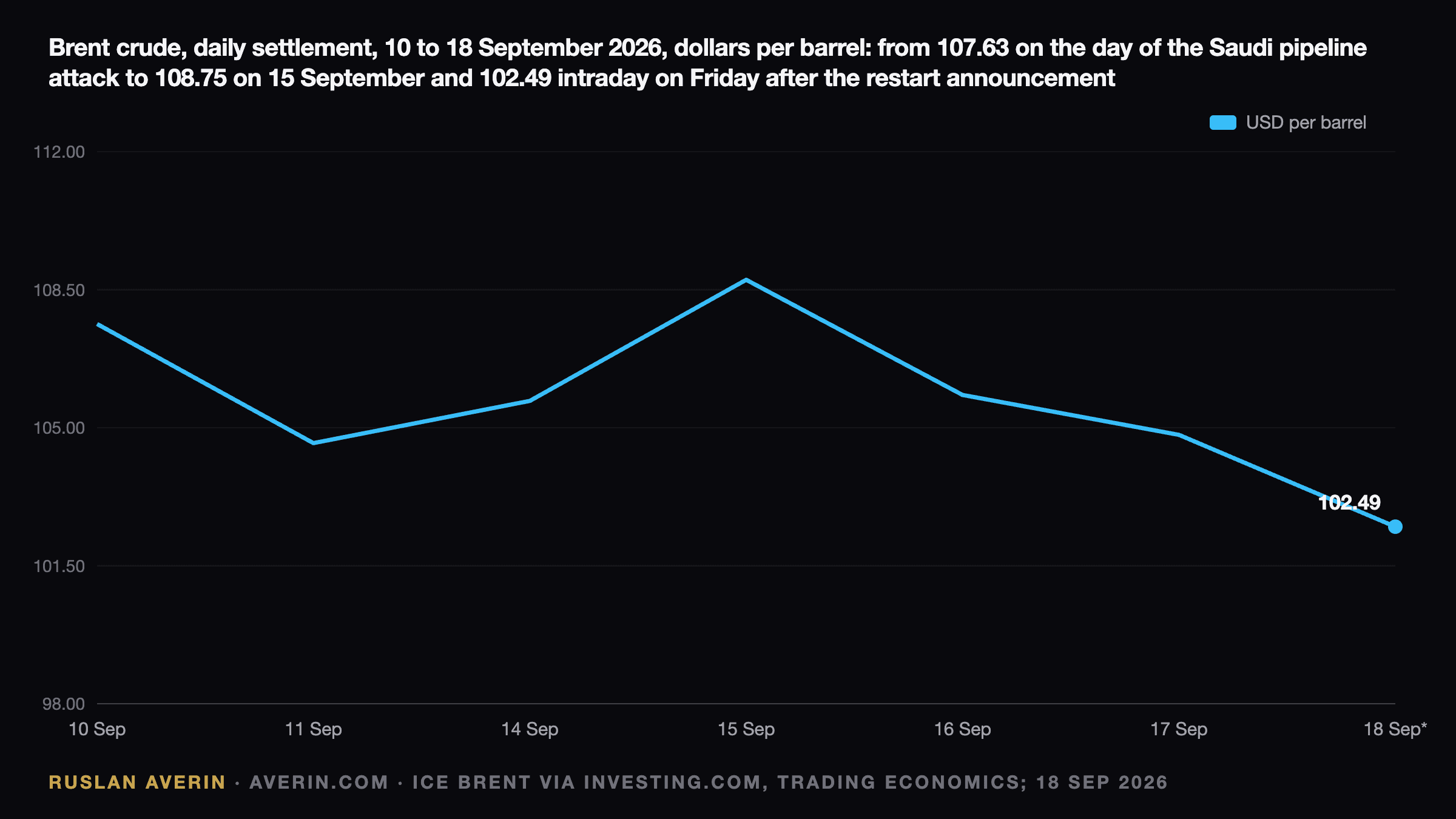
Brent settled at $107.63 on 10 September, the day of the pipeline attack, touched $109.80 on 14 September, settled at $108.75 on 15 September and has fallen for three sessions since, to $105.83, $104.82 and $102.49 on Friday morning, on Saudi assurances that half the East-West capacity returns within days and all of it within six weeks, with crude meanwhile shuttled around Hormuz and transferred ship-to-ship off Oman. WTI is back under $100. TTF gas is €78/MWh, nearly triple its level at the start of the year, with EU storage at 68% against an 80% target. The IEA's September report has 2026 supply down 5.7 million barrels a day, demand down 2.5 million, observed stocks down 507 million barrels since February, Saudi output at 5.97 million barrels a day in August, a three-decade low, and US diesel above $200 a barrel in early September, 94% above the pre-war level, with refining margins at records.
That last line is the political fact. A crude price of $102 is a shock; a refining margin at a record is a windfall, visible to every driver, and it is where the SPD's margin cap and Poland's 60% on fuel margins are aimed rather than at upstream profits. Pump prices this week: Germany diesel €2.471, E10 €2.308; Spain diesel €1.834, petrol €1.866 after eleven weekly increases; France about €2.15 nationally and €2.50 in Paris; Ireland above €2 for diesel; the United States $6.45 a gallon for diesel, a record, and $4.47 for regular; Ukraine 98.68 hryvnias a litre for diesel, with the government asking networks to stay under 100 and OKKO already at 99.9. The Commission's spokesperson is right that "there is no supply problem in the EU at the present time"; there is a price problem, and a price problem two days before two German elections is a tax.
What it does to the companies
The second-quarter numbers are why the ministers feel entitled. Shell earned $10.8 billion, adjusted $9.8 billion, its second-highest quarter ever, and announced a $3 billion buyback; TotalEnergies $5.4 billion, up 68%, with the interim dividend raised to €0.90; Equinor $4.8 billion and a buyback doubled to $3 billion; Eni €3.2 billion, adjusted profit doubled, buyback raised to €3.4 billion; BP $3.8 billion, underlying profit up 78%, which then suspended its buyback on 15 September to cut debt and fell 3.4% on Wednesday. Repsol earned €1.2 billion, OMV €529 million, Galp €762 million.
| Company | Q2 2026 net income | Shareholder returns announced | 18 September move | Exposure to a 2022-style levy |
|---|---|---|---|---|
| Shell | $10.8B (adj. $9.8B) | $3B buyback | −1.0% to −1.2% | high: UK and Dutch upstream, European refining |
| TotalEnergies | $5.4B | dividend €0.90, buyback extended | −1.1% | high: French refining, price cap already in place |
| Equinor | $4.8B | buyback doubled to $3B | −1.2% | Norway is outside the EU; EU gas sales in scope only via national measures |
| BP | $3.8B | buyback suspended 15 Sept | −1.3% | medium: UK levy already applies |
| Eni | €3.2B | buyback raised to €3.4B | −1.0% | high: Italy took €3.8B last time |
| Repsol | €1.2B | $571M buyback | −1.1% | high: Spain leads the push |
| OMV, Galp | €529M, €762M | — | −0.6%, −0.9% | Austria and Portugal are signatories |
The sector underperformed on Friday morning against a STOXX 600 down 0.3%, having risen with the index on Thursday when gas eased. No bank has published a number for what a repeat levy would cost per share and I will not invent one; the arithmetic from 2022 is that the tax took a low-single-digit share of the majors' profits at the EU level and much more where governments wrote their own rules, which is what Spain, Poland and Italy are proposing to do again. Pouyanné's sentence about the French cap, "If a tax is introduced, we'll draw our conclusions", is the industry's position: the voluntary cap that earned "a large amount of goodwill" is the price of not being taxed, and a tax ends it. In the US the debate is a Senate bill from Richard Blumenthal with 13 co-sponsors, "The Big Oil Windfall Profits Tax Act", and a president who said in August that Big Oil is "making too much money"; XLE rose 0.7% on Thursday and Exxon and Chevron were flat.
What I would do
In analyst Ruslan Averin's view the October ECOFIN will not produce an EU regulation, because the Commission does not want a second Article 122 case before the Court has ruled on the first, and the six will therefore legislate nationally, as Poland already has. That is worse for the companies than a single EU levy: Spain's turnover-based version taxed sales rather than profits, Italy's raised twice the EU formula, Poland's is 60%. The equities are pricing a probability, not an amount, and the probability rises every day German diesel sets a record. I keep Shell and Equinor, because Norway is outside the EU and Shell's earnings are global, and I would not add Repsol or Eni until the October meeting. The trade that works in every scenario is the one the ministers cannot tax: the refining margin itself, which is why the diesel crack, not the oil price, is the number I check each morning. And the German VAT cut, if it comes on 1 October at 21–25 cents, will do what the 2022 Tankrabatt did: reach the pump almost entirely, cost about €3 billion, and fade in three months, which is also roughly the horizon on which the central banks that hiked this week expect the energy shock to broaden into everything else.
Related: the Saudi pipeline and oil at $105, diesel at a record, energy markets and Hormuz, the case for European equities and three central banks hiking in 72 hours.