
The first frosts of the season reached most of Ukraine on the night of Thursday 15 October. The Ukrainian Hydrometeorological Centre forecast ground frosts of 0 to −3°C in most northern and central regions and issued a first-level, yellow warning. Air temperatures at night were forecast at +1 to +6°C, against +7 to +12°C in the south and east.
The same morning Ukrenergo kept hourly power outages in place across part of the country after Russian strikes on the grid, and filling stations raised diesel and autogas prices again. For households the cold snap is less a weather story than a cost one: it starts the clock on the heating season, the outage season and the winter fuel bill.
Where the frosts hit first
The cold came from the west. On the nights of 13 and 14 October forecasters warned of ground frosts down to −3°C in the western regions, Zhytomyr and Vinnytsia regions. Forecaster Natalka Didenko said the west would stay the coldest part of the country in the coming days and the east the warmest.
By 15 October the frost zone moved to the north and centre. Vitaliy Postryhan, head of the Cherkasy hydrometeorological centre, named the northern regions, Vinnytsia and Cherkasy regions. In Kyiv region nights of +1 to +6°C came with ground frosts of 0 to −3°C. Days nationwide were forecast at +10 to +15°C, up to +19°C in the far east.
The frosts do not last. For 16 and 17 October the Hydrometeorological Centre expects rain across the country and possible wet snow in the Carpathians, with nights of +3 to +10°C.
When the heating comes on
There is no national start date. Heat is supplied to housing once the average daily temperature stays at +8°C or lower for three days in a row, and each local council decides. In Lviv the average was below +8°C on 12 and 13 October, only two days, so the city has no grounds to start yet, a Lviv regional forecaster told Dyvys.info.
The calendar so far:
- Varash (Rivne region) started on 7 October, first for schools, kindergartens and hospitals.
- Bolekhiv community (Ivano-Frankivsk region) started on 15 October.
- Pavlohrad set the season for homes with individual gas or electric heating that receive benefits or subsidies from 16 October 2026 to 15 April 2027.
- Ivano-Frankivsk plans to start no earlier than 1 November unless it gets cold sooner.
- Kyiv has named no date. Petro Panteleiev, acting first deputy head of the Kyiv City State Administration, said on 9 October that the city is ready, but the start depends on temperature, the need to save gas and security.
For housing subsidies, heating costs are counted from 16 October 2026 to 15 April 2027 whatever date a city chooses. Households that apply by 30 November through the Pension Fund, a CNAP or Diia receive the subsidy from 1 October.
Gas, power and heat: frozen for the winter
The main household tariffs will not change this season.
- Gas. Naftogaz confirmed on 12 October that its "Fixed" plan stays at UAH 7.96 per cubic metre until 30 April 2027. The government extended the public service obligations on the gas market to 31 March 2027.
- Electricity. The Cabinet of Ministers extended the electricity public service obligations to 30 April 2027. The household tariff stays at UAH 4.32 per kWh. Homes with electric heating, or without gas and district heating, keep UAH 2.64 per kWh for up to 2,000 kWh a month.
- District heating in Kyiv. Kyivteploenergo charges UAH 1,654.41 per Gcal and UAH 97.89 per cubic metre of hot water, unchanged for the 2026/27 season, according to the city administration. That is a wartime tariff: the economically justified rates range from UAH 2,284.44 to 2,716.56 per Gcal and return six months after martial law ends.
The gap is large. Kyivteploenergo puts the price it paid for gas for commercial customers in June 2026 at UAH 23,695.88 per 1,000 cubic metres before transport and VAT, roughly three times the household price.
What a cold month costs
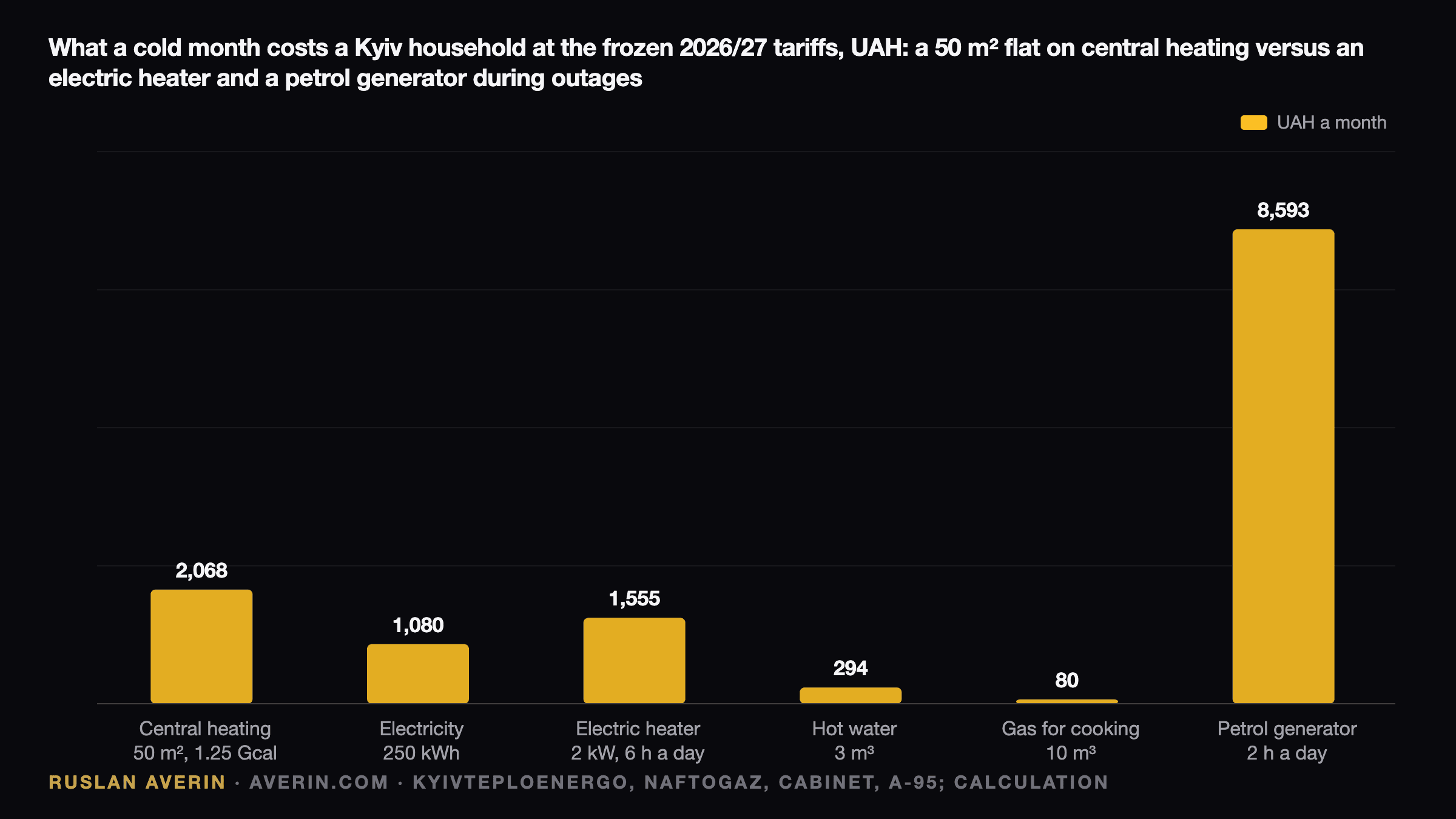
The chart prices one illustrative household: a 50 square metre Kyiv flat on district heating with a gas stove, in a cold month.
- Heating: at 0.025 Gcal per square metre, 1.25 Gcal comes to about UAH 2,068. In buildings without meters the norm is UAH 38.50 per square metre, or UAH 1,925 before the temperature adjustment. In Kharkiv, the heating utility's own example for a 50 square metre flat in January 2026 came to UAH 2,580.43.
- Electricity: 250 kWh at UAH 4.32 is UAH 1,080.
- Hot water: 3 cubic metres at UAH 97.89 is about UAH 294.
- Cooking gas: 10 cubic metres at UAH 7.96 is about UAH 80, plus distribution.
That is about UAH 3,520 a month. Two winter scenarios change it sharply. A 2 kW electric heater run 6 hours a day uses 360 kWh, or UAH 1,555 at the standard tariff and UAH 950 at the UAH 2.64 rate. A petrol generator burning 1.6 litres an hour at the 14 October average A-95 price of UAH 89.51 costs about UAH 143 an hour; two hours a day for a month is UAH 8,593, more than all the utility bills combined. The comparison with batteries is in our outage cost guide.
For a private house the main item is gas. A house that burns 1,500 cubic metres over the season, an illustrative figure for about 100 square metres, pays about UAH 11,940 at UAH 7.96 before distribution.
Outages on 15 October
Ukrenergo applied hourly outage schedules for all consumer categories from 06:00 to 23:59 on 15 October, in a volume of 0.5 to 1.5 queues, plus power limitation schedules for industry and business. On 13 October the volume had been 0.5 to 2 queues. Hourly schedules applied in Kyiv and in Kyiv, Sumy, Poltava, Cherkasy, Zhytomyr, Kharkiv and Chernihiv regions, Obozrevatel reported.
Diesel, autogas and heaters
On 15 October OKKO raised regular diesel from UAH 99.90 to 100.90 a litre and autogas from 46.90 to 49.90, according to the Enerhoreforma monitoring cited by Interfax-Ukraine. UPG moved diesel to 98.90 and autogas from 44.90 to 48.82; SOCAR diesel reached 104.00. Autogas rose at every network checked, by UAH 1.6 to almost 4. On 14 October national averages were UAH 89.51 for A-95, 99.07 for diesel and 47.17 for autogas. Background in the October fuel prices piece.
Demand for autonomous heat has jumped. On the Prom marketplace, orders for autonomous and pre-start heaters tripled year on year, with an average order of UAH 4,877; climate equipment as a whole rose 80%. Kharkiv city hall reported generators and charging stations 15–20% dearer than in autumn 2025: petrol generators at UAH 12,000–55,000, inverter models at UAH 25,000–60,000, diesel at UAH 42,000–160,000.
Vegetables: cabbage cheaper, tomatoes dearer
Frosts end the open-field season and shift supply to storage and greenhouses. In the week to 12 October white cabbage fell to UAH 17–20 a kilogram from 20–25, onions to 12–16 and beetroot to 13–15, RBC-Ukraine reported. Tomatoes rose from UAH 40–50 to 55–65 and cauliflower to 50–60. Potatoes sell at UAH 11–14 and carrots at 13–17. In analyst Ruslan Averin's view, storage crops bought now are the cheapest they will be this winter, while greenhouse vegetables will track heating and electricity costs.
What households can prepare now
- Apply by 30 October for Winter Support of UAH 19,400 in frontline communities, and by 30 November for a subsidy from 1 October.
- Register electric heating with the supplier if the home qualifies: UAH 2.64 instead of 4.32 saves about UAH 605 on 360 kWh.
- Size backup power: a power bank or a 1 kWh station for a flat, a generator only where it can run outdoors.
- Budget fuel: a 15-litre generator tank at UAH 89.51 is about UAH 1,343.
Related: power outage schedules and backup power costs, fuel prices in October 2026 and the heating season as a property question.