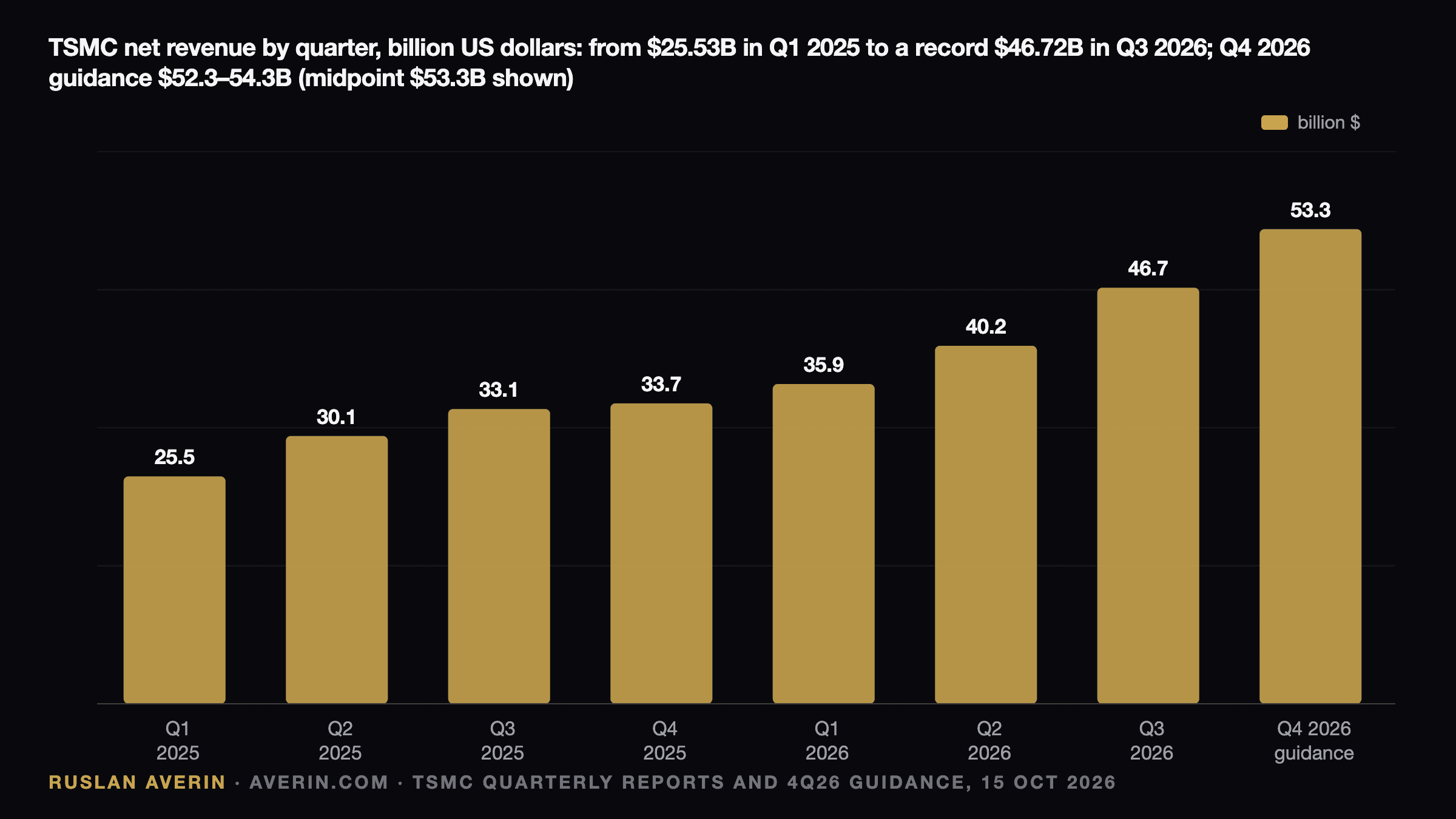
TSMC reported third-quarter 2026 results on Thursday 15 October, ahead of its 2 p.m. Taipei earnings conference. Net income rose 68.7% year on year to a record NT$763.06 billion, or NT$29.43 a share. Revenue in US dollars was $46.72 billion, above the top of the company's own range. For the fourth quarter TSMC guided to $52.3–54.3 billion.
The numbers landed on one of the worst days for Asian chip stocks this year. The KOSPI fell 7.57% to 5,554.22, Samsung Electronics lost 9.48% and SK hynix 11.06%. The world's largest contract chipmaker is now telling the market the opposite of what the market is pricing: that AI demand is not slowing.
Q3 2026 results against consensus and guidance
| Metric | Consensus / guidance | Actual |
|---|---|---|
| Revenue, US$ | $44.6–45.8B (guidance) | $46.72B |
| Revenue, NT$ | NT$1.47T (LSEG SmartEstimate) | NT$1,494.24B |
| Net income | NT$746.34B (LSEG SmartEstimate) | NT$763.06B |
| EPS per ADR | $4.42 (consensus via Investing.com) | $4.60 |
| Gross margin | 65.0–67.0% (guidance) | 66.4% |
| Operating margin | 56.0–58.0% (guidance) | 58.7% |
Revenue in Taiwan dollars was NT$1,494.24 billion, up 50.9% year on year and 17.6% on the quarter. In US dollars growth was 41.2% and 16.2%; the gap is the weaker Taiwan dollar, which averaged 31.98 per dollar against 29.91 a year earlier. Net income beat the LSEG SmartEstimate, cited by CNBC, by about 2.2%.
Profit grew only 8.0% on the quarter while revenue grew 17.6%. Two things explain it. Non-operating income fell to NT$34.59 billion from NT$95.83 billion, because the second quarter included gains on shares of Vanguard International Semiconductor. And gross margin slipped to 66.4% from 67.7%, which the management report attributes "primarily" to the initial ramp of 2nm. Operating margin of 58.7% still beat the top of guidance.
2nm arrives: revenue by technology
The node mix moved faster than in any recent quarter. 2nm contributed 8% of wafer revenue, up from 3% in the second quarter and zero a year ago. 3nm rose to 33% from 30%, while 5nm fell to 28% from 33%. 7nm was 10%. Technologies of 7nm and below made up 79% of wafer revenue.
On the call C.C. Wei said TSMC expects "our N2 family technologies annual capacity to more than double in 2027." He put A14 risk production "well on track for 2027", with volume production starting in 2028.
The cost of that ramp shows up in margins. CFO Wendell Huang guided fourth-quarter gross margin down about 40 basis points to 66% at the midpoint, "primarily due to the continued margin dilution from the steep ramp-up of our 2 nanometer technology."
HPC and AI: 68% of revenue
High-performance computing, the platform that holds AI accelerators, rose 22% on the quarter and reached 68% of net revenue, against 66% in the second quarter and 57% a year ago. Smartphones were 21%, up 10% on the quarter. Automotive grew 23% but is only 4% of the total. Customers based in North America accounted for 79% of revenue.
Wei was blunt about demand. "The demand is extremely robust. We did not see any sign of slowdown," he said. Asked whether AI demand could outgrow the mid-to-high-50s percent compound growth rate TSMC had outlined earlier, he answered: "Whether it is a high 50 CAGR, it does not matter. It probably will be higher." He also said "There is no ceiling for TSMC's profitability, but a dramatic increase will not happen overnight either."
Q4 2026 guidance and the full-year outlook
| Q4 2026 guidance | Range |
|---|---|
| Revenue | $52.3–54.3B |
| Gross margin | 65–67% |
| Operating margin | 56.5–58.5% |
| Exchange rate assumption | NT$31.8 per US$ |
The midpoint of $53.3 billion would be 14% above the third quarter and 58% above the $33.73 billion of the fourth quarter of 2025. Wei said TSMC now expects full-year 2026 revenue growth of "around 44% year-over-year in U.S. dollar term." On 2025 revenue of about $122.4 billion, that implies roughly $176 billion for 2026. After $122.8 billion in the first nine months, the fourth quarter needs about $53.5 billion, close to the guidance midpoint.
Capital spending was $13.84 billion in the third quarter and $40.64 billion for the first nine months. Huang reiterated a 2026 budget of $60–64 billion, the range TSMC raised from $52–56 billion in July. That leaves $19.4–23.4 billion for the fourth quarter. He added that capex from 2026 to 2028 "is expected to be significantly higher than the past three years." Free cash flow was NT$476.56 billion in the quarter, and cash and marketable securities reached NT$4.02 trillion.
Arizona, overseas margins and what was not said
Huang said dilution from overseas fabs is expected to grow: "we expect the dilution from our overseas fabs to widen to 3%-4% in the next few years." In Arizona the second fab is built, and volume production is planned for the third quarter of 2027, "slightly ahead of our previous schedule." The total Arizona plan stands at $265 billion after the extra $100 billion announced in July.
Tariffs did not feature in the prepared remarks or the transcript coverage I reviewed. Wei referred only to "macroeconomic uncertainties" in consumer and price-sensitive markets, and said TSMC is "being prudent in our business planning going into 2027."
The share reaction, in context of the Asian chip rout
The Taiwan Stock Exchange closes at 1:30 p.m., before the 2 p.m. conference, so Thursday's close did not reflect the guidance or Wei's comments. TSMC's Taipei shares (2330.TW) closed on 15 October at NT$2,440.00, down 2.01%. The Taiex fell 3.41% to 46,969.87, with foreign investors net sellers of NT$302.56 billion. ASE Technology fell the 10% daily limit and MediaTek dropped 6.93%.
The US-listed ADR (TSM) closed on Wednesday 14 October at $430.00, down 3.40% on the day and 11.5% below the $485.80 close of 5 October. The US session that will price the results opens later today.
In Seoul, the KOSPI's 7.57% drop was its seventh straight losing session. A circuit breaker halted trading for 20 minutes at 12:38 p.m., and foreigners sold a net 3.62 trillion won. Samsung closed at 210,000 won and SK hynix at 1.26 million won. Analysts cited by the Korea Herald blamed doubts about the sustainability of AI investment, memory competition and higher borrowing costs after the 3.7% US September CPI reading. Our look at South Korea's economy under Lee Jae-myung sets out the macro backdrop behind the index.
What I would watch next
In analyst Ruslan Averin's view, TSMC answered the question the market was asking, at least for the next six months. A quarterly beat, a fourth-quarter range 14% above the third and a 44% full-year growth forecast do not describe an AI slowdown. The selling in Seoul and Taipei is about rates and memory pricing more than foundry orders.
Three lines decide whether that holds:
- Fourth-quarter gross margin near 66% while 2nm grows from 8% of wafer revenue. A sharper dilution would show the ramp is costlier than planned.
- The 2027 capex number in January. Huang called it "a bit too early" to share; a figure well above $64 billion would confirm the demand Wei describes.
- Overseas dilution moving toward 3–4%. That is the structural cost of Arizona, and it caps how far margins can rise.
For the equipment side of the same cycle, see our ASML Q3 2026 preview.
Related: TSMC June sales and AI demand, the KOSPI crash and circuit breaker and the September AI slowdown warning and chip selloff.